

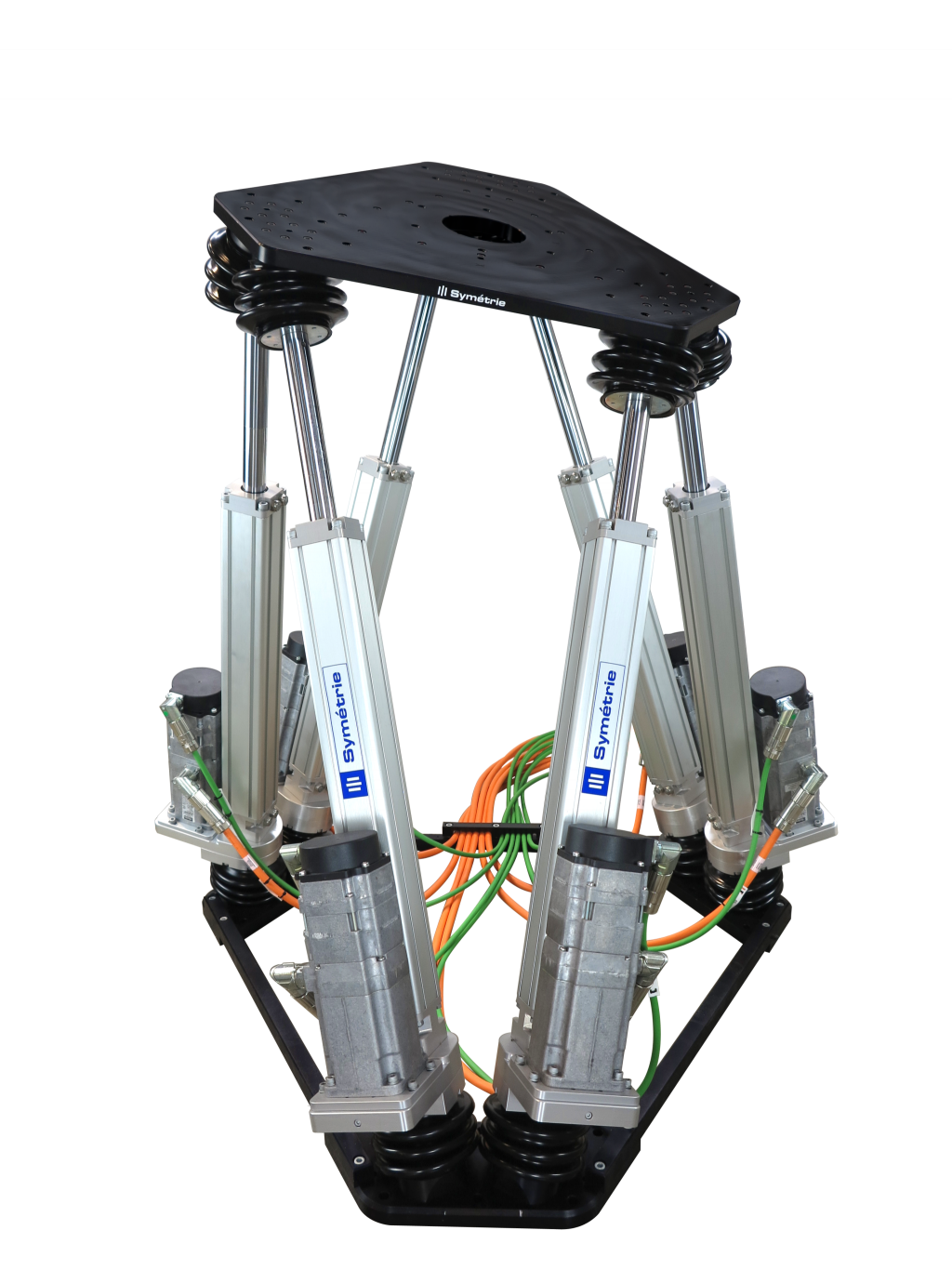


NOTUS | Compact Dynamic Motion Hexapod
Payload Capacity
100 kg (NOTUS V) / 200 KG (NOTUS P)
Acceleration
1 g
Maximum Speed
1.2 m/s
Size in Middle Position
1.1 m
 Description
 Specifications
 Applications
 Pictures
 Videos
 Downloads
 Publications
NOTUS Dynamic and Compact Motion Hexapod
The Symetrie NOTUS motion hexapod is a compact, structurally robust six-axis motion generator for simulation and dynamic testing, and a more affordable alternative to larger motion hexapods. It reaches 1 g acceleration and up to 1.2 m/s in a footprint of about 1.1 m.
NOTUS comes in two versions. NOTUS P (P for payload) carries 200 kg. NOTUS V (V for velocity) is the faster variant, with a 100 kg payload and higher speeds and accelerations on every axis. Both suit research laboratories and applications in medical research (neurology, kinesiology), naval testing (swell simulation, sloshing, wave basins), aerospace, automotive testing (sensors for autonomous vehicles, AdBlue tank testing) and optronics (stabilization testing of electro-optic systems). Axiom Optics helps you match the version and options to your payload and motion profile.
200 kg or 1.2 m/s
Choose payload capacity (NOTUS P) or speed (NOTUS V).
±250 mm, ±30°
Large six-axis travel for realistic motion simulation.
Real-time control
ERTT streaming, motion acquisition and an API over Ethernet.
Motion Envelope and Dynamics
For sinusoidal motion, three limits apply in turn: at low frequencies the full stroke is available, at mid frequencies peak speed caps the amplitude, and at high frequencies peak acceleration does. Explore where your test profile sits on each axis.
NOTUS motion envelope: how big can a cycle be?
Choose an axis and a sine frequency to see the largest motion the hexapod can reproduce and which limit sets it.
Maximum single-axis sine amplitude (log scale) vs frequency. The red marker is your selection.
Travel-limited. Travel limits the amplitude here: the full stroke is available at this frequency.
Travel-limited. Travel limits the amplitude here: the full stroke is available at this frequency.
Travel-limited. Travel limits the amplitude here: the full stroke is available at this frequency.
Speed-limited. Speed is the limit here: faster cycles need smaller strokes to stay within the rated velocity.
Acceleration-limited. Acceleration is the limit here: amplitude falls with the square of frequency.
Acceleration-limited. Acceleration is the limit here: amplitude falls with the square of frequency.
Travel-limited. Travel limits the amplitude here: the full stroke is available at this frequency.
Speed-limited. Speed is the limit here: faster cycles need smaller strokes to stay within the rated velocity.
Speed-limited. Speed is the limit here: faster cycles need smaller strokes to stay within the rated velocity.
Speed-limited. Speed is the limit here: faster cycles need smaller strokes to stay within the rated velocity.
Speed-limited. Speed is the limit here: faster cycles need smaller strokes to stay within the rated velocity.
Acceleration-limited. Acceleration is the limit here: amplitude falls with the square of frequency.
Travel-limited. Travel limits the amplitude here: the full stroke is available at this frequency.
Travel-limited. Travel limits the amplitude here: the full stroke is available at this frequency.
Speed-limited. Speed is the limit here: faster cycles need smaller strokes to stay within the rated velocity.
Speed-limited. Speed is the limit here: faster cycles need smaller strokes to stay within the rated velocity.
Speed-limited. Speed is the limit here: faster cycles need smaller strokes to stay within the rated velocity.
Acceleration-limited. Acceleration is the limit here: amplitude falls with the square of frequency.
Travel-limited. Travel limits the amplitude here: the full stroke is available at this frequency.
Travel-limited. Travel limits the amplitude here: the full stroke is available at this frequency.
Travel-limited. Travel limits the amplitude here: the full stroke is available at this frequency.
Speed-limited. Speed is the limit here: faster cycles need smaller strokes to stay within the rated velocity.
Acceleration-limited. Acceleration is the limit here: amplitude falls with the square of frequency.
Acceleration-limited. Acceleration is the limit here: amplitude falls with the square of frequency.
Travel-limited. Travel limits the amplitude here: the full stroke is available at this frequency.
Travel-limited. Travel limits the amplitude here: the full stroke is available at this frequency.
Travel-limited. Travel limits the amplitude here: the full stroke is available at this frequency.
Speed-limited. Speed is the limit here: faster cycles need smaller strokes to stay within the rated velocity.
Speed-limited. Speed is the limit here: faster cycles need smaller strokes to stay within the rated velocity.
Acceleration-limited. Acceleration is the limit here: amplitude falls with the square of frequency.
Single-axis sine motion at rated payload, from Symetrie’s published travel, speed and acceleration. Combined multi-axis motion, payload inertia and an offset center of mass reduce the usable envelope; confirm your profile with HexaSym. NOTUS V travel ranges are taken as equal to NOTUS P.
NOTUS P vs NOTUS V
Travel ranges are shared; the versions differ in payload, speed and acceleration. Symetrie details the full speeds in the datasheet.
| Specification | NOTUS P | NOTUS V |
|---|---|---|
| Payload (vertical) | 200 kg | 100 kg |
| Speed Tx, Ty | 800 mm/s | 1,200 mm/s |
| Speed Tz | 300 mm/s | 640 mm/s |
| Speed Rx, Ry, Rz | 50°/s | 135°/s |
| Acceleration Tz | 6,000 mm/s² | 10,000 mm/s² |
| Acceleration Rx, Ry, Rz | 1,000°/s² | 2,000°/s² |
NOTUS P or NOTUS V for your application?
Start with: NOTUS P
Reproduce swell, ship motion and sloshing for onboard equipment, models and tanks. The 200 kg payload carries heavier test articles; Symetrie offers wave basin and outdoor options.
Start with: NOTUS V or P
Excite sensors for autonomous vehicles or slosh AdBlue tanks under realistic road motion. NOTUS V suits faster, lighter sensor heads; NOTUS P carries full tanks and fixtures.
Start with: NOTUS V
Test the line-of-sight stabilization of electro-optical systems against platform motion. NOTUS V reaches 1.2 m/s and 135°/s for demanding disturbance profiles.
Start with: NOTUS P or V
Simulate aircraft, vehicle or platform motion for equipment qualification and hardware-in-the-loop testing, with external real-time trajectory control (ERTT) to stream your own trajectories.
Start with: NOTUS V
Generate controlled motion for neurology and kinesiology research, balance studies and laboratory experiments that need repeatable six-axis profiles.
Choose an application.
Options for Demanding Test Environments
- Outdoor use and wave basin use for naval and field testing.
- Specific joints for large angles to extend rotational motion.
- Extra Rz rotation in the mobile platform (C axis).
- Acquisition for motion storage, an API, and external real-time trajectory control (ERTT).
Choosing the Right Hexapod
Symetrie offers free HexaSym simulation software to check the travel ranges and load capacities of every hexapod in its lineup. Enter your payload, center of mass and pivot point, test different configurations, and confirm the most suitable model before you order. See the Software tab for more on HexaSym.
Want a structured walkthrough? Read the Axiom Optics Hexapod Buyer’s Guide, or explore motion and positioning hexapod applications.
NOTUS Key Specifications
- Travel Tx, Ty
- ±250 mm
- Travel Tz
- ±200 mm
- Travel Rx, Ry
- ±25°
- Travel Rz
- ±30°
- Payload (vertical)
- 200 kg (P) / 100 kg (V)
- Max speed
- Up to 1.2 m/s (V)
- Acceleration
- Up to 1 g
- Motor
- Brushless
- Mobile platform
- Ø 660 mm
- Height, middle position
- About 1,080 mm
- Mass
- About 120 kg
- Cable length
- 7 m
- Operating temperature
- 0 to +40 °C
- Controller interface
- Ethernet
Values from Symetrie for NOTUS P unless noted.
NOTUS FAQ
What is the NOTUS hexapod?
NOTUS is a dynamic, robust, mid-sized motion hexapod from Symetrie. It generates six-axis motion for simulation and testing, and is offered as NOTUS P with a 200 kg payload and NOTUS V, a faster version with a 100 kg payload. It is a more affordable alternative to Symetrie's larger motion hexapods.
What is the difference between NOTUS P and NOTUS V?
P stands for payload and V for velocity. NOTUS P carries 200 kg with translation speeds up to 800 mm/s in X and Y. NOTUS V carries 100 kg and is faster, reaching 1,200 mm/s in X and Y, 640 mm/s in Z and 135°/s in rotation, with rotational acceleration up to 2,000°/s².
What travel ranges does NOTUS offer?
Symetrie lists ±250 mm in Tx and Ty, ±200 mm in Tz, ±25° in Rx and Ry, and ±30° in Rz. These are single-axis limits; combined motions reduce the available range, which HexaSym simulation software can check for your payload and pivot point.
What applications is NOTUS used for?
NOTUS serves naval testing such as swell simulation, sloshing and wave basins, aerospace, automotive work such as autonomous vehicle sensor testing and AdBlue tank tests, optronics stabilization testing, and medical and research applications including neurology and kinesiology.
Can NOTUS follow my own motion profiles in real time?
Yes. Symetrie offers external real-time trajectory control (ERTT) to stream trajectories from your system, an acquisition option for motion storage, and an API for integration. The controller connects over Ethernet.
Can NOTUS be used outdoors or in a wave basin?
Symetrie offers outdoor use and wave basin options for NOTUS, as well as specific joints for large angles and an extra Rz rotation axis in the mobile platform.
How large and heavy is NOTUS?
NOTUS P has a Ø 660 mm mobile platform, stands about 1,080 mm tall in its middle position and weighs about 120 kg, with a 7 m cable. It operates from 0 to +40 °C.
How do I check that NOTUS fits my payload and motion?
Use Symetrie's free HexaSym simulation software to check travel ranges and load capacity for your payload, or contact Axiom Optics with your motion profile and payload details for a review.
Size NOTUS for your motion profile
Send Axiom Optics your payload, center of mass and target motion. We will confirm NOTUS P or V and the options your tests need.
-

NOTUS Hexapod
-

NOTUS Hexapod for wind simulator experiment
-

A helicopter must land on a boat despite the swell, simulated by the hexapod. NRC-CNRC credits
-

Hexapod NOTUS for the Giraffe project: wave simulator to calibrate the stabilization system of an onboard gravimeter
-

Hexapod NOTUS for the Giraffe project: wave simulator to calibrate the stabilization system of an onboard gravimeter
-

Hexapod NOTUS at SPHEREA. Testing of camera-type optical components (copy. SPHEREA)
-

NOTUS Hexapod at the University of Michigan. Hexapod walking simulation for kinesiology research
-

NOTUS Hexapod for LAVAL University. Hexapod wave simulator for testing a marine catalytic reactor.
-

NOTUS hexapod in high position