
Positioning and Motion Hexapods
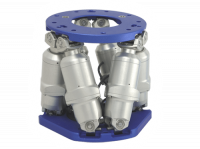
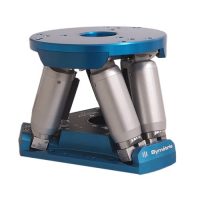
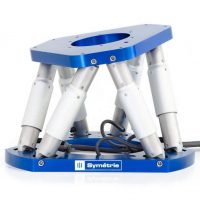
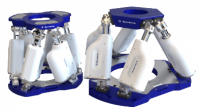
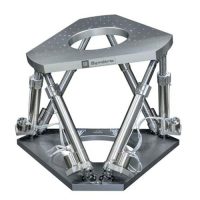
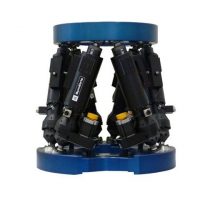
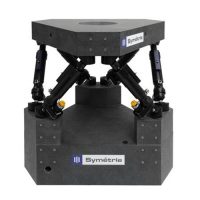
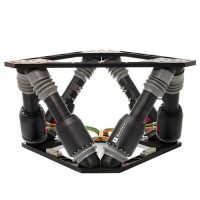
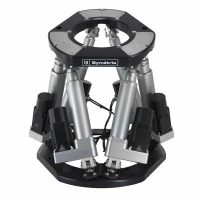
Positioning hexapods give scientists and researchers the flexibility to optimally position or align samples on beamlines, satellites, telescopes, and other electro-optical components or instruments.
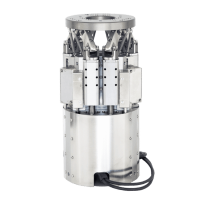
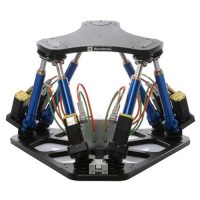
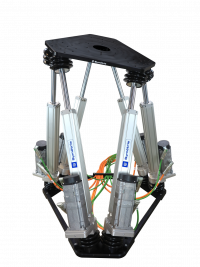
Motion hexapods simulate how land vehicles, planes, ships, or military vehicles move to test the response of instruments that may be aboard them. Large motion ones serve in flight simulators for training as well.
Engineers, astronomers, spacecraft builders, and optical manufacturers all use positioning and motion hexapods for alignment, testing, and calibration. When choosing one for a particular application, it’s important to consider whether the hexapod and the instrument it supports will be in motion. Also, note the maximum load the hexapod can support, the travel range, speed, acceleration, and accuracy required.
For more information on Symetrie hexapods, visit our applications page.
Compare the Symetrie Hexapods
Axiom Optics offers fifteen Symetrie hexapods, split into positioning hexapods for precise static alignment and motion hexapods for dynamic movement simulation. All move a platform through six degrees of freedom, so the choice comes down to whether the payload will be in motion, how much load it must carry, the travel range and platform size required, and, for positioning models, whether vacuum compatibility is needed. The tables below summarize the range; full specifications are on each product page.
Positioning Hexapods
For optimally aligning and positioning samples and instruments on beamlines, satellites, telescopes, and other electro-optical setups. Rows are ordered from lowest to highest payload.
| Model | Max payload | Linear travel | Angular travel | Platform diameter | Vacuum compatible |
|---|---|---|---|---|---|
| SOLANO | 5 to 10 kg | < ±50 mm | ±10° to ±20° | < 150 mm | No |
| MAUKA | 5 to 10 kg | < ±50 mm | < ±10° | < 150 mm | Yes |
| BORA | 5 to 10 kg | < ±50 mm | ±10° to ±20° | 151 to 350 mm | Yes |
| PUNA | 20 to 30 kg | < ±50 mm | ±10° to ±20° | 151 to 350 mm | No |
| SIRIUS | 100 to 200 kg | > ±100 mm | ±10° to ±20° | 351 to 1000 mm | See product page |
| BREVA | 100 to 200 kg | ±50 to ±100 mm | > ±20° | 351 to 1000 mm | No |
| ZONDA | 400 to 500 kg | ±50 to ±100 mm | ±10° to ±20° | 351 to 1000 mm | Yes |
| KUBAN | 400 to 500 kg | < ±50 mm | < ±10° | 351 to 1000 mm | Yes |
| SURES | 400 to 500 kg | < ±50 mm | < ±10° | 351 to 1000 mm | No |
| JORAN | > 1,000 kg | ±50 to ±100 mm | < ±10° | > 1000 mm | Yes |
See all ten in the positioning hexapods category.
Motion Hexapods
For simulating how vehicles, aircraft, and ships move, to test onboard instruments, and for flight simulators. Rows are ordered from lowest to highest payload.
| Model | Max payload | Linear travel | Angular travel | Platform diameter |
|---|---|---|---|---|
| HEGOA | 50 kg | > ±100 mm | ±23° | 500 mm |
| NOTUS | 100 to 200 kg | See product page | ±25° | 1200 mm |
| MISTRAL | > 1,000 kg | ±400 mm | ±30° | 2278 mm |
| SIROCCO | 2000 kg | ±600 mm | ±40° | 3350 mm |
| AQUILON | 6000 kg | ±800 mm | ±40° | 2100 mm |
See all five in the motion hexapods category. Speed, acceleration, and accuracy figures are on each product page.
Hexapod FAQs
What is a hexapod?
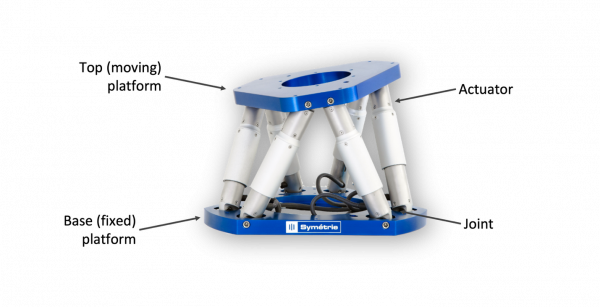
A hexapod is a positioning system that moves a platform through six degrees of freedom using six coordinated actuators arranged as three pairs. It can translate along the x, y, and z axes and rotate in pitch, roll, and yaw, which lets it place or move a payload to almost any pose within its travel range. Symetrie hexapods use this arrangement to deliver precise positioning or controlled motion depending on the model.
What is the difference between a positioning hexapod and a motion hexapod?
A positioning hexapod moves a payload to a precise, stable pose and holds it there, which suits aligning samples and instruments on beamlines, satellites, telescopes, and other electro-optical setups. A motion hexapod is designed to move continuously and dynamically, reproducing how land vehicles, aircraft, or ships move so that onboard instruments can be tested, with larger units used in flight simulators. The key question is whether the payload will be in motion during use.
What is a Stewart platform?
A Stewart platform is a parallel manipulator in which a moving platform is connected to a fixed base by six actuators, giving full six-degree-of-freedom control. Hexapods are built on this principle, which is what gives them their combination of stiffness, precision, and range of motion compared with stacked single-axis stages. For a deeper explanation, see the article on Stewart platforms linked on this page.
How do I choose the right hexapod?
Start by deciding whether the payload will be in motion, which selects a positioning or a motion hexapod. Then work through payload capacity, the linear and angular travel range needed, the platform size and footprint, and whether vacuum compatibility is required, before comparing resolution and accuracy for positioning or speed and acceleration for motion. The criteria-to-consider article linked on this page walks through the positioning case in detail.
What payload capacities are available?
The Symetrie range spans a very wide payload envelope. Positioning hexapods start at 5 to 10 kg on the compact SOLANO, MAUKA, and BORA and reach more than 1,000 kg on the JORAN, while motion hexapods run from 50 kg on the HEGOA up to 6,000 kg on the AQUILON. This makes it possible to match a hexapod to loads ranging from small optical components to large instruments and simulator platforms.
Which hexapods are vacuum compatible?
Five of the positioning hexapods are vacuum compatible: the MAUKA, BORA, ZONDA, KUBAN, and JORAN. These suit beamline, space simulation, and other applications that require operation inside a vacuum chamber. The remaining models are specified for standard environments, so vacuum-compatible selection should begin with those five.
What are hexapods used for?
Positioning hexapods are used to align and position samples and instruments on beamlines, satellites, telescopes, and other electro-optical systems, while motion hexapods simulate vehicle, aircraft, and ship movement to test onboard instruments and to drive flight simulators. Engineers, astronomers, spacecraft builders, and optical manufacturers use both types for alignment, testing, and calibration. The hexapod applications page has more detail on these use cases.
More about hexapods
Visit application pageBlogs
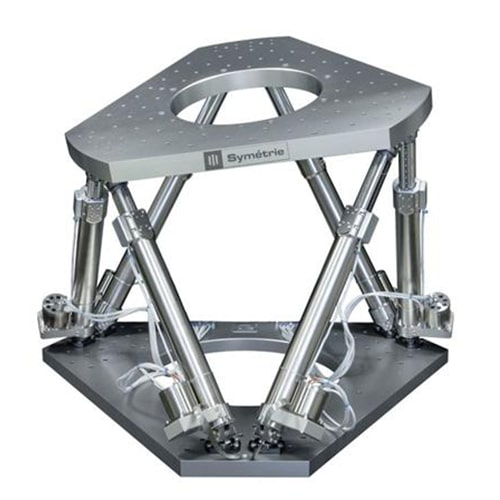
Criteria To Consider Before Purchasing a Positioning Hexapod
What is a Stewart platform?
Watch our videos

