


HEGOA Table Top Motion Hexapod
Payload Capacity
50 kg
Acceleration
800 mm/s(2)
Maximum Speed
0.2 m/s
Size in Mid Position
0.42 m
Diameter
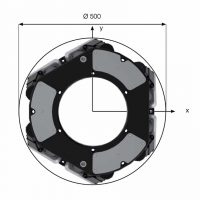
500 mm
 Description
 Specifications
 Videos
 Downloads
 Software
HEGOA Table Top Motion Hexapod
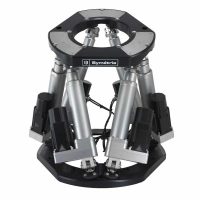
The Symetrie HEGOA table top motion hexapod is a versatile, compact six-axis motion generator. Measuring just 42 cm tall and weighing 30 kg, it is the easiest Symetrie hexapod to set up and operate, and more cost-effective than larger models.
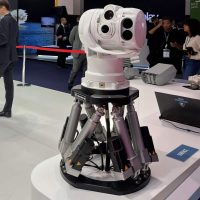
With a 50 kg load capacity, HEGOA is built for dynamic industrial applications. It is particularly suited to the naval field (swell simulation, sloshing and wave basins), aerospace, automotive testing (sensor testing for autonomous vehicles and AdBlue tank tests) and optronics (stabilization tests for electro-optical systems). It also serves research laboratories and medical applications such as neurology and kinesiology. Axiom Optics helps you confirm HEGOA against your payload, motion profile and integration needs.
Table top, 42 cm
Compact and light enough for benches and tight test cells.
50 kg payload
±100 mm and ±30° travel for realistic six-axis motion.
Real-time control
ERTT trajectory streaming, absolute encoders and an Ethernet controller.
Motion Envelope and Dynamics
At low frequencies the full stroke is available; as cycles get faster, peak speed and then peak acceleration cap the amplitude. Explore what HEGOA can reproduce on each axis.
HEGOA motion envelope: how big can a cycle be?
Choose an axis and a sine frequency to see the largest motion the hexapod can reproduce and which limit sets it.
Maximum single-axis sine amplitude (log scale) vs frequency. The red marker is your selection.
Travel-limited. Travel limits the amplitude here: the full stroke is available at this frequency.
Travel-limited. Travel limits the amplitude here: the full stroke is available at this frequency.
Speed-limited. Speed is the limit here: faster cycles need smaller strokes to stay within the rated velocity.
Acceleration-limited. Acceleration is the limit here: amplitude falls with the square of frequency.
Acceleration-limited. Acceleration is the limit here: amplitude falls with the square of frequency.
Acceleration-limited. Acceleration is the limit here: amplitude falls with the square of frequency.
Travel-limited. Travel limits the amplitude here: the full stroke is available at this frequency.
Travel-limited. Travel limits the amplitude here: the full stroke is available at this frequency.
Speed-limited. Speed is the limit here: faster cycles need smaller strokes to stay within the rated velocity.
Speed-limited. Speed is the limit here: faster cycles need smaller strokes to stay within the rated velocity.
Acceleration-limited. Acceleration is the limit here: amplitude falls with the square of frequency.
Acceleration-limited. Acceleration is the limit here: amplitude falls with the square of frequency.
Travel-limited. Travel limits the amplitude here: the full stroke is available at this frequency.
Travel-limited. Travel limits the amplitude here: the full stroke is available at this frequency.
Speed-limited. Speed is the limit here: faster cycles need smaller strokes to stay within the rated velocity.
Acceleration-limited. Acceleration is the limit here: amplitude falls with the square of frequency.
Acceleration-limited. Acceleration is the limit here: amplitude falls with the square of frequency.
Acceleration-limited. Acceleration is the limit here: amplitude falls with the square of frequency.
Travel-limited. Travel limits the amplitude here: the full stroke is available at this frequency.
Travel-limited. Travel limits the amplitude here: the full stroke is available at this frequency.
Speed-limited. Speed is the limit here: faster cycles need smaller strokes to stay within the rated velocity.
Acceleration-limited. Acceleration is the limit here: amplitude falls with the square of frequency.
Acceleration-limited. Acceleration is the limit here: amplitude falls with the square of frequency.
Acceleration-limited. Acceleration is the limit here: amplitude falls with the square of frequency.
Single-axis sine motion from Symetrie’s published HEGOA travel, speed and acceleration. Combined motion, payload inertia and an offset center of mass reduce the usable envelope; confirm your profile with HexaSym.
Mounting and Payload
HEGOA works upright as a table top unit or mounted on its side, with the payload rating adjusted for orientation. Its mobile platform (Ø 332 mm) and fixed platform (Ø 438 mm) both have central apertures, 150 mm and 180 mm, for cables or optical paths.
Payload by mounting orientation
The full 50 kg rating applies with the hexapod upright, the standard table top configuration.
Mounted horizontally, Symetrie rates HEGOA at 15 kg. Check off-axis loads and center of mass with HexaSym before finalizing a fixture.
Choosing a Motion Hexapod
Is HEGOA the right motion hexapod?
HEGOA
A table top motion hexapod about 42 cm tall, the easiest Symetrie model to set up and operate and more cost-effective than larger models. Carries 50 kg vertically or 15 kg horizontally.
NOTUS
Step up to NOTUS for 200 kg (NOTUS P) or up to 1.2 m/s and 1 g (NOTUS V), with ±250 mm travel.
MISTRAL or SIROCCO
For larger test articles, compare the MISTRAL large payload and SIROCCO high payload motion hexapods with Axiom Optics.
AQUILON
For the largest strokes, see the AQUILON large amplitude motion hexapod.
Choose your main requirement.
Browse all motion hexapods.
Choosing the Right Hexapod
Symetrie offers free HexaSym simulation software to check the travel ranges and load capacities of every hexapod in its lineup. Enter your payload, center of mass and pivot point, test different configurations, and confirm the most suitable model before you order. See the Software tab for more on HexaSym.
Want a structured walkthrough? Read the Axiom Optics Hexapod Buyer’s Guide, or explore motion and positioning hexapod applications.
HEGOA Key Specifications
- Travel Tx, Ty
- ±100 mm
- Travel Tz
- ±50 mm
- Travel Rx, Ry
- ±23°
- Travel Rz
- ±30°
- Speed Tx, Ty / Tz
- 200 mm/s / 120 mm/s
- Speed Rx, Ry, Rz
- 50°/s
- Acceleration
- 800 mm/s², 200°/s²
- Payload
- 50 kg vertical, 15 kg horizontal
- Motor and encoder
- Brushless, absolute
- Platforms
- Mobile Ø 332 mm, fixed Ø 438 mm
- Apertures
- Mobile Ø 150 mm, fixed Ø 180 mm
- Height, central position
- 420 mm
- Mass
- 30 kg
- Cable length
- 5 m
- Operating temperature
- +10 to +40 °C
- Controller
- ALPHA+, Ethernet, 110-240 VAC
Values from Symetrie.
HEGOA FAQ
What is the HEGOA hexapod?
HEGOA is a compact table top motion hexapod from Symetrie. It generates six-axis motion for dynamic testing where space is limited, carries up to 50 kg, and stands about 42 cm tall in its central position.
What payload can HEGOA carry?
Symetrie rates HEGOA at 50 kg in vertical orientation and 15 kg in horizontal orientation.
What are HEGOA's travel ranges and speeds?
Symetrie lists ±100 mm in Tx and Ty, ±50 mm in Tz, ±23° in Rx and Ry and ±30° in Rz, with speeds up to 200 mm/s in X and Y, 120 mm/s in Z and 50°/s in rotation, and accelerations of 800 mm/s² and 200°/s².
What is HEGOA used for?
HEGOA suits dynamic industrial and research applications, including naval testing such as swell simulation, sloshing and wave basins, aerospace, automotive work such as autonomous vehicle sensor testing and AdBlue tank tests, optronics stabilization tests, and medical research in neurology and kinesiology.
Why choose HEGOA over a larger motion hexapod?
HEGOA is the easiest Symetrie motion hexapod to set up and operate. It weighs 30 kg, fits on a table, and is more cost-effective than larger models, while still offering real-time trajectory control and accurate trajectory tracking.
Which controller and interface does HEGOA use?
HEGOA runs on Symetrie's ALPHA+ controller with an Ethernet interface and a 110-240 VAC supply. Software options include an SDK, Modbus, a LabVIEW library and Tango and EPICS devices, plus external real-time trajectory control (ERTT) and an optional data acquisition module.
Does HEGOA need homing at startup?
HEGOA uses absolute encoders, so it knows its position as soon as the controller is powered on.
How do I check that HEGOA fits my application?
Use Symetrie's free HexaSym simulation software to check travel and load capacity for your payload and pivot point, or send Axiom Optics your payload and motion profile for a review.
Put HEGOA on your bench
Share your payload and motion profile with Axiom Optics. We will confirm HEGOA fits and configure the controller and software options.

SIMPLE SOFTWARE FOR A COMPLEX MACHINE
The SYM_Motion movement software allows you to control the movements of a dynamic hexapod on the basis of complex algorithms. It transforms the movements desired in the 6 degrees of freedom into useful information for each of the motors.
The software is simple and ergonomic so that operators can easily use the system.
SYM_MOTION ALLOWS :
■ Position display in real time
■ Position the hexapod
■ The generation of sinusoidal and harmonic trajectories
■ To reproduce trajectories from recordings
■ The configuration of the center of rotation
■ Validate the trajectories in complete safety for the hexapod and its loading
OPTIONS
■ Acquisition: the possibility of retrieving the position of the hexapod from information from the absolute encoders of the motors, in real time or in post-processing
■ ERTT: External Real Time Trajectory, to control the hexapod in real time, for example via a joystick (ERTT requires the API option)
■ API: the possibility of going through a software interface other than SYM_Motion to control the hexapod
HEXASYM SIMULATOR
HexaSym is a useful simulation software created by Symetrie to test the possibilities of movement and load of our motion hexapods.

.