





CinCam InGaAs | Plug-and-Play SWIR laser beam profiler
Spectral ranges
900 - 1700 nm, 400 - 1700 nm or 1300 - 2200 nm
Small pixel pitch
As low as 5 µm
Main features
Beam width, Centroid, Pointing stability, Divergence, Beam Quality
Interface
GigE Ethernet (or USB3.0 with adapter)
No coverglass
Available on select sensors
Always
3-year warranty parts and labor & Fast delivery (ask about our current stock)
 Description
 Specifications
 QE Curve
 Applications
 Videos
 Downloads
SWIR laser beam profiling made easy
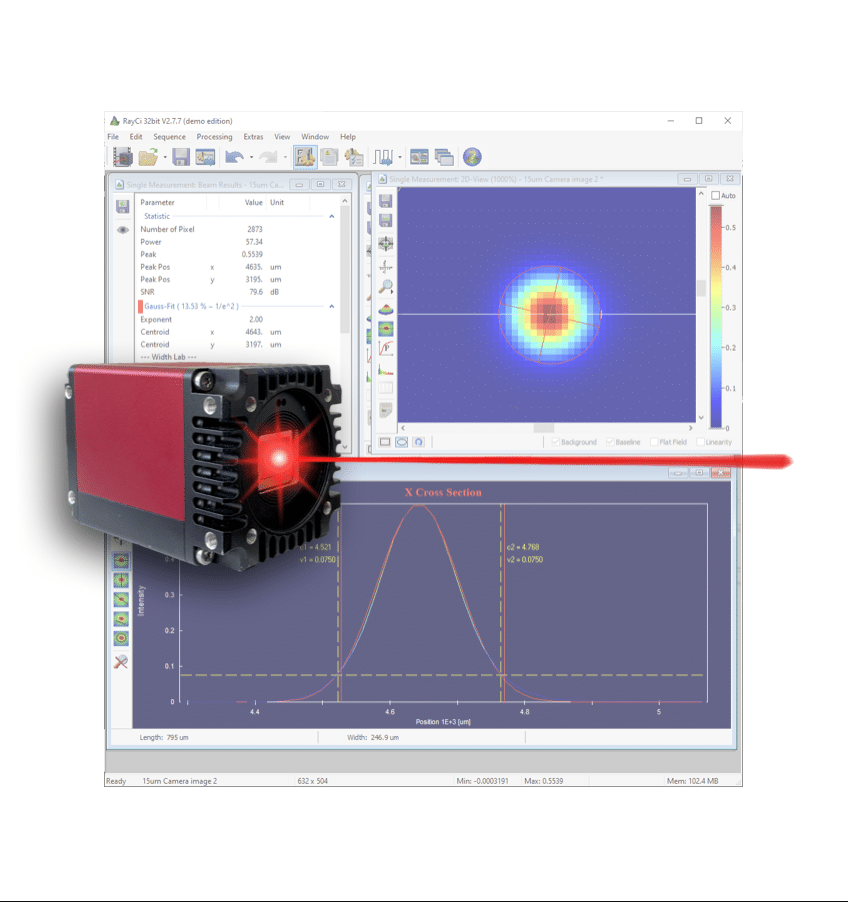
The CinCam InGaAs is a plug-and-play solution for laser beam profiling of CW and pulsed lasers in the SWIR (900 – 1700 nm), VIS SWIR (400 – 1700 nm) and XSWIR (1300 – 2200 nm) spectral ranges. Using a machine-vision grade InGaAs camera and a dedicated laser beam profiling software (RayCi), the CinCam InGaAs allows simple and accurate laser beam analysis according to ISO standards.
The camera is cooled with a thermo-electric cooling (TEC1, thus ensuring stable, repeatable and quantitative measurements in any environment (laboratory or industrial).
Scope of delivery
Spectral range 900 – 1700 nm:
-
- CinCam InGaAs SWIR 320-30: Entry level with an active area of 9.60 x 7.68 mm and a 30 µm pixel pitch, OR
- CinCam InGaAs SWIR 636-15: Intermediate level with an active area of 9.54 x 7.62 mm and a 15 µm pixel pitch, OR
- CinCam InGaAs SWIR 636-25: Largest active area of 15.9 x 12.7 mm and a 25 µm pixel pitch
Spectral range 400 – 1700 nm:
-
- CinCam InGaAs-VSWIR 636-5: Entry level with an active area of 3.2 x 2.4 mm and a 5 µm pixel pitch, OR
- CinCam InGaAs-VSWIR 1280-5: Intermediate level with an active area of 6.4 x 5.12 mm and a 5 µm pixel pitch
Spectral range 1300 – 2200 nm:
- CinCam InGaAs-XSWIR 320-30: Entry level with an active area of 9.60 x 7.68 mm and a 30 µm pixel pitch, OR
- CinCam InGaAs-XSWIR 636-15: Intermediate level with an active area of 9.54 x 7.62 mm and a 15 µm pixel pitch, OR
+ CinCam InGaAs kit:
-
- 1 RayCi software license (Standard or Pro) with USB dongle or license key
- 1 power supply + US power cable
- 1 ethernet cable
Options:
- External triggering
- Option 1: cable with open leads (DC power and TTL signal must be wired)
- Option 2: cable with BNC connector (TTL input signal) and PoE injector
- Coverglass removal
- On select models only (please inquire)
SWIR 320-30

SWIR 636-15

SWIR 636-25

VSWIR 1280-5
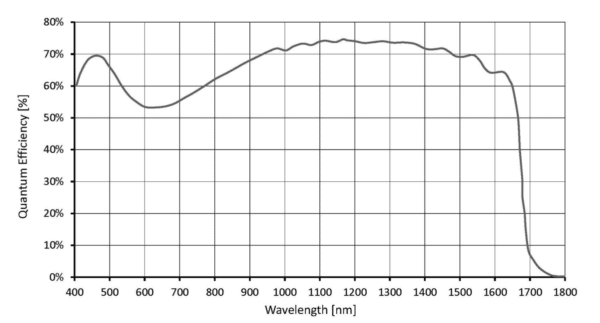
XSWIR 320-30 & 636-15

RayCi Software
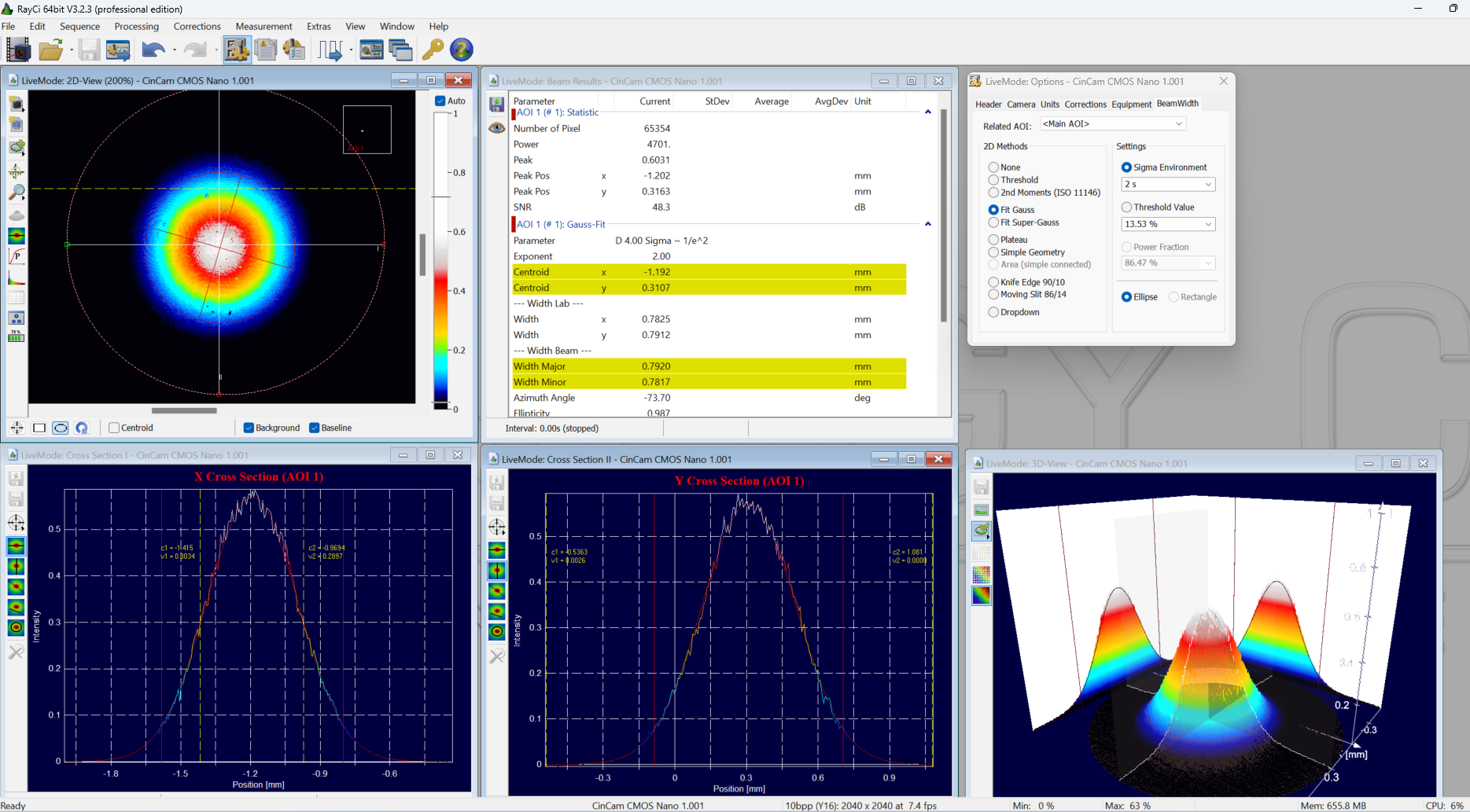
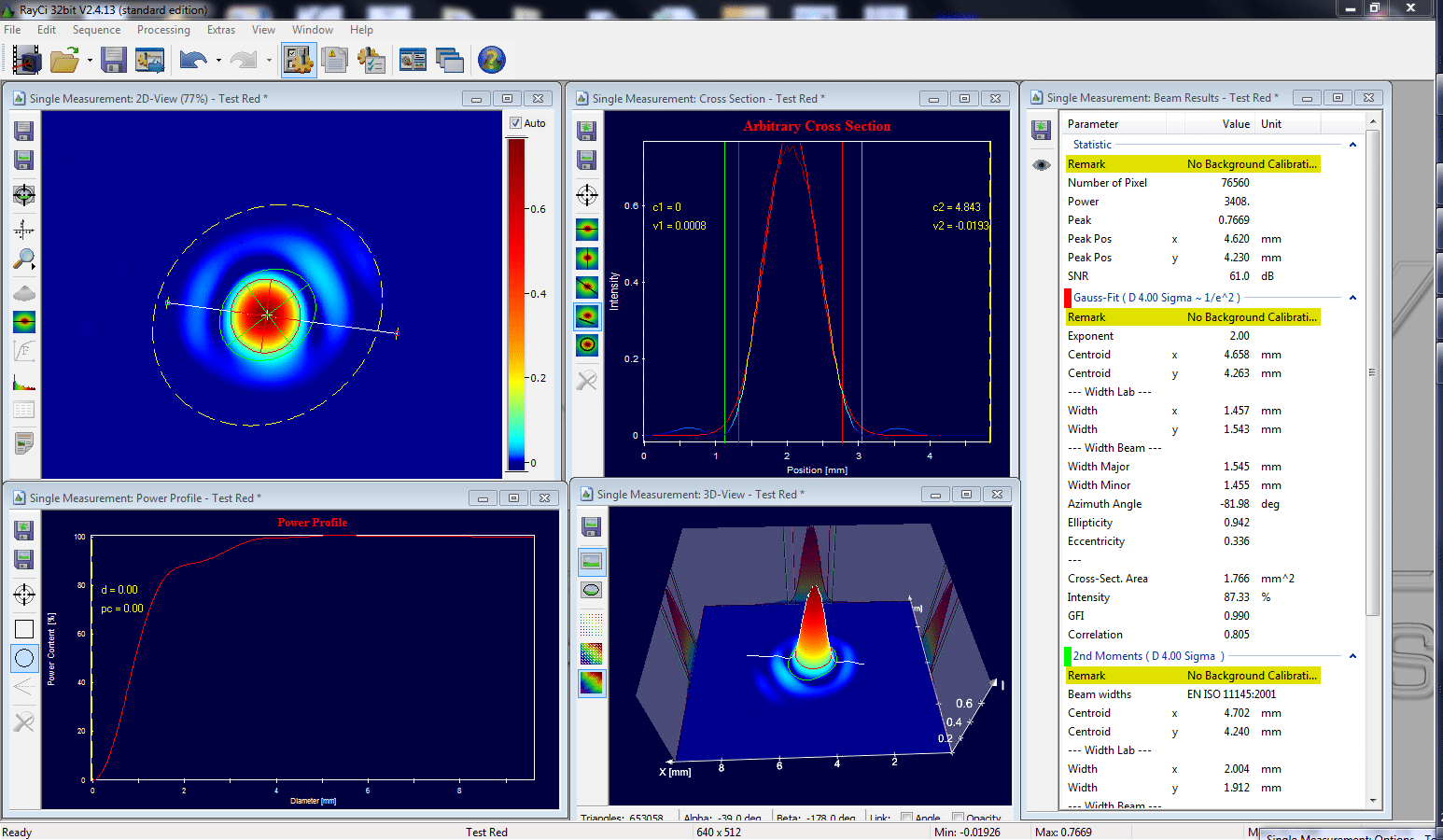
RayCi software is specifically designed for beam profilers and utilizes new developed correction algorithms and incomparable visualizations modes. This ensures the highest accuracy in beam profile analysis according to ISO standards. (ISO conformity: ISO 11145, 11146, 11554, 11670, 13694)
RayCi for CinCam InGaAs has 2 versions available:
– RayCi-Standard (Includes SDK)
– RayCi-Professional (includes SDK, beam quality / M2 measurement and simultaneous multi-camera measurements)
Cross Section Analysis – 1D Beam Width / Edge Steepness
Percentage of Peak:
RayCi supports the most commonly used ‘percentage of peak’ method to determine the width from the beam cross section line. Therefore, two opposite markers are positioned automatically to the specified intensity level. The distance between the markers are used to define the beam width. Two pairs of markers can be used simultaneously to compare different settings. To expand the beam analysis level and roughness options with statistical values are available
Edge Steepness:
Cross section lines of beam profiles are of particular interest for further beam analysis. Especially for flat-top beams the knowledge of the edge steepness is of great importance. RayCi defines the edge steepness of such beams by using different options.


2D Beam Width Analysis
RayCi supports several 2D techniques to determine the beam width of a laser beam. The customer can choose the best technique for their application. This extensive tool on beam width techniques is unique on the market for laser beam profiling.


Visualization Tool
| 2D-View |
|
| 3D-View |
|
| Histogram |
|
| Cross Section |
|
| Beam Result |
|


Measurement Tool
| Snapshot Single Measurement Time Series |
|
| Pointing Stability: |
|
| Beam Stability |
|
| Divergence Measurement |
|
| Beam Quality M2 (RayCi Pro) |
|
Accessories
External triggering (pulsed lasers):
- Trigger cable, 12-pin Hirose female to BNC, 2.0m (trigger input)
- TP Link TL-POE150S PoE Injector, with 2 Ethernet cable (CAT.5 UTP) and power adapter (allows powering up the camera using PoE)

Or
- I/O cable, 12-pin Hirose female to open end, 2.0m (allows wiring of power supply and TTL input as well as other I/O)
GigE Networking:
- For Gigabit Ethernet components (switches, PoE injectors, host adapter cards, etc.), please refer to our hardware selector guide.