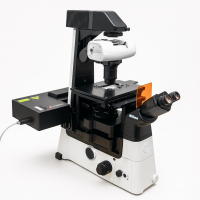
Optical Tweezers
Optical tweezers trap and move microscopic objects with a focused laser beam, and they measure the tiny forces that drive cell mechanics. Axiom Optics offers SENSOCELL from Impetux, an optical tweezers platform built around direct force measurement: it reads force from the momentum of the trapping light itself, so it needs no trap stiffness calibration and works inside living cells and tissue.
With up to 256 simultaneous traps on a Nikon inverted microscope, SENSOCELL brings quantitative force spectroscopy to mechanobiology, micro-rheology, and cell biology labs. Our team helps match the configuration to your microscope, imaging modes, and experiments.
How Optical Tweezers Measure Force
Every optical trap can hold and move objects. The difference between systems is how they turn a trapped object’s response into a force value, and whether that value stays accurate inside a cell.
| Method | How force is obtained | Calibration | Works on | Trade-off |
|---|---|---|---|---|
| Video bead tracking | Bead displacement from camera images, multiplied by trap stiffness (F = k·x) | Yes, for each bead, laser power, and medium | Spherical beads of known size | Speed limited by camera frame rate |
| Back-focal-plane interferometry | Bead displacement from a position detector, multiplied by trap stiffness | Yes, for each bead, laser power, and medium | Spherical beads of known size | Calibration does not carry over into cells |
| Light-momentum detection (SENSOCELL) | Read directly from the change in momentum of the trapping light | No | Irregular objects, cells, and tissue | Needs the light leaving the trap to be collected |
For a visual walkthrough of the spring model and the momentum method side by side, read our post on optical tweezers and direct force measurement for mechanobiology.
SENSOCELL at a Glance
- Calibration-free force measurement. Force comes directly from light momentum, independent of the object’s shape, size, and refractive index and of the surrounding medium.
- Up to 256 optical traps. Acousto-optic deflection at 25 kHz moves traps along trajectories and oscillations, by click and drag, or through pattern morphing.
- Multi-trap, three-axis sensing. Simultaneous force measurements across multiple independent traps in X, Y, and Z.
- Force Clamp mode. Controls pulling and pushing force rates during an experiment.
- Sample protection. Laser power at the sample plane is monitored continuously to limit photobleaching.
- Published performance. Typical installations pair a 1064 nm trapping laser with NA 1.4 immersion optics and report force resolution below 50 fN, 1 nm position resolution, and sampling up to 100 kHz.
SENSOCELL Configurations
| Configuration | Microscope | Imaging modes | Best for |
|---|---|---|---|
| Add-on module | Your existing Nikon inverted microscope | Brightfield, epi-fluorescence, DIC, TIRF, confocal | Labs that already run a Nikon inverted stand |
| Integrated platform | Supplied with a new Nikon Ti2 inverted microscope | Brightfield, epi-fluorescence, DIC, TIRF, confocal | New turnkey mechanobiology setups |
How to Choose an Optical Tweezers System
- Decide where you need force. If forces only matter on calibrated beads in buffer, a conventional trap works. If you need forces inside cells, in tissue, or on irregular objects, choose direct light-momentum detection.
- Count your traps. Single-trap experiments differ from multi-point manipulation; SENSOCELL drives up to 256 traps with independent force readout.
- Start from your microscope. An add-on keeps your existing Nikon inverted stand and imaging; the integrated platform delivers a complete Ti2-based system.
- Plan the imaging. Confirm which modes run alongside trapping: brightfield, epi-fluorescence, DIC, TIRF, or confocal microscopy.
- Consider trapping depth. Aberrations weaken traps deep in samples; adaptive optics and spatial light modulators can restore and shape the trapping focus.
Not sure which setup fits? Contact our team with your microscope model and experiment, or explore our full range of advanced light microscopy solutions.
Optical Tweezers FAQs
What are optical tweezers?
Optical tweezers use a tightly focused laser beam to trap and move microscopic objects such as beads, cells, and organelles without touching them. Light refracted by the object exerts a restoring force toward the focus, so the trap can hold an object, steer it, and measure forces in the piconewton range.
How does SENSOCELL measure force without calibration?
SENSOCELL measures force directly from the change in momentum of the trapping light. Light that pushes on a trapped object changes direction, and that change equals the force on the object, so Impetux’s momentum method needs no trap stiffness calibration and stays independent of the object’s shape, size, and refractive index and of the surrounding medium.
Why is trap stiffness calibration a problem inside cells?
Conventional optical tweezers convert bead displacement into force using a trap stiffness measured on spherical beads in a known medium. Inside a living cell, the trapped object is rarely a sphere and the local refractive index and viscosity are unknown, so the calibration no longer holds and force values become uncertain.
Can SENSOCELL measure forces inside living cells?
Yes. Impetux designed SENSOCELL for direct force measurement inside living cells and tissue, on irregular and non-spherical objects, with simultaneous measurements across multiple independent traps in the X, Y, and Z directions.
How many optical traps can SENSOCELL create?
SENSOCELL creates up to 256 simultaneous optical traps, steered by acousto-optic deflection at 25 kHz. Traps can follow predefined trajectories and oscillations, be moved by click and drag, or switch between patterns, and a Force Clamp mode controls pulling and pushing force rates.
Which microscopes work with SENSOCELL?
SENSOCELL installs as an add-on to Nikon inverted microscopes or ships as an integrated platform with a new Nikon Ti2. It is compatible with brightfield, epi-fluorescence, DIC, TIRF, and confocal imaging.
What can SENSOCELL measure in mechanobiology?
SENSOCELL supports micro-rheology of soft biological tissue and force-relaxation tests of cell membrane and nucleus mechanics, with a measurable stiffness range from a few pascals to several kilopascals. Researchers apply it in cancer, developmental biology, inflammation, and regenerative medicine.
Can adaptive optics improve an optical trap?
Yes. Aberrations from the coverslip and the sample spread the laser focus as the trap goes deeper, which weakens trapping. Adaptive optics corrects those aberrations to restore a tight focus, and spatial light modulators can also shape the trapping beam into holographic trap patterns.