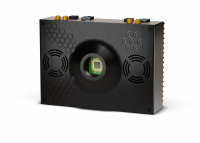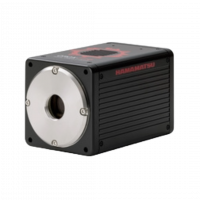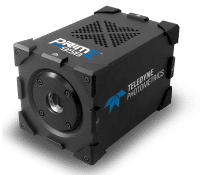


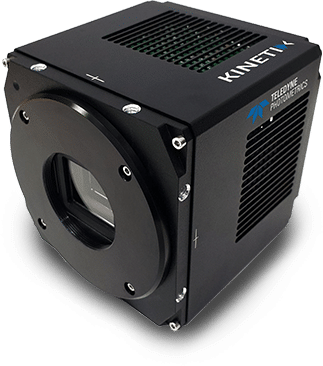


Kinetix & Kinetix 22 | High-Speed sCMOS Cameras
Sensor Technology
sCMOS
Quantum Efficiency
95% @ 575 nm
Readout Noise
0.7 e-
Sensor Resolution
3200 x 3200 / 2400 x 2400
Frame Rate
498 fps
Interface
USB 3.2 / PCIe
 Description
 Specifications
 QE Curve
 Pictures
 Downloads
Kinetix is the high-speed, back-illuminated sCMOS camera family from Teledyne Photometrics, built for imaging where speed, field of view, and sensitivity all count at once. The 29.4 mm Kinetix reads 10.2 megapixels at up to 498 fps, the 22 mm Kinetix22 reaches 664 fps, and both drop to 0.7 e⁻ median read noise in Sub-Electron mode with up to 96% peak quantum efficiency. Four readout modes (Speed, Sensitivity, Dynamic Range, and Sub-Electron) make them the most versatile option for labs that need one sCMOS camera to cover many experiments.
That combination moves more pixels per second than conventional sCMOS without giving up low-light performance, which makes Kinetix a strong fit for live-cell fluorescence, fast functional imaging, single-molecule work, and large-field microscopes. Axiom Optics helps labs choose between the two models, configure the right mode and interface, and integrate the camera with their microscope.
Key Features
Extreme speed
Taking advantage of an 8-bit readout mode, Kinetix delivers 498 frames per second at full frame across its 29.4 mm diagonal field of view, and Kinetix22 reaches 664 fps across its 22 mm field.
An optimized line time lets both cameras significantly outperform typical sCMOS devices. Kinetix moves more than 5,000 megapixels per second, which Teledyne Photometrics rates at over a 10-fold improvement on typical sCMOS.

Large field of view
The square sensor of Kinetix, 29.4 mm on the diagonal, is designed to increase throughput, maximize the data captured in a single frame, and take full advantage of new, larger field of view microscopes.
Its imaging area is 2.4 times larger than typical sCMOS cameras, which significantly speeds up data acquisition. Kinetix22 puts the same 6.5 µm pixel on a 22 mm diagonal sensor that matches a standard 22 mm microscope field.

High sensitivity
Kinetix and Kinetix22 are back-illuminated, reaching peak quantum efficiencies of 95% and 96%. By bringing light in from the back of the sensor, photons land directly on the light-receiving surface, maximizing light collection.
Combined with read noise as low as 0.7 e⁻ in Sub-Electron mode, that places both among the most sensitive sCMOS cameras available. Sensitivity mode holds read noise at 1.2 e⁻ while running at 88 fps on Kinetix and 118 fps on Kinetix22.

High resolution
Both cameras feature 6.5 µm × 6.5 µm pixels, the accepted standard for most live-cell applications at 40× and 60× magnification. This pixel size delivers highly detailed images across the imaging plane and suits the broadest range of microscope objectives.
Superior background quality
Pattern Noise Reduction Technology and Correlated Noise Reduction Technology deliver clean, pattern-free images with minimal pixel defects, improving image quality in low-light conditions.
Kinetix or Kinetix22?
Same pixel, same modes, same noise floor. The choice comes down to field of view against frame rate.
| Specification | Kinetix | Kinetix22 |
|---|---|---|
| Resolution | 3200 × 3200 (10.2 MP) | 2400 × 2400 (5.8 MP) |
| Sensor area | 20.8 × 20.8 mm, 29.4 mm diagonal | 15.56 × 15.56 mm, 22 mm diagonal |
| Pixel size | 6.5 × 6.5 µm | 6.5 × 6.5 µm |
| Peak QE | 95% | 96% |
| Full frame, Speed / Sensitivity / Dynamic Range | 498 / 88 / 83 fps | 664 / 118 / 111 fps |
| Full frame, Sub-Electron | 5.2 fps | 6.9 fps |
| Read noise (median) | 0.7 to 2.0 e⁻ by mode | 0.7 to 2.0 e⁻ by mode |
| Interfaces | PCIe Gen 3, USB 3.2 Gen 2 | PCIe Gen 3, USB 3.2 Gen 2 |
| Lens mount | T-, F- and C-mount, swappable | C-mount |
| Cooling | Air or liquid, to 0 °C | Air or liquid, to 0 °C |
| Choose it for | Largest field of view, large-FOV microscopes | Highest frame rate, standard 22 mm fields |
Four Camera Modes, One Sensor
Instead of committing to one readout trade-off, Kinetix lets you switch modes to match the experiment. Speed mode pushes frame rate, Sensitivity mode lowers read noise at high speed, Dynamic Range mode opens up a 15,000 e⁻ full well, and Sub-Electron mode reaches 0.7 e⁻ for photon-starved samples.
Camera mode explorer
Kinetix trades speed, read noise, and full well through four readout modes. Pick a model and a mode to see what each one delivers.
Speed mode (8-bit). Fast dynamics where frame rate outranks photon range: calcium and voltage imaging, particle tracking, and high-throughput acquisition. Line time is 0.625 µs, so a full 3,200-row frame reads out in 2.0 ms.
Sensitivity mode (12-bit). Low-light fluorescence at high frame rates, such as live-cell imaging and fast single-molecule localization. Line time is 3.5312 µs, so a full 3,200-row frame reads out in 11.3 ms.
Dynamic Range mode (16-bit). Bright and dim structures in the same frame: quantitative fluorescence, tissue sections, and large mosaics. Line time is 3.749 µs, so a full 3,200-row frame reads out in 12.0 ms.
Sub-Electron mode (16-bit). The faintest signals, when speed can give way to sensitivity: photon-starved single-molecule and luminescence work. Line time is 60.1 µs, so a full 3,200-row frame reads out in 192.3 ms.
Speed mode (8-bit). Fast dynamics where frame rate outranks photon range: calcium and voltage imaging, particle tracking, and high-throughput acquisition. Line time is 0.625 µs, so a full 2,400-row frame reads out in 1.5 ms.
Sensitivity mode (12-bit). Low-light fluorescence at high frame rates, such as live-cell imaging and fast single-molecule localization. Line time is 3.53125 µs, so a full 2,400-row frame reads out in 8.5 ms.
Dynamic Range mode (16-bit). Bright and dim structures in the same frame: quantitative fluorescence, tissue sections, and large mosaics. Line time is 3.749 µs, so a full 2,400-row frame reads out in 9.0 ms.
Sub-Electron mode (16-bit). The faintest signals, when speed can give way to sensitivity: photon-starved single-molecule and luminescence work. Line time is 60.1 µs, so a full 2,400-row frame reads out in 144.2 ms.
Values from Teledyne Photometrics datasheets (Kinetix rev. 2024-09-10, Kinetix22 2024 rev. 2). Dynamic range is full well divided by median read noise. Full-frame rates are over PCIe.
Frame Rate by Region of Interest and Interface
Kinetix reads out row by row, so frame rate scales with the number of rows in the region of interest. The interface matters too: PCIe Gen 3 carries the sensor’s full output, while USB 3.2 caps the fastest modes.
Frame rate by ROI and interface
Crop the sensor or change the link and every mode speeds up or slows down. Kinetix (29.4 mm) values, log scale.
PCIe carries the full sensor rate: 498 fps in Speed mode at 3200 × 3200. Frame rate scales with the number of rows read, so cropping height is what buys speed.
Over USB, Speed mode drops from 498 to 79 fps at this ROI because the link, not the sensor, sets the limit. Choose PCIe when frame rate is the priority. Sub-Electron mode runs at the same rate on either link.
PCIe carries the full sensor rate: 691 fps in Speed mode at 3200 × 2304. Frame rate scales with the number of rows read, so cropping height is what buys speed.
Over USB, Speed mode drops from 691 to 110 fps at this ROI because the link, not the sensor, sets the limit. Choose PCIe when frame rate is the priority. Sub-Electron mode runs at the same rate on either link.
PCIe carries the full sensor rate: 778 fps in Speed mode at 3200 × 2048. Frame rate scales with the number of rows read, so cropping height is what buys speed.
Over USB, Speed mode drops from 778 to 122 fps at this ROI because the link, not the sensor, sets the limit. Choose PCIe when frame rate is the priority. Sub-Electron mode runs at the same rate on either link.
PCIe carries the full sensor rate: 996 fps in Speed mode at 3200 × 1600. Frame rate scales with the number of rows read, so cropping height is what buys speed.
Over USB, Speed mode drops from 996 to 158 fps at this ROI because the link, not the sensor, sets the limit. Choose PCIe when frame rate is the priority. Sub-Electron mode runs at the same rate on either link.
From the Kinetix datasheet frame-rate table. Bars use a log scale from 1 to 1,000 fps. In line-scan operation over PCIe, Dynamic Range mode reaches 88,900 Hz at 3200 × 2.
Field of View: Matching Kinetix to Your Microscope
A larger sensor only pays off if the microscope delivers a field big enough to fill it. Kinetix’s 29.4 mm diagonal suits large-field research microscopes, while Kinetix22’s 22 mm diagonal matches a standard 22 mm field with no wasted corners.
Field of view and fit checker
Check how much of the sensor your microscope’s field fills, and what the camera sees at the sample.
Kinetix: 20.8 mm square sensor, 29.4 mm diagonal. A 29.4 mm field or larger illuminates the whole chip.
Kinetix: 20.8 mm square sensor, 29.4 mm diagonal. A 29.4 mm field or larger illuminates the whole chip.
Kinetix: 20.8 mm square sensor, 29.4 mm diagonal. A 29.4 mm field or larger illuminates the whole chip.
Kinetix: 20.8 mm square sensor, 29.4 mm diagonal. A 29.4 mm field or larger illuminates the whole chip.
Kinetix22: 15.56 mm square sensor, 22 mm diagonal. A 22 mm field or larger illuminates the whole chip.
Kinetix22: 15.56 mm square sensor, 22 mm diagonal. The field number covers the full diagonal.
Kinetix22: 15.56 mm square sensor, 22 mm diagonal. The field number covers the full diagonal.
Kinetix22: 15.56 mm square sensor, 22 mm diagonal. The field number covers the full diagonal.
Geometry only: assumes a centered sensor, a circular field, and no camera adapter magnification. The usable field at a side port can be smaller than the eyepiece field number, so confirm with your microscope documentation or ask our team.
More Capabilities
SMART Streaming
Cycle rapidly through multiple exposure times and drive up to four light sources from four Expose Out signals.
Effective global shutter
All Rows and Rolling Shutter trigger modes, plus a programmable scan mode over PCIe, for synchronized illumination.
Flexible triggering
Trigger First, Level, Edge, and SMART Streaming inputs; Any Row, First Row, and Line Output modes; Read Out and Trigger Ready signals.
Easy integration
PCIe Gen 3 or USB 3.2 Gen 2 (10 Gbps), air or liquid cooling, symmetrical and asymmetrical binning up to 4 × 4, and a 1.8 kg body.
Applications
- Live-cell fluorescence. 6.5 µm pixels suit 40× and 60× objectives, the workhorses of live-cell imaging.
- Calcium and voltage imaging. Hundreds of frames per second across a wide field capture fast neuronal activity.
- Single-molecule localization. Sensitivity and Sub-Electron modes for single-molecule localization microscopy.
- Confocal and spinning-disk systems. High throughput for confocal microscopy and volumetric acquisition.
- Large-field and screening. The 29.4 mm Kinetix captures more of each field per frame for tiling and high-content screening.
- Line-scan and UV work. Line rates to 88,900 Hz and UV response make Kinetix one of our UV camera options.
Not sure which Kinetix fits your setup?Tell us your microscope, objectives, and target frame rate, and our imaging team will recommend the model, mode, interface, and adapter.
Kinetix FAQs
What is the difference between Kinetix and Kinetix22?
Both are back-illuminated sCMOS cameras from Teledyne Photometrics with 6.5 µm pixels and the same four camera modes. Kinetix has a 3200 × 3200 sensor with a 29.4 mm diagonal for the largest field of view. Kinetix22 has a 2400 × 2400 sensor with a 22 mm diagonal and runs faster in every mode, up to 664 fps at full frame versus 498 fps.
Which Kinetix camera mode should I use?
Use Speed mode (8-bit) when frame rate matters most, Sensitivity mode (12-bit) for low-light imaging at high frame rates, Dynamic Range mode (16-bit) when bright and dim signals share the frame, and Sub-Electron mode (16-bit) for the faintest signals, where its 0.7 e⁻ median read noise matters more than speed.
How fast is the Kinetix sCMOS camera?
Kinetix reaches 498 fps at full 3200 × 3200 resolution in Speed mode over PCIe, and 996 fps at a 3200 × 1600 region of interest. In line-scan operation, Dynamic Range mode reaches 88,900 Hz at 3200 × 2. Kinetix22 reaches 664 fps at its full 2400 × 2400 resolution.
Should I connect Kinetix over PCIe or USB?
Use PCIe Gen 3 when you need the full frame rate. At full frame in Speed mode, Kinetix runs at 498 fps over PCIe but 79 fps over USB 3.2, because the USB link limits throughput. Sub-Electron mode runs at the same rate on either interface, so USB is fine for slow, low-light work.
Can Kinetix replace an EMCCD camera for low-light imaging?
Teledyne Photometrics positions Sub-Electron mode as offering EMCCD-like sensitivity, with 0.7 e⁻ median read noise and a peak quantum efficiency of 95% on Kinetix and 96% on Kinetix22. The trade-off is speed: Sub-Electron mode runs at 5.2 fps at full frame on Kinetix and 6.9 fps on Kinetix22.
Does Kinetix have a global shutter?
Kinetix uses a rolling shutter and offers an effective global shutter with two trigger modes. All Rows keeps the full exposure time at a lower frame rate, and Rolling Shutter keeps the frame rate while shortening the effective exposure by the readout time. A programmable scan mode is also available over PCIe.
Will the 29.4 mm Kinetix sensor fit my microscope?
The whole Kinetix sensor is illuminated only when the field at the camera port is at least 29.4 mm across. On a 25 mm field, about 95% of the sensor area is illuminated and the corners fall outside. Kinetix22, with a 22 mm diagonal, is fully illuminated by a 22 mm field or larger.
What lens mounts and cooling options are available?
Kinetix accepts swappable T-mount, F-mount, and C-mount adapters, and Kinetix22 uses a C-mount. Both cameras are available air-cooled or liquid-cooled, with the sensor cooled to 0 °C.
Compare more options: high-speed scientific cameras, scientific CMOS cameras, and the Axiom Optics camera catalog.

Sensitivity Comparison (Dynamic Range) - Argolight Intensity Gradation Pattern, DMi8, 100x 1.4NA, GFP
-

Kinetix22, 100 ms, 2400x2400
-

Kinetix22, 10 ms, 2400x2400
-

Kinetix22, 1 ms, 2400x2400
-

Kinetix22, 100 µs, 2400x2400
-

Kinetix22, 10 µs, 2400x2400
Sensitivity Comparison (Sub-Electron) - Argolight Intensity Gradation Pattern, DMi8, 100x 1.4NA, GFP
-

Kinetix22, 100 ms, 2400x2400
-

Kinetix22, 10 ms, 2400x2400
-

Kinetix22, 1 ms, 2400x2400
-

Kinetix22, 100 µs, 2400x2400
-

Kinetix22, 10 µs, 2400x2400
Sensitivity Comparison (Sensitivity) - Argolight Intensity Gradation Pattern, DMi8, 100x 1.4NA, GFP
-

Kinetix22, 100 ms, 2400x2400
-

Kinetix22, 10 ms, 2400x2400
-

Kinetix22, 1 ms, 2400x2400
-

Kinetix22, 100 µs, 2400x2400
-

Kinetix22, 10 µs, 2400x2400
Sensitivity Comparison (Speed) - Argolight Intensity Gradation Pattern, DMi8, 100x 1.4NA, GFP
-

Kinetix22, 100 ms, 2400x2400
-

Kinetix22, 10 ms, 2400x2400
-

Kinetix22, 1 ms, 2400x2400
-

Kinetix22, 100 µs, 2400x2400
-

Kinetix22, 10 µs, 2400x2400
Kinetix22 Field of View Comparison - Convallaria Autofluorescence, DMi8 20x, TexasRed
-

Kinetix22, 1 ms, 2400x2400
-

Kinetix22, 1 ms, 1200x1200
-

Kinetix22, 1 ms, 600x600
-

Kinetix22, 1 ms, 300x300