
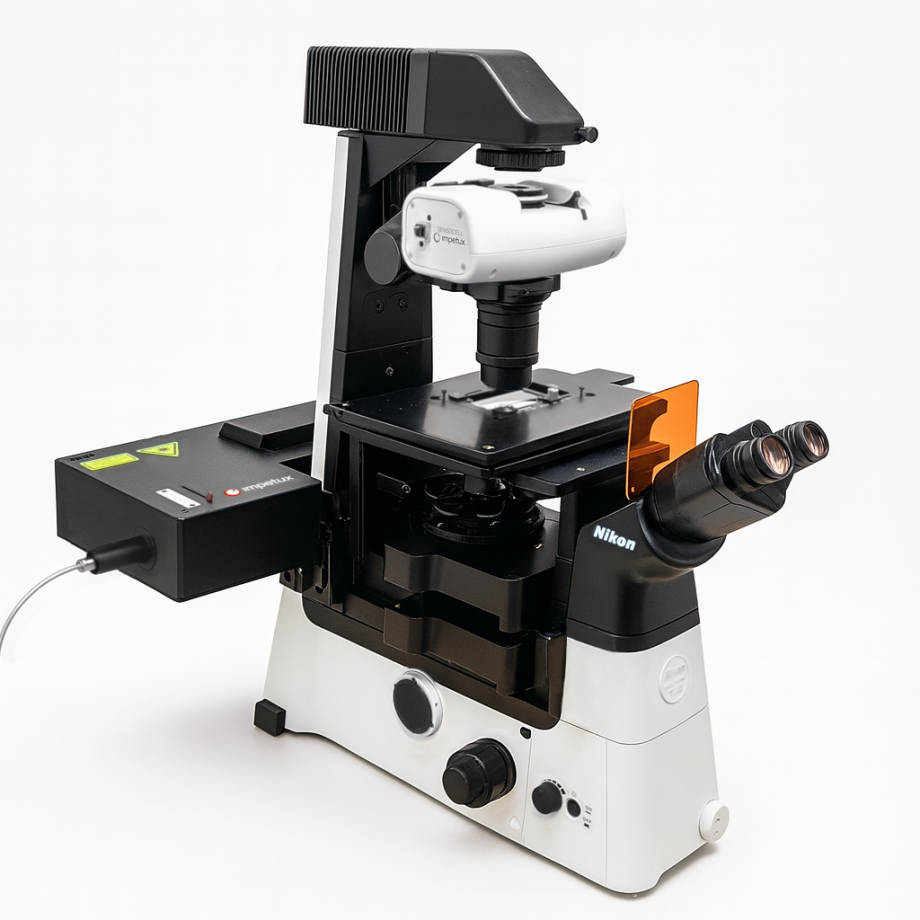
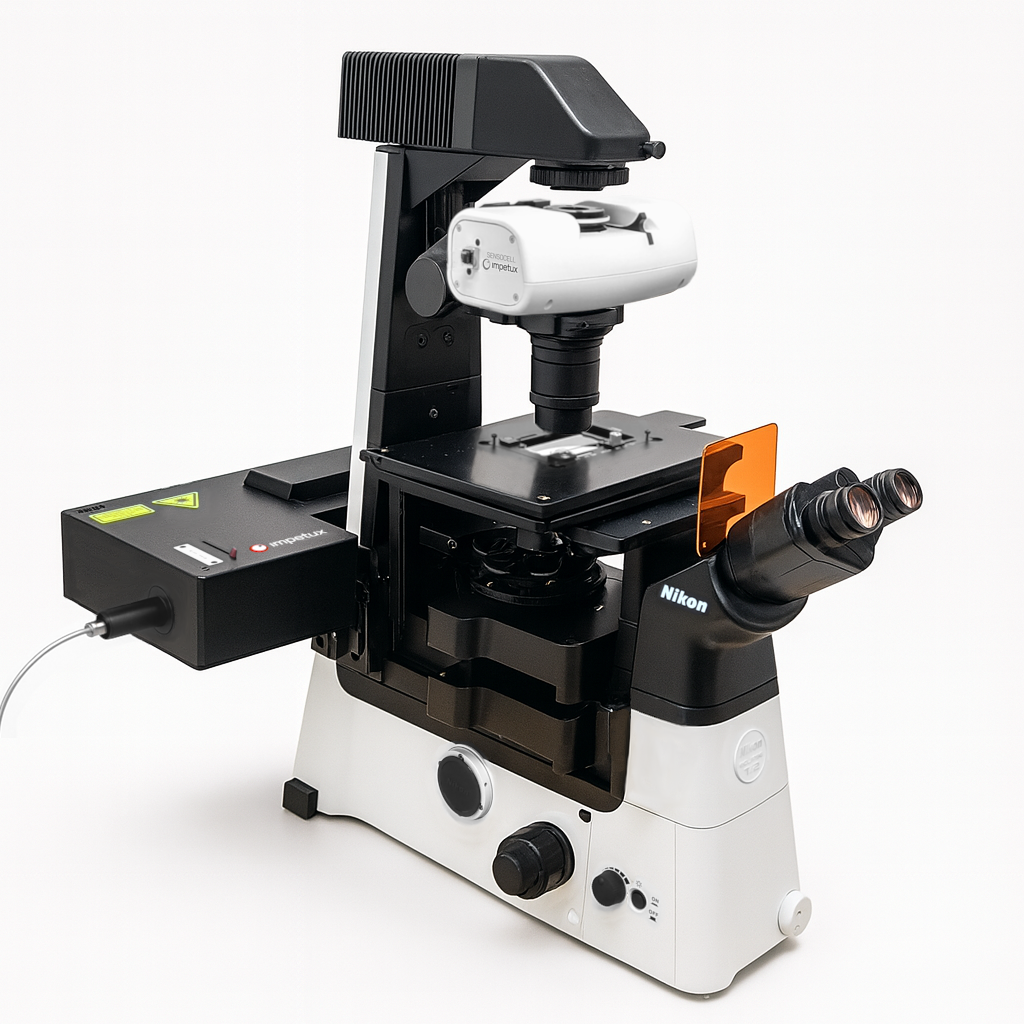
SENSOCELL | Optical Tweezers for Mechanobiology
Modality
Brightfield, DIC, widefield, confocal, TIRF, ...
Configuration
Complete system / Add-on
Force sensor method
Momentum forward-scattering
Number of traps
Up to 256
Steering technology
AOD
Steering frequency
100 kHz
 Description
 Specifications
 Applications
 Videos
 Downloads
 Publications
SENSOCELL Optical Tweezers for Mechanobiology by Impetux
SENSOCELL is a turnkey optical tweezers platform that traps, moves and probes microscopic samples while measuring the forces involved directly, with no calibration. Built by Impetux for mechanobiology, it brings simultaneous force measurement and active or passive microrheology inside living cells and 3D tissues to Nikon inverted microscopes.
Mechanobiology is reshaping research in cancer, morphogenesis, immunology and regenerative medicine. SENSOCELL lets researchers manipulate individual cells, nuclei, membranes and other native structures while tracking forces non-invasively. Impetux’s patented light momentum sensor measures forces in places conventional optical tweezers cannot, including on irregular objects and in complex media. Axiom Optics helps labs plan the configuration, from microscope compatibility to imaging modes and software routines.
Up to 256 traps
Acousto-optic steering at up to 25 kHz for trajectories, oscillations and pattern morphing.
Direct force, no calibration
Force resolution below 50 fN from a factory-calibrated light momentum sensor.
Built for living samples
A 1064 nm, 5 W single-frequency laser and compatibility with confocal, TIRF and more.
The SENSOCELL Platform
SENSOCELL is an add-on instrument for Nikon inverted microscopes. It can be installed on an existing microscope or delivered as an integrated platform with a new Nikon Ti2. The system has four parts:
- Optical manipulation module that generates and steers multiple traps for trapping and moving microscopic samples.
- Force sensor module for simultaneous, direct measurement of the optical trapping forces.
- Rack mount case with all electronics and a single-frequency 1064 nm, 5 W laser source.
- LightAce software for trap control, real-time force and position analysis, and automated routines.
Versatile Multi-Trap Optical Manipulation
The manipulation module is a compact, robust satellite instrument enclosed in an aluminum housing and mounted directly on the microscope body. Mounting it on the microscope rather than the optical table minimizes the effect of table instabilities, for maximum mechanical stability and the lowest drift. Acousto-optic deflection creates up to 256 simultaneous traps across a field of about 80 x 80 µm with a 60x objective, with individual trap placement at sub-nanometer precision. The ultra-stable, low-noise 1064 nm laser holds long-term power fluctuations below 0.3%.
Interactive
Multi-trap budget: up to 256 traps
Choose how many traps to run and see how power, stiffness and steering are shared across the array.
Number of traps
A single trap gets the full beam: the stiffest, highest-force configuration.
Splitting the beam 4 ways lowers stiffness per trap, yet a 100 nm displacement still produces 150 times the 50 fN force resolution.
Splitting the beam 16 ways lowers stiffness per trap, yet a 100 nm displacement still produces 38 times the 50 fN force resolution.
Splitting the beam 64 ways lowers stiffness per trap, yet a 100 nm displacement still produces 9 times the 50 fN force resolution.
Splitting the beam 256 ways lowers stiffness per trap, yet a 100 nm displacement still produces 2 times the 50 fN force resolution.
Illustrative estimate using Impetux typical values: 300 mW maximum at the sample for force measurement, trap stiffness of about 1 pN/(mW·µm), and 25 kHz acousto-optic steering shared equally across traps. Real stiffness depends on bead size, refractive index and objective. Because SENSOCELL measures force directly from light momentum, force readings do not depend on these stiffness estimates.
Direct Force Measurement From Light Momentum
Conventional optical tweezers infer force from probe position and a stiffness calibration that must be repeated for every probe and medium. SENSOCELL instead measures the change in momentum of the trapping light, which is proportional to the force on the sample. The conversion constant is set once at the factory, so forces are absolute and calibration-free, even on non-spherical objects, inside cells and beyond the linear region of the trap.
Compare
Calibration-free force measurement
Toggle between a conventional workflow and SENSOCELL’s direct force measurement.
Conventional optical tweezers
- Calibrate trap stiffness for each probe, medium and power setting.
- Track the probe position with back-focal-plane interferometry or video.
- Assume a spherical probe of known size in a known medium.
- Convert position to force with F = k·x, valid only in the linear region.
- Repeat calibration when the sample, cell or depth changes.
SENSOCELL direct force
- Factory-calibrated conversion constant, unique and permanent for each sensor.
- Force read from the change in light momentum, with no position tracking needed.
- Works on irregular and non-spherical objects, organelles and membranes.
- Measures beyond the linear region of the trap, so higher forces at a given power.
- Same calibration inside living cells, viscoelastic media and 3D tissues.
See the physics in action in our interactive guide, Optical Tweezers for Mechanobiology: Direct Force Measurement with SENSOCELL.
Mechanobiology Applications
With force resolution below 50 fN and integrated noise below 0.1 pN, SENSOCELL covers the force range of molecular motors, membranes, organelles and whole cells.
Explore
Mechanobiology applications on a force scale
Select an application to place its typical forces against SENSOCELL’s sensitivity.
10 fN100 fN1 pN10 pN100 pN1 nNMembrane tether pullingMotor protein kineticsCell nucleus indentationIntracellular rheologyCell-cell interaction forcesresolution <50 fNintegrated noise <0.1 pN
Membrane tether pulling
Pull a membrane tether from a trapped bead and read the force live as it extends. Force clamp mode holds a set force while LightAce records tether length and dynamics.
Typical force scale: about 10 to 100 pN. LightAce modes: Force clamp, trajectories.
Motor protein kinetics
Follow in vitro stepping and stall of motor proteins such as kinesin, which stalls near 6 pN, with 1 nm position resolution and sub-pN force sensitivity.
Typical force scale: about 1 to 10 pN. LightAce modes: Static traps, force clamp.
Cell nucleus indentation
Push on the nucleus or other organelles inside a living cell and measure the resistance directly, without calibrating against the cytoplasm.
Typical force scale: about 10 to 300 pN. LightAce modes: Trajectories, click and drag.
Intracellular rheology
Oscillate a probe inside the cytoplasm for active microrheology, or record passive fluctuations, to map viscoelastic properties in cells and 3D tissues.
Typical force scale: about 0.1 to 10 pN. LightAce modes: Custom oscillations.
Cell-cell interaction forces
Bring cells into contact with multiple traps and measure adhesion and interaction forces as they form and rupture.
Typical force scale: about 10 to 200 pN. LightAce modes: Multiple traps, pattern morphing.
Application force ranges are indicative orders of magnitude from the optical tweezers literature, not SENSOCELL specifications. Resolution and noise are Impetux typical values. Log scale.
LightAce Control Software
- Multi-trap control: click and drag, custom oscillations, trajectories, static patterns and pattern morphing.
- Real-time analysis: force and position data for multiple traps, with force clamp mode to control pulling and pushing rates.
- Synchronized recording: video captured in step with force and position data.
- Automation: predefined and customizable routines for cell mechanobiology, a simple macro language for your own routines, and the LightAce SDK.
- Open foundations: built on LabVIEW, ImageJ and µManager.
Microscope Integration and Imaging
SENSOCELL mounts through the epi-fluorescence port of a Nikon Ti2 inverted microscope and works alongside brightfield, DIC, epi-fluorescence, TIRF and confocal imaging, including spinning disk confocal.
Selector
Which SENSOCELL configuration fits your lab?
Your starting point
Add-on installation
SENSOCELL mounts on your existing Nikon Ti2 inverted microscope through the epi-fluorescence port, after a compatibility check by Impetux and Axiom Optics. Your current imaging modes stay in place.
Integrated platform
Choose SENSOCELL as a complete platform built on a new Nikon Ti2 inverted microscope, configured with a Hamamatsu ORCA camera and Ti2-LAPP modules for epi-fluorescence or TIRF.
Talk to Axiom Optics
SENSOCELL is designed as an add-on for Nikon inverted microscopes. Contact Axiom Optics to discuss your setup and the most practical route to integrated force measurement.
Choose your starting point.
SENSOCELL Key Specifications
- Traps
- Up to 256, acousto-optic deflection
- Trap steering
- Up to 25 kHz, 2D
- Field of view
- About 80 x 80 µm with 60x objective
- Trap stiffness
- About 1 pN/(mW·µm), typical
- Laser
- 1064 nm, 5 W, single frequency, <0.3% long-term fluctuation
- Force resolution
- <50 fN
- Force accuracy
- Typically <5-10%
- Integrated sensor noise
- Typically <0.1 pN, full bandwidth
- Position resolution
- 1 nm, typical
- Detector
- Temperature-compensated dual-lateral PSD, up to 100 kHz
- ADC
- 18-bit, up to 100 kHz
- Sensor optics
- NA 1.4 immersion objective, optimized for 1064 nm
- Max power at sample (force sensor)
- 300 mW, other ranges available
- Microscope
- Nikon Ti2 inverted, via epi-FL port
- Imaging
- Brightfield, DIC, epi-FL, TIRF, confocal
- Software
- LightAce with SDK
Values from Impetux; typical values where noted.
SENSOCELL FAQ
What is SENSOCELL?
SENSOCELL is a turnkey optical tweezers platform from Impetux for mechanobiology. It adds multi-trap optical manipulation and direct force measurement to Nikon inverted microscopes, so researchers can trap, move and probe cells, organelles and beads while measuring the forces involved in real time.
How does SENSOCELL measure force without calibration?
SENSOCELL measures the change in momentum of the trapping light as it is deflected by the sample. That change is proportional to the optical force, and the conversion constant depends only on the sensor’s optics and electronics, so Impetux calibrates it once at the factory. No trap stiffness calibration or probe position tracking is needed.
How many optical traps can SENSOCELL create?
Up to 256 simultaneous traps, generated with acousto-optic deflection and steered at up to 25 kHz. Traps can follow trajectories, oscillate, form static patterns or morph between patterns, and forces can be measured on multiple traps at once.
What force resolution does SENSOCELL offer?
Impetux specifies force resolution below 50 fN, typical force accuracy below 5-10%, integrated sensor noise below 0.1 pN over the full bandwidth, and 1 nm typical position resolution, with detector sampling up to 100 kHz.
Can SENSOCELL measure forces inside living cells and tissues?
Yes. Because the direct force method does not depend on the probe’s shape, size or the surrounding medium, SENSOCELL measures forces on irregular and non-spherical objects, inside living cells, in viscoelastic media and in 3D tissues.
Which microscopes is SENSOCELL compatible with?
SENSOCELL is an add-on for Nikon Ti2 inverted microscopes, mounted through the epi-fluorescence port. It can be installed on an existing Ti2 after a compatibility check or supplied as an integrated platform with a new Ti2. It works alongside brightfield, DIC, epi-fluorescence, TIRF and confocal imaging.
What laser does SENSOCELL use?
SENSOCELL includes an ultra-stable single-frequency 1064 nm infrared laser with 5 W output and long-term power fluctuations below 0.3%. Near-infrared light at 1064 nm is chosen for compatibility with biological samples.
What does the LightAce software do?
LightAce controls multiple traps, analyzes force and position data in real time, applies force clamping, and records video synchronized with force data. It includes predefined routines for mechanobiology, a macro language for custom routines and an SDK, built on LabVIEW, ImageJ and µManager.
Bring force measurement to your microscope
Tell Axiom Optics about your microscope, samples and target forces. We will confirm compatibility and configure SENSOCELL for your experiments.
SENSOCELL Optical Tweezer Applications
Cell Mechanobiology

- Membrane tension & receptor forces: Analyzing membrane mechanics and receptor activity through tether pulling and particle-cell interaction assays.
- Nucleus and subcellulal mechanics: Applying stress-relaxation and creep tests inside the cell to determine the stiffness and viscosity of the nucleus and surrounding medium.
- Intracellular rheology: Measuring the mechanical properties of the cytoplasm and nucleus using non-automated or manual rheology techniques.
- Cell-cell interactions: Quantifying cell-cell binding forces with precise control over cellular orientation and contact duration.
- Membrane stiffness and elasticity: Study how cells respond to stress by stretching or indenting them to determine their mechanical properties.
- Cell motility force dynamics: Analyzing how cells generate and experience force while investigating the mechanics of their movement.
Molecular Biophysics

- Motor proteins and filaments: Analyzing motor protein activity and the mechanical properties of the cytoskeleton under both in vitro and in vivo conditions.
- Single-molecule interactions
Phase Separation (LLPS)

- LLPS of biomolecular condensates: Measuring how protein condensates stiffen over time by tracking their G modulus with active rheology.
Colloids & Soft Matter Physics

- Colloids and soft matter physics: Characterizing colloidal interactions and the rheology of soft matter systems, including gels, biofilms, and liquid crystals.
Discover LightAce, powerful, flexible and user-friendly control software suite for SENSOCELL™ optical tweezers.
LightAce is the control software suite for SENSOCELL™ based on the integration of LABVIEW (National Instruments), ImageJ and μ-Manager. Easy and intuitive to work with, LightAce is easy and intuitive to work with, allowing you to:
- Take control over multiple optical traps and read real time force & position data for each trapped target.; apply force clamping or launch built-in routines. Simply selecting the different options on the interface menu, LightAce offers you an incredible set of trapping, manipulation & measurement capabilities!
- Customize predefined routines for your specific experiments choosing the setting parameter values for each menu option.
- Use our predefined and customizable automated routines for cell mechanobiology or create your own routines using our simple and flexible LightAce Software Development Kit (SDK) completed by a variety of examples.
Best efforts have been dedicated to create a user-friendly GUI. After a short training course given, non-experts users can start working immediately and plan experiments from the very beginning.
Watch the tutorials for the LightAce Software Below:
LightAce software suite Introduction
Optical trap oscillations with LightAce
Optical trap trajectories with LightAce
Force Measurements with SENSOCELL optical tweezers.
Create your own custom routines with LightAce SDK
How to create your own routines using LightAce SDK.
1. Choose among the manipulation & measurements .vi functions included in the LightAce SDK library:

2. Customize your selected .vi functions by setting their input parameters values:

3. Combine them to create your routines controlling all features of SENSOCELL™ :
