
CinCam InGaAs Beam Profilers
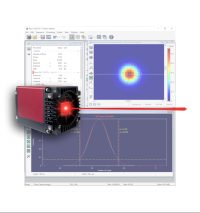
CinCam InGaAs beam profilers bring plug-and-play laser beam profiling to the short-wave infrared. CINOGY builds them on Allied Vision Goldeye InGaAs cameras and pairs them with its RayCi analysis software to measure CW and pulsed lasers from 900 to 1700 nm, the band where silicon-based profilers lose sensitivity and where 1064 nm, 1310 nm, and 1550 nm lasers operate.
The CinCam InGaAs HR versions, available exclusively from Axiom Optics, extend coverage down to 400 nm with Sony SenSWIR sensors, so one SWIR laser beam profiler can handle visible alignment beams and infrared lasers alike. Every model measures beam profile, beam width, divergence, and pointing stability for lab and production use.
Compare CinCam InGaAs Beam Profilers
| Model | Spectral range | Pixels and pitch | Active area | Best for |
|---|---|---|---|---|
| CinCam InGaAs 320 | 900 to 1700 nm | 320 × 256, 30 µm | 9.6 × 7.7 mm | Entry-level SWIR profiling and larger beams |
| CinCam InGaAs 640 | 900 to 1700 nm | 640 × 512, 15 µm | 9.6 × 7.7 mm | Smaller beams and finer profile detail |
| CinCam InGaAs 636 | 900 to 1700 nm | 636 × 508, 25 µm | 15.9 × 12.7 mm | Large beams and multiple beams in one frame |
| CinCam InGaAs HR (0.3 MP) | 400 to 1700 nm | 656 × 520, 5 µm | 3.3 × 2.6 mm | Small, focused beams across VIS and SWIR |
| CinCam InGaAs HR (1.3 MP) | 400 to 1700 nm | 1280 × 1024, 5 µm | 6.4 × 5.1 mm | Highest resolution across VIS and SWIR |
The 320, 640, and 636 models use Goldeye G-008, G-033, and G-032 InGaAs cameras. The CinCam InGaAs HR versions use Goldeye G-030 and G-130 cameras with Sony IMX991 and IMX990 sensors.
How to Choose a SWIR Beam Profiler
- Start with wavelength. For lasers between 900 and 1700 nm, any CinCam InGaAs model works. If you also need to profile visible beams down to 400 nm, choose an HR version.
- Match pixel pitch to your smallest beam. For an accurate width measurement, the beam should span about 10 pixels or more. Smaller pitch resolves smaller beams: 5 µm on the HR versions, 15 µm on the 640, 25 µm on the 636, and 30 µm on the 320.
- Match active area to your largest beam. The beam and its wings must fit on the sensor with margin. The 636 offers the largest area for big or multiple beams; the HR versions trade area for resolution.
- Plan for laser power. High-power CW and pulsed lasers need attenuation ahead of the sensor to stay below saturation and protect it.
- Decide whether you need M². A profiler measures beam size, shape, and position at one plane. For beam quality to ISO 11146, add a CinSquare M² Tool VIS+SWIR or browse our M² measurement systems.
Recommended beam diameter by model
| Model | Smallest beam | Largest beam |
|---|---|---|
| CinCam InGaAs 320 | 150 µm | 5.7 mm |
| CinCam InGaAs 640 | 150 µm | 5.7 mm |
| CinCam InGaAs 636 | ≈250 µm* | ≈9.5 mm* |
| CinCam InGaAs HR (0.3 MP) | ≈50 µm* | ≈1.9 mm* |
| CinCam InGaAs HR (1.3 MP) | ≈50 µm* | ≈3.8 mm* |
Values for the 320 and 640 are CINOGY’s recommended range. *Values marked with an asterisk are estimates, based on 10 pixels across the smallest beam and about three-quarters of the sensor height for the largest. Contact our team to confirm the right model for your beam.
RayCi Laser Beam Analysis Software
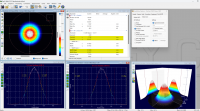
Every CinCam InGaAs profiler includes RayCi, CINOGY’s Windows software for ISO-standard laser beam analysis. RayCi runs several beam profiler cameras from one computer at the same time and compares live measurements with stored data, which makes it practical for both R&D benches and production lines. Learn more about laser beam profiling applications, or see the full range of Goldeye SWIR cameras behind these profilers. For lasers below 1100 nm, our UV, VIS, and NIR laser beam profilers are another option.
CinCam InGaAs Beam Profiler FAQs
What is an InGaAs beam profiler?
An InGaAs beam profiler is a camera-based laser beam profiler built on an indium gallium arsenide sensor, which responds in the short-wave infrared where silicon does not. CinCam InGaAs profilers combine Allied Vision Goldeye InGaAs cameras with CINOGY’s RayCi software to measure beam profile, beam width, divergence, and pointing stability for CW and pulsed lasers from 900 to 1700 nm.
Can I use a silicon beam profiler at 1550 nm?
No. Silicon sensors lose sensitivity beyond about 1100 nm, so they cannot image 1310 nm or 1550 nm lasers. An InGaAs beam profiler covers 900 to 1700 nm, which includes 1064 nm, 1310 nm, and 1550 nm sources, and the CinCam InGaAs HR versions extend coverage down to 400 nm.
Which CinCam InGaAs model is best for small beams?
Pixel pitch sets the smallest beam you can profile accurately, because the beam should span roughly 10 pixels or more. The CinCam InGaAs HR versions, with 5 µm pixels, handle the smallest focused beams. Among the standard InGaAs models, the CinCam InGaAs 640 has the finest pitch at 15 µm, and CINOGY recommends it for beams from 150 µm to 5.7 mm.
Can one beam profiler measure both visible and SWIR lasers?
Yes. The CinCam InGaAs HR versions, available exclusively from Axiom Optics, use Sony IMX990 and IMX991 SenSWIR sensors on Allied Vision Goldeye G-130 and G-030 cameras, covering 400 to 1700 nm. One profiler can then handle a visible alignment beam and a SWIR laser on the same bench.
Does CinCam InGaAs work with pulsed lasers?
Yes. CinCam InGaAs beam profilers measure both CW and pulsed lasers. High peak power or high average power beams need attenuation ahead of the sensor to stay below saturation, and our team can help specify it.
What software comes with CinCam InGaAs beam profilers?
CinCam InGaAs profilers ship with RayCi, CINOGY’s Windows laser beam analysis software. RayCi supports ISO-standard beam analysis, controls several beam profiler cameras on one computer at the same time, and compares live measurements against stored data.
How do I measure M² in the SWIR?
A single beam profile gives width, shape, and position, while M² needs beam widths measured through a focus. For automated M² measurement from 400 to 1700 nm, the CinSquare M² Tool VIS+SWIR pairs an IMX990 sensor with a motorized caustic scan.
Blogs

To cool or not to cool? - Do I need cooling for my SWIR camera?

Need For Speed - How to select a high-speed SWIR InGaAs camera?
Sony's IMX992 InGaAs Sensor: A Quantum Leap in High-Resolution SWIR Imaging
What is An InGaAs Camera? Exploring InGaAs' Origins and Manufacturing Techniques for SWIR Imaging
3 Factors To Consider When Selecting a Laser Beam Profiler
Expansion of our Line of the BeamPro Beam Profiler
