
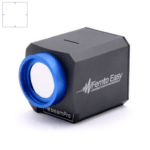
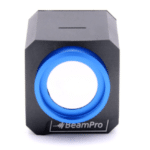
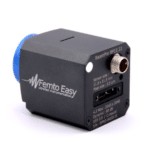

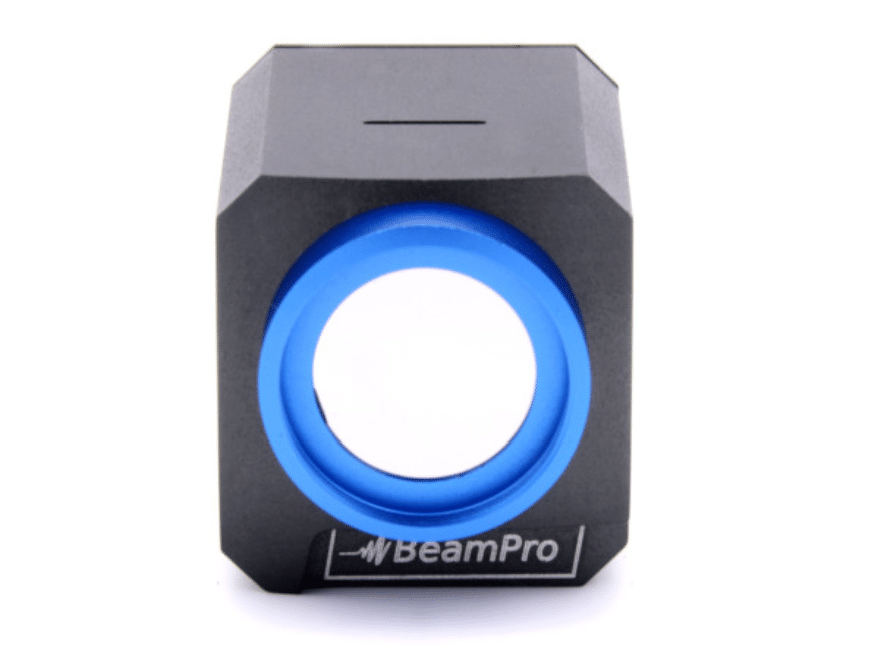
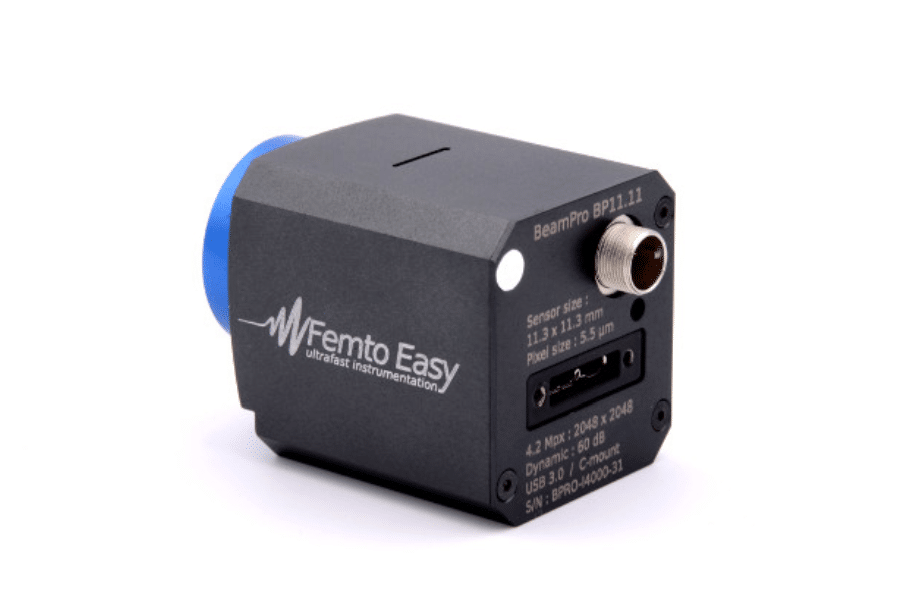
BeamPro | Large Area Laser Beam Profiler
Smallest pixel pitch
2.40 µm
Largest active area
25 x 16.1 mm or Φ25
Bit depth
12/16-bit (with HDR option)
Interface
USB3.1
Software
STAR software + Web API
Options
UV, trigger, windowless, vacuum compatible
 Description
 Specifications
 Downloads
 Software
BeamPro Large Area Laser Beam Profiler for Beams Above 10 mm
The Femto Easy BeamPro Large Area is a family of large area laser beam profilers that capture big collimated beams in a single shot. Active areas run from 11.2 x 11.2 mm up to a full-frame 38.4 x 30.6 mm, including a 25 mm circular sensor, so beams above 10 mm can be profiled without scanning or reduction optics.
Silicon models cover 375-1100 nm, or 190-1100 nm with the UV option, while VSWIR and SWIR versions extend to 1700 nm. Every Large Area model uses a global shutter, connects over USB 3.1 for most models, and runs Femto Easy’s STAR BeamPro software for ISO-compliant analysis. Axiom Optics helps you size the sensor to your beam, plan attenuation and choose options such as UV extension, windowless sensors and pulse triggering.
Up to 38.4 x 30.6 mm
The largest active areas in the BeamPro range for collimated and expanded beams.
190 to 1700 nm
UV, visible, NIR and SWIR models share one software platform.
Global shutter
Every Large Area sensor captures the whole beam in one exposure, ideal for pulsed sources.
Sizing a Beam Profiler to Your Beam
Second-moment beam diameters depend on the faint wings of the beam as much as the bright core. If the wings fall off the sensor, the measured D4σ diameter comes out too small. A practical rule is to keep the 1/e² diameter within about two thirds of the shortest sensor side, which keeps everything above roughly 1% of peak intensity on the detector.
Will your beam fit?
Choose a BeamPro model and your beam’s 1/e² diameter to see it to scale on the sensor.
Sensor outline and Gaussian beam to scale; dashed circle marks the 1/e² diameter.
Fits with full wings. The beam and its wings out to about 1% of peak land on the sensor, so second-moment (D4σ) diameters stay accurate.
Fits, wings clipped. The 1/e² diameter fits, but the outer wings fall off the sensor and D4σ results will read small. Use a larger model or slightly reduce the beam.
Too large. The 1/e² diameter is larger than the sensor, so a significant share of the beam misses it. Choose a larger active area or add a reducing telescope ahead of the profiler.
Too large. The 1/e² diameter is larger than the sensor, so a significant share of the beam misses it. Choose a larger active area or add a reducing telescope ahead of the profiler.
Too large. The 1/e² diameter is larger than the sensor, so a significant share of the beam misses it. Choose a larger active area or add a reducing telescope ahead of the profiler.
Too large. The 1/e² diameter is larger than the sensor, so a significant share of the beam misses it. Choose a larger active area or add a reducing telescope ahead of the profiler.
Fits with full wings. The beam and its wings out to about 1% of peak land on the sensor, so second-moment (D4σ) diameters stay accurate.
Fits with full wings. The beam and its wings out to about 1% of peak land on the sensor, so second-moment (D4σ) diameters stay accurate.
Fits, wings clipped. The 1/e² diameter fits, but the outer wings fall off the sensor and D4σ results will read small. Use a larger model or slightly reduce the beam.
Fits, wings clipped. The 1/e² diameter fits, but the outer wings fall off the sensor and D4σ results will read small. Use a larger model or slightly reduce the beam.
Too large. The 1/e² diameter is larger than the sensor, so a significant share of the beam misses it. Choose a larger active area or add a reducing telescope ahead of the profiler.
Too large. The 1/e² diameter is larger than the sensor, so a significant share of the beam misses it. Choose a larger active area or add a reducing telescope ahead of the profiler.
Fits with full wings. The beam and its wings out to about 1% of peak land on the sensor, so second-moment (D4σ) diameters stay accurate.
Fits with full wings. The beam and its wings out to about 1% of peak land on the sensor, so second-moment (D4σ) diameters stay accurate.
Fits with full wings. The beam and its wings out to about 1% of peak land on the sensor, so second-moment (D4σ) diameters stay accurate.
Fits with full wings. The beam and its wings out to about 1% of peak land on the sensor, so second-moment (D4σ) diameters stay accurate.
Fits, wings clipped. The 1/e² diameter fits, but the outer wings fall off the sensor and D4σ results will read small. Use a larger model or slightly reduce the beam.
Fits, wings clipped. The 1/e² diameter fits, but the outer wings fall off the sensor and D4σ results will read small. Use a larger model or slightly reduce the beam.
Fits with full wings. The beam and its wings out to about 1% of peak land on the sensor, so second-moment (D4σ) diameters stay accurate.
Fits with full wings. The beam and its wings out to about 1% of peak land on the sensor, so second-moment (D4σ) diameters stay accurate.
Fits, wings clipped. The 1/e² diameter fits, but the outer wings fall off the sensor and D4σ results will read small. Use a larger model or slightly reduce the beam.
Too large. The 1/e² diameter is larger than the sensor, so a significant share of the beam misses it. Choose a larger active area or add a reducing telescope ahead of the profiler.
Too large. The 1/e² diameter is larger than the sensor, so a significant share of the beam misses it. Choose a larger active area or add a reducing telescope ahead of the profiler.
Too large. The 1/e² diameter is larger than the sensor, so a significant share of the beam misses it. Choose a larger active area or add a reducing telescope ahead of the profiler.
Too large. The 1/e² diameter is larger than the sensor, so a significant share of the beam misses it. Choose a larger active area or add a reducing telescope ahead of the profiler.
Fits with full wings. The beam and its wings out to about 1% of peak land on the sensor, so second-moment (D4σ) diameters stay accurate.
Fits with full wings. The beam and its wings out to about 1% of peak land on the sensor, so second-moment (D4σ) diameters stay accurate.
Fits, wings clipped. The 1/e² diameter fits, but the outer wings fall off the sensor and D4σ results will read small. Use a larger model or slightly reduce the beam.
Fits, wings clipped. The 1/e² diameter fits, but the outer wings fall off the sensor and D4σ results will read small. Use a larger model or slightly reduce the beam.
Too large. The 1/e² diameter is larger than the sensor, so a significant share of the beam misses it. Choose a larger active area or add a reducing telescope ahead of the profiler.
Too large. The 1/e² diameter is larger than the sensor, so a significant share of the beam misses it. Choose a larger active area or add a reducing telescope ahead of the profiler.
Fits with full wings. The beam and its wings out to about 1% of peak land on the sensor, so second-moment (D4σ) diameters stay accurate.
Fits with full wings. The beam and its wings out to about 1% of peak land on the sensor, so second-moment (D4σ) diameters stay accurate.
Fits with full wings. The beam and its wings out to about 1% of peak land on the sensor, so second-moment (D4σ) diameters stay accurate.
Fits with full wings. The beam and its wings out to about 1% of peak land on the sensor, so second-moment (D4σ) diameters stay accurate.
Fits with full wings. The beam and its wings out to about 1% of peak land on the sensor, so second-moment (D4σ) diameters stay accurate.
Fits, wings clipped. The 1/e² diameter fits, but the outer wings fall off the sensor and D4σ results will read small. Use a larger model or slightly reduce the beam.
Centered TEM00 Gaussian beam. “Full wings” means the 1/e² diameter is at most two thirds of the shortest sensor side (or of the 25 mm circle), so intensity at the edge is about 1% of peak. Active areas and effective pixel sizes from the Femto Easy BeamPro datasheet.
Choosing a Large Area Model
Wavelength sets the sensor technology and beam size sets the active area. Use the selector below, or compare every model in the specification table.
Find your Large Area BeamPro
Start with: BP11.11 or BP12.10 with UV option
The UV extension takes these 1-inch sensors down to 190 nm. Choose the BP12.10 for 73 fps and 4.8 µm pixels, or the square BP11.11 for round beams.
Start with: BPΦ25 UV or BP25.16 UV
Both UV versions cover 200-750 nm. The BPΦ25 UV gives a 25 mm circular area for round beams; the BP25.16 UV a 25 x 16.1 mm field for elongated beams.
Start with: Talk to Axiom Optics
No Large Area UV model exceeds 25 mm. A reflective beam reducer ahead of a BPΦ25 UV is the usual route; we can help size it.
Start with: BP11.11
A square 11.2 x 11.2 mm global shutter sensor at 80 fps, the all-round choice for 10-15 mm beams. For finer sampling choose the 18.4 Mpx BP11.10; for speed with a wider field, the BP12.10.
Start with: BPΦ25
A 25 mm circular active area with 12.65 µm effective pixels at 80 fps, made for round collimated beams. The BP25.16 suits elongated or line-shaped beams.
Start with: Reduce, then profile on the BPΦ25
Beams above 25 mm are usually reduced with a telescope of known magnification, then measured on the BPΦ25 and scaled back. Axiom Optics can recommend optics.
Start with: VSWIR 19.15
One 19.3 x 15.3 mm sensor covers 400-1700 nm at up to 128 fps, so visible alignment lasers and NIR or SWIR sources share one profiler.
Start with: VSWIR 19.15 or SWIR 22.18
The VSWIR 19.15 keeps visible coverage for beams up to about 15 mm with full wings. Past that, the SWIR 22.18 covers 900-1700 nm on a 22 x 17.6 mm sensor.
Start with: SWIR 38.30 for the SWIR part
The full-frame SWIR 38.30 offers 38.4 x 30.6 mm for 900-1700 nm. For visible content in very large beams, reduce the beam onto a VSWIR or BPΦ25 model.
Start with: SWIR 13.10
A TE-cooled 1-inch SWIR sensor with 1280 x 1024 pixels at 10 µm and 60 fps for 900-1700 nm beams up to about 15 mm.
Start with: SWIR 22.18
A 22 x 17.6 mm APS-C size sensor at up to 230 fps for 900-1700 nm beams.
Start with: SWIR 38.30
The largest BeamPro: a full-frame 38.4 x 30.6 mm SWIR sensor with 1280 x 1024 pixels for very large 900-1700 nm beams.
Choose your wavelength and beam size to get a recommendation.
Now choose your wavelength range.
Now choose your beam diameter.
Focused beams below 10 mm are better served by the BeamPro Small Pixel line; tight spaces by the BeamPro Compact Footprint profilers.
STAR BeamPro Software
Femto Easy’s STAR software is touchscreen-friendly and extracts beam properties live, even at full resolution. It runs the same way across the whole BeamPro range, so users moving between Small Pixel, Compact and Large Area profilers work in one interface.
STAR BeamPro software
Select a capability.
ISO beam parameters
STAR computes ISO-compliant beam parameters in real time, including second-moment (D4σ) diameters, centroid position and ellipticity, from images above 20 Mpx.
Background and hot pixels
Built-in background subtraction and hot pixel treatment keep wing data clean, which matters most on large beams where the wings spread over many pixels.
Compare and log
Recall the last 10 acquisitions with logging, and compare a live beam against up to 10 reference measurements to spot drift or alignment changes.
Remote and multi-unit
A client/server interface controls several BeamPro units from one screen over a network, and standard communication protocols integrate the profiler into your own software.
Pulsed lasers
The Trigger option synchronizes acquisition to single pulses, with the trigger cable included. Global shutter sensors capture each pulse without rolling-shutter artifacts.
Options and Accessories
- Windowless sensor: removes the cover glass to eliminate interference fringes from coherent sources.
- UV extension: extends silicon models down to 190 nm for excimer and harmonic lasers.
- ND filters: one filter included, with additional OD1 to OD4 filters available.
- High dynamic range: 16-bit HDR on supported models for beams with strong core-to-wing contrast.
- Trigger: single-pulse synchronization, trigger cable included.
- Vacuum-compatible versions: available for some models.
BeamPro Large Area Specifications
| Model | Active area | Wavelength | Resolution | Pixel | Max fps |
|---|---|---|---|---|---|
| BP11.11 | 11.2 x 11.2 mm | 375-1100 nm | 2048 x 2048 | 5.5 µm | 80 |
| BP12.10 | 12.4 x 9.8 mm | 375-1100 nm | 2592 x 2048 | 4.8 µm | 73 |
| BP11.10 | 11.3 x 10.2 mm | 375-1100 nm | 4508 x 4096 | 2.5 µm | 20 |
| BP25.16 | 25 x 16.1 mm | 375-1100 nm | 1920 x 1200 | 13.48 µm | 47 |
| BPΦ25 | Φ 25.0 mm | 375-1100 nm | 2048 x 2048 | 12.65 µm | 80 |
| VSWIR 19.15 | 19.3 x 15.3 mm | 400-1700 nm | 1296 x 1032 | 15 µm | 128 |
| SWIR 13.10 | 12.8 x 10.2 mm | 900-1700 nm | 1280 x 1024 | 10 µm | 60 |
| SWIR 22.18 | 22 x 17.6 mm | 900-1700 nm | 640 x 512 | 34.5 µm | 230 |
| SWIR 38.30 | 38.4 x 30.6 mm | 900-1700 nm | 1280 x 1024 | 30 µm | 60 |
UV versions: BP11.11, BP12.10 and BP11.10 extend to 190 nm with the UV option; BP25.16 UV and BPΦ25 UV cover 200-750 nm. Pixel sizes for BP25.16 and BPΦ25 are effective values. All Large Area models use a global shutter. Source: Femto Easy BeamPro datasheet.
BeamPro Large Area FAQ
What is a large area laser beam profiler?
A large area laser beam profiler is a camera-based beam profiler with an oversized sensor that captures collimated beams above about 10 mm in diameter in a single image, without scanning or beam reduction. The BeamPro Large Area line offers active areas from 11.2 x 11.2 mm up to 38.4 x 30.6 mm, including a 25 mm circular model.
How large a beam can the BeamPro Large Area measure?
It depends on the model. As a rule of thumb, keep the 1/e² beam diameter within about two thirds of the shortest sensor side so the beam's wings stay on the sensor: about 7.5 mm on the BP11.11, 16.7 mm on the BPΦ25, and 20 mm on the SWIR 38.30. Larger beams still fit up to the full sensor size, with clipped wings.
What wavelengths does the BeamPro Large Area cover?
Silicon CMOS models cover 375-1100 nm, extending to 190 nm with the UV option, and the BP25.16 UV and BPΦ25 UV versions cover 200-750 nm. The VSWIR 19.15 covers 400-1700 nm, and the SWIR 13.10, SWIR 22.18 and SWIR 38.30 cover 900-1700 nm.
Does the BeamPro measure according to ISO 11146?
The STAR BeamPro software calculates ISO-compliant beam parameters such as second-moment diameters, centroid and ellipticity in real time, with background and hot pixel treatment to keep results accurate.
Can the BeamPro profile pulsed lasers?
Yes. With the Trigger option the BeamPro synchronizes acquisition to single pulses, and the Large Area models use global shutter sensors so each pulse is captured in one exposure.
How do I attenuate a high-power beam for the profiler?
BeamPro profilers ship with a neutral density filter, and additional ND filters from OD1 to OD4 are available. For high-power lasers, use a beam sampler or wedge ahead of the filters so only a small, known fraction of the power reaches the sensor. Axiom Optics can help you plan the attenuation chain.
Which options are available?
Options include a windowless sensor to remove interference fringes, UV extension to 190 nm, additional ND filters, high dynamic range, trigger synchronization, and vacuum-compatible versions for some models. Most models connect over USB 3.1, with GigE on some TE-cooled SWIR models.
Where can I buy a BeamPro?
Axiom Optics supplies Femto Easy BeamPro profilers and supports them from its Cambridge, Massachusetts office. Popular models such as the BP11.11 and BPΦ25 can be ordered directly from the Axiom Optics online store, and every model is available by quote.
Profile your large beam
Send your wavelength, beam diameter and power. Axiom Optics will recommend the model, attenuation and options, or order the BP11.11 and BPΦ25 online.
Beam Profiler Software STAR
BeamPro comes with a powerful and very user friendly software, designed with touch screens in mind, in order to give you the best user experience.
- Live extraction of beam properties, even with resolutions larger than 20 Mpx
- Several parameters and methods supported (ISO calculation included)
- Enhanced background & hot pixels treatment for optimum dynamic and signal-to-noise ratio
- Client / Server interface, allowing remote control through network
- Advanced logging and permanent access to the 10 previous acquisitions
- Live comparison with up to 10 different reference measurements
- 1-click installation, completely configurable, export assistant

