Deformable Mirrors

Deformable mirrors are nowadays commonly used for adaptive optics and wavefront correction in many different fields such as astronomy, telecommunication, laser physics, ophthalmology, light microscopy, laser processing and more. Axiom Optics offers 3 different types of deformable mirrors depending on their respective actuator technology :

  • Mechanical actuators for reliable, low speed correction of thermal effects in large diameter (up to 400 mm and more) high power laser beams.
  • Piezoelectric actuators for high speed focus correction of high power CW beams used for material processing
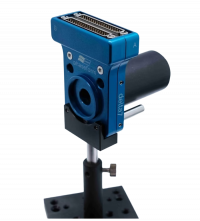
  • Electromagnetic actuators for small diameter mirrors (less than 20 mm) , high speed adaptive optics in astronomy, free space telecommunication, or high quality wavefront correction in life science applications such as retinal imaging and light microscopy.

When selecting a deformable mirror, please consider the following important specifications :

  • Diameter (mm)
  • Number of actuators
  • Speed (Hz)
  • Active flat ( nm rms)
  • Reflectivity and damage threshold ( J/cm2)
  • Dynamic range ( nm ) and linearity
  • Control electronics, software and API simplicity

Axiom Optics is a well known supplier of high-quality optical instruments for industrial and scientific applications. Contact us about deformable mirrors today, we will be happy to discuss your needs, assist you in selecting the right components, and advise you with integration.

Compare Deformable Mirrors

The table below summarizes every deformable mirror and transmissive wavefront modulator in the Axiom Optics lineup. Full specifications and datasheets are available on each product page. ILAO Star values vary by model (50 through 250).

Model Technology Actuators Key specs Best suited for
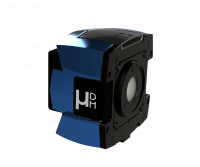
muDM Electromagnetic 91 15 mm, ±50 µm PV, 300 Hz, <3 nm RMS flat Microscopy and retinal imaging, USB 3.0, no external controller
Mirao 52e Electromagnetic 52 15 mm, ±50 µm PV, 200 Hz, <10 nm RMS flat Closed loop bio-imaging, ophthalmology, beam shaping
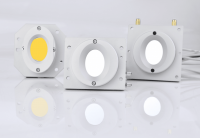
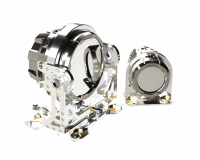
ILAO Star Mechanical 19 to 52 Beams 16 to 170 mm (custom to 500 mm), >20 to 50 µm range Ultra high intensity lasers, full power correction
Delta 7 Electrostatic, transmissive 63 10 mm pupil, 7th order Zernike, <λ/40 RMS flat In-line adaptive optics at the microscope pupil
Zwobbel Focus drive 91 532 or 1020 nm, 20 mm focus travel in 2 ms Laser welding, cutting, and structuring

Need help matching a mirror to your beam parameters? The AO Kit DM pairs a deformable mirror with a HASO wavefront sensor and WaveTune software as a complete closed loop system.

How to Choose a Deformable Mirror

The right deformable mirror depends on the aberrations being corrected, the beam it must survive, and how the correction loop will run. The specifications below are the ones that matter most.

Actuator count and correction order

The number of actuators sets the highest spatial frequency the mirror can correct. Low order aberrations such as defocus and astigmatism need relatively few actuators, while higher order Zernike modes require denser layouts. The 52 actuator Mirao 52e corrects Zernike modes up to the 6th order, while the 91 actuator muDM reaches the 10th order thanks to an optimized actuator layout. More actuators only pay off when the aberration content of the system actually contains those higher frequencies, so characterizing the wavefront first with a wavefront sensor is the fastest way to avoid over-specifying.

Aperture and beam diameter

The mirror pupil must match the beam at the plane where correction is applied, typically a conjugate of the system pupil. Compact electromagnetic mirrors with 15 mm apertures suit microscopy and retinal imaging systems where the beam is relayed to the mirror. High energy laser chains are the opposite case: expanding a petawatt class beam down to a small mirror is not an option, which is why mechanical mirrors like the ILAO Star scale from 16 mm up to 500 mm beam diameters.

Stroke and dynamic range

Stroke determines the amplitude of wavefront error the mirror can generate or remove. Large stroke matters when correcting strong defocus, for example when refocusing through thick samples or compensating ocular aberrations. Both the muDM and Mirao 52e generate up to 50 microns peak to valley while retaining actuator headroom for higher order correction on top of the focus term. Linearity and hysteresis determine how predictable that stroke is: a mirror with near perfect linearity and negligible hysteresis, such as the muDM at greater than 99.5 percent linearity and less than 0.1 percent hysteresis, can run accurately in open loop without a sensor in the loop.

Speed

Correction bandwidth must exceed the rate at which the aberrations evolve. Sample induced aberrations in fixed specimens are quasi-static, while atmospheric turbulence in free space optical links and dynamic focusing in laser processing demand hundreds of hertz or millisecond response. The Zwobbel shifts focus 20 mm in 2 ms for exactly this reason, replacing mechanical z-stages in welding and cutting heads.

Surface quality and active flat

Active flat is the residual wavefront error that remains after the mirror is commanded to its best flat shape, expressed in nanometers RMS. It represents the noise floor of the correction: a mirror cannot correct a system to better quality than its own flattened surface. Values below 10 nm RMS support diffraction limited imaging in the visible, and the muDM achieves better than 3 nm RMS.

Reflectivity and damage threshold

Coating choice sets both the photon budget and the survivability of the mirror. Protected silver and gold coatings preserve broadband reflectivity for imaging applications where every photon counts. High power laser work requires dielectric or hybrid coatings with damage thresholds matched to the fluence at the mirror, one of the reasons ILAO Star mirrors are built to order around the laser’s parameters and support rapid substrate replacement.

Control electronics and software

Integration effort is often the deciding factor between otherwise similar mirrors. The muDM embeds its electronics in the mirror head and connects over a single USB 3.0 cable with no external controller. All Imagine Optic mirrors operate under WaveTune for calibration and closed loop control with HASO sensors, and the WaveKit SDK provides C++, Python, and LabVIEW interfaces for custom control loops, including sensorless image based optimization for microscopy.

Deformable Mirror FAQs

What is the difference between a deformable mirror and a spatial light modulator?

A deformable mirror reshapes a continuous reflective surface with tens of actuators, offering large stroke, fast response, achromatic operation, and polarization independence. A spatial light modulator uses millions of liquid crystal pixels to modulate phase with far higher spatial resolution, but with limited stroke, wavelength dependence, and polarization sensitivity. Deformable mirrors are generally preferred for aberration correction, while SLMs excel at complex beam shaping and holography.

How many actuators does a deformable mirror need?

Enough to reproduce the highest order aberration present in the system. Correcting defocus and astigmatism requires only a handful of actuators, while high resolution microscopy through scattering tissue typically benefits from 50 to 100 actuators covering Zernike modes to the 6th order and beyond. Measuring the system wavefront with a Shack-Hartmann sensor before purchase removes the guesswork.

What does active flat mean?

Active flat is the residual surface error, in nanometers RMS, after the mirror is driven to its flattest achievable shape. It defines the quality floor of any correction the mirror performs. An active flat below 10 nm RMS is generally required for diffraction limited performance at visible wavelengths.

Can deformable mirrors be used with high power lasers?

Yes, with the right actuator technology and coating. Mechanical deformable mirrors such as the ILAO Star are designed for ultra high intensity beams, perform correction at full power, accept dielectric high damage threshold coatings, and hold their shape even with the electronics powered off. Membrane based electromagnetic mirrors are better suited to imaging and low power beam shaping.

Do I need a wavefront sensor to use a deformable mirror?

Not always. In closed loop operation a wavefront sensor measures the residual error and the mirror corrects it iteratively, which delivers the highest accuracy. Mirrors with high linearity and low hysteresis, such as the muDM and Delta 7, can also run open loop or sensorless, where an image quality metric drives the correction instead of a direct wavefront measurement.
Deformable Mirrors

Deformable mirrors are nowadays commonly used for adaptive optics and wavefront correction in many different fields such as astronomy, telecommunication, laser physics, ophthalmology, light microscopy, laser processing and more. Axiom Optics offers 3 different types of deformable mirrors depending on their respective actuator technology :

  • Mechanical actuators for reliable, low speed correction of thermal effects in large diameter (up to 400 mm and more) high power laser beams.
  • Piezoelectric actuators for high speed focus correction of high power CW beams used for material processing
  • Electromagnetic actuators for small diameter mirrors (less than 20 mm) , high speed adaptive optics in astronomy, free space telecommunication, or high quality wavefront correction in life science applications such as retinal imaging and light microscopy.

When selecting a deformable mirror, please consider the following important specifications :

  • Diameter (mm)
  • Number of actuators
  • Speed (Hz)
  • Active flat ( nm rms)
  • Reflectivity and damage threshold ( J/cm2)
  • Dynamic range ( nm ) and linearity
  • Control electronics, software and API simplicity

Axiom Optics is a well known supplier of high-quality optical instruments for industrial and scientific applications. Contact us about deformable mirrors today, we will be happy to discuss your needs, assist you in selecting the right components, and advise you with integration.

Compare Deformable Mirrors

The table below summarizes every deformable mirror and transmissive wavefront modulator in the Axiom Optics lineup. Full specifications and datasheets are available on each product page. ILAO Star values vary by model (50 through 250).

Model Technology Actuators Key specs Best suited for
muDM Electromagnetic 91 15 mm, ±50 µm PV, 300 Hz, <3 nm RMS flat Microscopy and retinal imaging, USB 3.0, no external controller
Mirao 52e Electromagnetic 52 15 mm, ±50 µm PV, 200 Hz, <10 nm RMS flat Closed loop bio-imaging, ophthalmology, beam shaping
ILAO Star Mechanical 19 to 52 Beams 16 to 170 mm (custom to 500 mm), >20 to 50 µm range Ultra high intensity lasers, full power correction
Delta 7 Electrostatic, transmissive 63 10 mm pupil, 7th order Zernike, <λ/40 RMS flat In-line adaptive optics at the microscope pupil
Zwobbel Focus drive 91 532 or 1020 nm, 20 mm focus travel in 2 ms Laser welding, cutting, and structuring

Need help matching a mirror to your beam parameters? The AO Kit DM pairs a deformable mirror with a HASO wavefront sensor and WaveTune software as a complete closed loop system.

How to Choose a Deformable Mirror

The right deformable mirror depends on the aberrations being corrected, the beam it must survive, and how the correction loop will run. The specifications below are the ones that matter most.

Actuator count and correction order

The number of actuators sets the highest spatial frequency the mirror can correct. Low order aberrations such as defocus and astigmatism need relatively few actuators, while higher order Zernike modes require denser layouts. The 52 actuator Mirao 52e corrects Zernike modes up to the 6th order, while the 91 actuator muDM reaches the 10th order thanks to an optimized actuator layout. More actuators only pay off when the aberration content of the system actually contains those higher frequencies, so characterizing the wavefront first with a wavefront sensor is the fastest way to avoid over-specifying.

Aperture and beam diameter

The mirror pupil must match the beam at the plane where correction is applied, typically a conjugate of the system pupil. Compact electromagnetic mirrors with 15 mm apertures suit microscopy and retinal imaging systems where the beam is relayed to the mirror. High energy laser chains are the opposite case: expanding a petawatt class beam down to a small mirror is not an option, which is why mechanical mirrors like the ILAO Star scale from 16 mm up to 500 mm beam diameters.

Stroke and dynamic range

Stroke determines the amplitude of wavefront error the mirror can generate or remove. Large stroke matters when correcting strong defocus, for example when refocusing through thick samples or compensating ocular aberrations. Both the muDM and Mirao 52e generate up to 50 microns peak to valley while retaining actuator headroom for higher order correction on top of the focus term. Linearity and hysteresis determine how predictable that stroke is: a mirror with near perfect linearity and negligible hysteresis, such as the muDM at greater than 99.5 percent linearity and less than 0.1 percent hysteresis, can run accurately in open loop without a sensor in the loop.

Speed

Correction bandwidth must exceed the rate at which the aberrations evolve. Sample induced aberrations in fixed specimens are quasi-static, while atmospheric turbulence in free space optical links and dynamic focusing in laser processing demand hundreds of hertz or millisecond response. The Zwobbel shifts focus 20 mm in 2 ms for exactly this reason, replacing mechanical z-stages in welding and cutting heads.

Surface quality and active flat

Active flat is the residual wavefront error that remains after the mirror is commanded to its best flat shape, expressed in nanometers RMS. It represents the noise floor of the correction: a mirror cannot correct a system to better quality than its own flattened surface. Values below 10 nm RMS support diffraction limited imaging in the visible, and the muDM achieves better than 3 nm RMS.

Reflectivity and damage threshold

Coating choice sets both the photon budget and the survivability of the mirror. Protected silver and gold coatings preserve broadband reflectivity for imaging applications where every photon counts. High power laser work requires dielectric or hybrid coatings with damage thresholds matched to the fluence at the mirror, one of the reasons ILAO Star mirrors are built to order around the laser’s parameters and support rapid substrate replacement.

Control electronics and software

Integration effort is often the deciding factor between otherwise similar mirrors. The muDM embeds its electronics in the mirror head and connects over a single USB 3.0 cable with no external controller. All Imagine Optic mirrors operate under WaveTune for calibration and closed loop control with HASO sensors, and the WaveKit SDK provides C++, Python, and LabVIEW interfaces for custom control loops, including sensorless image based optimization for microscopy.

Deformable Mirror FAQs

What is the difference between a deformable mirror and a spatial light modulator?

A deformable mirror reshapes a continuous reflective surface with tens of actuators, offering large stroke, fast response, achromatic operation, and polarization independence. A spatial light modulator uses millions of liquid crystal pixels to modulate phase with far higher spatial resolution, but with limited stroke, wavelength dependence, and polarization sensitivity. Deformable mirrors are generally preferred for aberration correction, while SLMs excel at complex beam shaping and holography.

How many actuators does a deformable mirror need?

Enough to reproduce the highest order aberration present in the system. Correcting defocus and astigmatism requires only a handful of actuators, while high resolution microscopy through scattering tissue typically benefits from 50 to 100 actuators covering Zernike modes to the 6th order and beyond. Measuring the system wavefront with a Shack-Hartmann sensor before purchase removes the guesswork.

What does active flat mean?

Active flat is the residual surface error, in nanometers RMS, after the mirror is driven to its flattest achievable shape. It defines the quality floor of any correction the mirror performs. An active flat below 10 nm RMS is generally required for diffraction limited performance at visible wavelengths.

Can deformable mirrors be used with high power lasers?

Yes, with the right actuator technology and coating. Mechanical deformable mirrors such as the ILAO Star are designed for ultra high intensity beams, perform correction at full power, accept dielectric high damage threshold coatings, and hold their shape even with the electronics powered off. Membrane based electromagnetic mirrors are better suited to imaging and low power beam shaping.

Do I need a wavefront sensor to use a deformable mirror?

Not always. In closed loop operation a wavefront sensor measures the residual error and the mirror corrects it iteratively, which delivers the highest accuracy. Mirrors with high linearity and low hysteresis, such as the muDM and Delta 7, can also run open loop or sensorless, where an image quality metric drives the correction instead of a direct wavefront measurement.
Read More

Contact Us

No Fields Found.

Tech Support

Contact Us

Scroll to Top