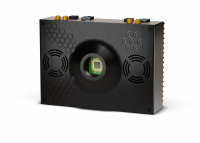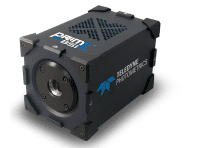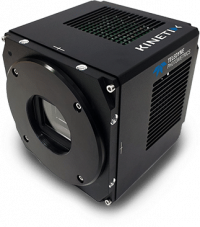


Prime 95B Series | Low Noise sCMOS Camera
Sensor Technology
sCMOS
Quantum Efficiency
95%
Readout Noise
1.6 e-
Resolution
11 µm x 11 µm pixels
Speed
80 FPS (at 12-bit)
Interface
PCle, USB 3.0
 Description
 Specifications
 QE Curve
 Applications
 Downloads
Teledyne Photometrics Prime 95B from Axiom Optics
Back-illuminated sCMOS camera with 95% QE for low-light imaging
The Teledyne Photometrics Prime 95B is a high-sensitivity scientific CMOS camera built on a back-illuminated sensor with over 95% peak quantum efficiency and large 11 µm pixels. Teledyne Photometrics introduced it as the first back-illuminated sCMOS camera, designed to outperform EMCCD cameras in signal-to-noise while delivering a larger field of view and faster frame rates.
With 1.6 e- median read noise, an 80,000 e- full well in 16-bit HDR mode, and full-frame rates up to 82 fps, the Prime 95B is a workhorse for single-molecule localization, spinning disk confocal, live-cell, calcium imaging, and astronomy. Three sensor formats, 18.7 mm, 22 mm, and 25 mm on the diagonal, let the camera fill the field of any modern research microscope. Axiom Optics supplies the Prime 95B with application support for microscopy and low-light imaging systems.
Interactive tool
Field of view and Nyquist sampling on your microscope
Choose a Prime 95B format and objective to see the field of view at the sample, the size of each pixel projected onto the specimen, and whether the 11 µm pixels sample the optical resolution. The drawing shows each sensor to scale inside 22 mm and 25 mm microscope fields.
Undersampled, light-efficient
Field and photon collection take priority over fine detail. This suits screening, counting, and calcium imaging, where signal and coverage matter more than resolution.
Undersampled, light-efficient
Field and photon collection take priority over fine detail. This suits screening, counting, and calcium imaging, where signal and coverage matter more than resolution.
Undersampled, light-efficient
Field and photon collection take priority over fine detail. This suits screening, counting, and calcium imaging, where signal and coverage matter more than resolution.
Slightly undersampled
Pixels set the resolution limit here. A 1.6x relay or magnification changer reaches Nyquist; staying at native magnification keeps more signal per pixel.
Nyquist sampled
Each pixel is about half the optical resolution, so the camera captures everything the objective resolves with no relay optics.
Undersampled, light-efficient
Field and photon collection take priority over fine detail. This suits screening, counting, and calcium imaging, where signal and coverage matter more than resolution.
Undersampled, light-efficient
Field and photon collection take priority over fine detail. This suits screening, counting, and calcium imaging, where signal and coverage matter more than resolution.
Undersampled, light-efficient
Field and photon collection take priority over fine detail. This suits screening, counting, and calcium imaging, where signal and coverage matter more than resolution.
Slightly undersampled
Pixels set the resolution limit here. A 1.6x relay or magnification changer reaches Nyquist; staying at native magnification keeps more signal per pixel.
Nyquist sampled
Each pixel is about half the optical resolution, so the camera captures everything the objective resolves with no relay optics.
Resolution uses the Rayleigh criterion at 520 nm emission, typical of GFP. Nyquist sampling needs about two pixels per resolution element. Field of view assumes a 1x camera adapter and a field number large enough for the sensor.

Multiple fields of view
The Prime 95B is offered with 18.8, 22, or 25 mm diagonal fields of view. The larger formats increase throughput and data capture per frame, and take full advantage of new, larger field of view microscopes.
Interactive comparison
Prime 95B vs. EMCCD: signal-to-noise at low light
EMCCD cameras remove read noise with on-chip gain, but the multiplication itself adds noise that acts like halving the quantum efficiency. The Prime 95B avoids that penalty with 95% QE and very low read noise. Choose a signal level to compare.

Back-illuminated for up to 95% QE
In a back-illuminated sensor, photons reach the light-sensitive silicon without passing through wiring layers, so nearly every incident photon becomes signal. Unlike microlens-based QE gains, which fall off at high magnification, back-illumination holds its efficiency at any objective.
Combined with 11 µm pixels, Teledyne Photometrics reports that the Prime 95B captures over 300% more signal than standard sCMOS cameras at 100x magnification, while avoiding the EM gain calibration, excess noise, and sensor aging of EMCCDs.
At this extreme photon level the EMCCD leads by 49%. The crossover is about 3.4 photons per pixel. Bars show signal-to-noise as a share of a perfect, noise-free detector.
At this extreme photon level the EMCCD leads by 3%. The crossover is about 3.4 photons per pixel. Bars show signal-to-noise as a share of a perfect, noise-free detector.
Prime 95B leads the EMCCD by 22% in signal-to-noise. Bars show signal-to-noise as a share of a perfect, noise-free detector.
Prime 95B leads the EMCCD by 34% in signal-to-noise. Bars show signal-to-noise as a share of a perfect, noise-free detector.
Prime 95B leads the EMCCD by 39% in signal-to-noise. Bars show signal-to-noise as a share of a perfect, noise-free detector.
Prime 95B leads the EMCCD by 41% in signal-to-noise. Bars show signal-to-noise as a share of a perfect, noise-free detector.
Model: Prime 95B at 95% QE and 1.8 e- rms read noise; EMCCD at 95% QE with an excess noise factor of √2 and negligible read noise at high gain. Dark current and clock-induced charge are ignored, which is realistic for millisecond exposures.
Interactive explorer
Frame rate by format, region of interest, and readout mode
A rolling-shutter sCMOS reads row by row, so cropping the number of rows raises the frame rate almost proportionally. Pick a format, a region of interest, and a readout mode to see the datasheet frame rate.
Frame rates from the Teledyne Photometrics datasheets over PCIe. Sensitivity mode uses the high-gain 12-bit channel; HDR mode combines both gains into a 16-bit image with an 80,000 e- full well and 50,000:1 dynamic range.
Prime 95B formats compared
Every Prime 95B shares the same 11 µm back-illuminated pixel, over 95% peak QE, 1.6 e- median read noise, and 80,000 e- HDR full well. The formats differ in field of view, speed, and lens mount.
| Model | Array | Sensor area | Diagonal | Full frame, 12 / 16-bit | Mount |
|---|---|---|---|---|---|
| Prime 95B | 1200 x 1200 (1.44 MP) | 13.2 x 13.2 mm | 18.7 mm | 82 / 41 fps | C-mount |
| Prime 95B 22mm | 1412 x 1412 (2.0 MP) | 15.5 x 15.5 mm | 22 mm | 68 / 34 fps | C-mount |
| Prime 95B 25mm | 1608 x 1608 (2.58 MP) | 17.69 x 17.69 mm | 25 mm | 60 / 30 fps | F-mount |
Need smaller pixels for low-magnification objectives or more speed over a large field? Compare the Prime BSI, Kinetix, and the full scientific CMOS lineup.
Application guide
Where the Prime 95B excels
Single-molecule localization and tracking
Localization precision scales with the number of photons collected per molecule, so the Prime 95B pairs over 95% peak quantum efficiency with 11 µm pixels that gather more light per pixel than small-pixel sCMOS. On the Plus Features configuration, Teledyne Photometrics adds PrimeLocate, which finds and transfers only the regions around detected molecules for faster live tracking, and PrimeEnhance real-time denoising.
Spinning disk, re-scan confocal, and live-cell imaging
Live-cell work runs on a tight photon budget: every extra photon of excitation adds phototoxicity and bleaching. High QE lets the same image come from less light, and multiple Expose Out lines can switch up to four light sources in step with the sensor. SMART Streaming cycles through up to 16 preprogrammed exposure times for multi-probe acquisition without software overhead.
Calcium imaging and fast physiology
Neural and cardiac signals are both dim and fast. In 12-bit sensitivity mode the Prime 95B reaches 82 fps across its full 1200 x 1200 array and up to 737 fps on a 128-row region of interest, so frame rate can follow the biology without binning away resolution.
Multiphoton and adaptive optics microscopy
Scattering tissue returns very few photons, which is where high QE and low read noise pay off most. Combined with adaptive optics that correct sample-induced aberrations, the Prime 95B keeps faint signal above the noise floor at depth.
Astronomy, lucky imaging, and space situational awareness
Large 11 µm pixels match the plate scale of many telescopes, and low read noise makes short-exposure lucky imaging and fast tracking practical. The 22 mm and 25 mm formats add field without changing pixel size, and 16-bit HDR mode holds bright stars and faint targets in the same frame.
UV and broadband imaging
Teledyne Photometrics lists the Prime 95B spectral response from 200 nm in the UV through 1000 nm in the near infrared, so a single back-illuminated sensor covers UV fluorescence, visible, and NIR work. Axiom Optics can help match the camera to UV optics and sources.
Acquisition features built for quantitative imaging

Superior background quality
Pattern Noise Reduction and Correlated Noise Reduction technologies produce clean, pattern-free images with minimal pixel defects, which matters most in the low-light images the Prime 95B is built for.
Teledyne Photometrics: control of noise and background in sCMOS

PrimeLocate, Multi-ROI, and PrimeEnhance
Two data reduction technologies keep throughput high. PrimeLocate finds single molecules on the camera and transfers only the regions around them, and can be extended to live particle tracking for real-time observation of molecular movement. Multi-ROI reads several regions of interest in one frame.
PrimeEnhance active denoising gives a real-time, quantitative increase in signal-to-noise by reducing the effect of photon shot noise at low light levels. These features are offered on the Plus Features configuration.

Advanced triggering with SMART Streaming
Sequenced Multiple Acquisition Real Time (SMART) Streaming captures continuously while cycling through up to 16 preset exposure times, enabling rapid multi-channel acquisition without software overhead.
Up to four Expose Out signals drive light sources directly from the camera, in step with the rolling shutter or an effective global shutter window.
Effective global shutter
The All Rows output mode signals when every row is exposing at once, letting pulsed illumination behave like a global shutter.
PCIe and USB 3.0
Both interfaces deliver the full frame rate on the Prime 95B, with the PVCAM SDK, Ocular software, and broad third-party support.
Quantitative 16-bit HDR
True 16-bit dynamic range captures faint and bright signals in the same image with photon-noise-limited performance.
Prime 95B frequently asked questions
What is the Prime 95B camera?
The Prime 95B from Teledyne Photometrics is a back-illuminated scientific CMOS (sCMOS) camera with over 95% peak quantum efficiency, 11 µm pixels, and 1.6 e- median read noise. Teledyne Photometrics introduced it as the first back-illuminated sCMOS camera. It is offered in three formats with 18.7 mm, 22 mm, and 25 mm sensor diagonals, and Axiom Optics supplies and supports it.
Is the Prime 95B better than an EMCCD camera?
For most low-light imaging, yes. An EMCCD multiplies away read noise but adds an excess noise factor of about 1.4, which halves its effective quantum efficiency. With 95% QE and 1.8 e- rms read noise, the Prime 95B delivers higher signal-to-noise than an EMCCD above roughly 3.4 photons per pixel, while offering a larger field of view, higher frame rates, and no EM gain aging. EMCCD still leads at true single-photon levels.
Why does the Prime 95B use 11 µm pixels?
Larger pixels collect more photons each, which raises signal-to-noise in light-starved imaging. At high magnification they also sample the image correctly: with a 100x 1.45 NA objective, each 11 µm pixel covers 110 nm at the sample, which is Nyquist sampling for green emission without extra relay optics.
Which Prime 95B model should I choose?
All three models share the same 11 µm pixel, QE, and read noise. The Prime 95B (1200 x 1200, 18.7 mm diagonal) has the highest full-frame speed. The 22mm model (1412 x 1412) adds field on a C-mount, and the 25mm model (1608 x 1608, F-mount) fills the 25 mm field of modern research microscopes such as the Nikon ECLIPSE Ti2.
How fast is the Prime 95B?
The Prime 95B runs at 82 fps full frame in 12-bit sensitivity mode and 41 fps in 16-bit HDR mode. Reducing the region of interest raises the rate, up to 737 fps at 1200 x 128 pixels in sensitivity mode. Teledyne Photometrics specifies no frame rate change between the PCIe and USB 3.0 interfaces.
What is the difference between sensitivity and HDR modes?
Sensitivity mode reads out at 12-bit with the fastest frame rates and the lowest-noise high-gain channel, ideal for dim, fast samples. HDR mode combines high and low gain into a 16-bit image with an 80,000 e- full well, so bright and dim features can be quantified in the same frame.
What software works with the Prime 95B?
Teledyne Photometrics supports the Prime 95B with the PVCAM SDK and driver and its Ocular acquisition software, along with a wide range of third-party imaging packages. Ask Axiom Optics to confirm compatibility with your microscope control software.
How does the Prime 95B compare with the Prime BSI and Kinetix?
The Prime BSI and Kinetix use smaller pixels, which suit lower magnification objectives and higher resolution sampling, and the Kinetix is built for very high speed over a large field. The Prime 95B is the choice when sensitivity per pixel matters most, such as single-molecule imaging, spinning disk confocal, and high-magnification live-cell work.
Configure your Prime 95B
Axiom Optics imaging specialists can recommend the right format, cooling, and interface for your microscope or telescope and integrate it with your light sources and optics.