
Supercontinuum Lasers
Unlike traditional lasers, which emit light at specific wavelengths or colors, supercontinuum lasers produce an extremely broad and continuous spectrum of light. The generation of a supercontinuum spectrum typically involves nonlinear optical effects such as self-phase modulation, cross-phase modulation, and four-wave mixing in a specially designed optical fiber. These nonlinear effects cause the input laser light to undergo spectral broadening, resulting in an ultra broadband output.
We offer the entire range of supercontinuum laser sources and accessories manufactured by FYLA, a well known leader in the field, located in Valencia, Spain. Founded in 2014, FYLA has been offering compact supercontinuum solutions to universities, research institutes and industry worldwide.
Here are some key characteristics and features of FYLA supercontinuum lasers:
- Broad Spectrum, for example 410 – 2300 nm for VIS-IR
- Tunable: we offer a full line of plug-and-play tunable filters to adjust the central wavelength and spectral bandwidth of the generated spectrum
- Pulse duration from a few ps to a few hundred ps
- Adjustable repetition rates, from 500 kHz to 40 MHz
- Total power up to to 4 W
Supercontinuum sources have revolutionized several scientific and industrial fields due to their versatility and the ability to provide a continuous, broad spectrum of light in a compact and reliable form.
FYLA supercontinuum laser sources are currently used in:
- Biomedical imaging (OCT)
- Fluorescence microscopy (confocal, multiphoton, lifetime, CARS)
- Spectroscopy
- Metrology of optical components
- Materials characterization
Compare the FYLA Supercontinuum Lasers
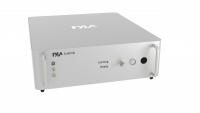
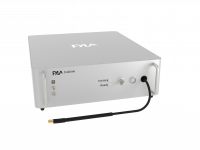
Axiom Optics offers three FYLA supercontinuum white-light lasers. All three deliver an ultra-broadband, spatially coherent beam across the visible and near-infrared and share the same TTL (SMA) interface and beam diameters, so the choice comes down to spectral coverage, output power, pulse repetition rate, and spectral flatness. The table below summarizes the differences; full specifications are on each product page.
| Model | Spectral range | Output power | Cooling | Best suited for |
|---|---|---|---|---|
| Iceblink Pro V1 | 410 to 2300 nm | > 2 W at 40 MHz | Air cooling, TEC-cooled | High repetition rate for fast imaging and scanning |
| Iceblink V3 | 450 to 2300 nm | ≥ 3 W | Air cooling, TEC-cooled | A cost-effective high-power broadband source |
| Horizon V2 | 410 to 2300 nm | ≥ 4 W | Air cooling, TEC-cooled | Highest power and a flat spectrum for even output across the band |
All three share a TTL (SMA) trigger interface and the same beam diameters (≤ 2 mm at 470 nm, ≤ 2.5 mm at 580 nm, ≤ 3.5 mm at 725 nm, and ≤ 5.5 mm at 1150 nm). To select a single wavelength or band from any of them, add a plug-and-play tunable filter.
Supercontinuum Laser FAQs
What is a supercontinuum laser?
A supercontinuum laser produces an extremely broad, continuous spectrum of light rather than a single wavelength. It works by sending ultrafast laser pulses into a specially designed nonlinear optical fiber, where effects such as self-phase modulation, cross-phase modulation, and four-wave mixing broaden the narrow input into an ultra-broadband output. The result combines the brightness and spatial coherence of a laser with the broad spectral coverage of a lamp.
Which FYLA supercontinuum laser should I choose?
It depends on spectral range, power, repetition rate, and flatness. The Iceblink Pro V1 (410 to 2300 nm, more than 2 W at 40 MHz) suits fast, high-repetition-rate imaging; the Iceblink V3 (450 to 2300 nm, at least 3 W) is a cost-effective high-power option; and the Horizon V2 (410 to 2300 nm, at least 4 W) offers the highest power and a flat spectrum for even output across the band. Sharing the wavelengths, power, and timing the application needs will narrow it quickly.
What wavelength range do these lasers cover?
All three FYLA models cover the visible and near-infrared. The Iceblink Pro V1 and Horizon V2 span 410 to 2300 nm, and the Iceblink V3 spans 450 to 2300 nm. This VIS-to-SWIR coverage lets a single source address applications that would otherwise require several lasers at different wavelengths.
Can I select a single wavelength from a supercontinuum laser?
Yes. Because the spectrum is continuous, a tunable filter can select any central wavelength and spectral bandwidth from the beam. FYLA offers a full line of plug-and-play tunable filters for this, which is what allows one supercontinuum laser to replace a rack of single-wavelength sources in imaging and spectroscopy setups.
What are supercontinuum lasers used for?
They are used across biomedical imaging such as optical coherence tomography (OCT); fluorescence microscopy including confocal, multiphoton, lifetime, and CARS; spectroscopy; metrology of optical components; and materials characterization. Their combination of broad, continuous spectrum, high brightness, and spatial coherence makes them versatile enough to serve many of these roles from a single compact instrument.
What pulse durations and repetition rates are available?
FYLA supercontinuum lasers provide pulse durations from a few picoseconds to a few hundred picoseconds and adjustable repetition rates from 500 kHz up to 40 MHz, with total power up to 4 W. Higher repetition rates suit fast imaging and scanning, while the adjustable range allows the source to be matched to the timing and signal requirements of the measurement.
How is a supercontinuum laser different from an OPO?
Both are broadband laser sources, but they work differently and suit different needs. A supercontinuum laser generates a continuous spectrum in a nonlinear fiber and is typically filtered to select bands, while an optical parametric oscillator (OPO) generates tunable narrowband output through a parametric process. For a fuller comparison, see the article on supercontinuum lasers versus OPOs linked on this page.
More on Supercontinuum Lasers
Visit application pageBlogs
