SPAD Cameras & Arrays
Each SPAD in the camera array is assigned a unique address, allowing individual SPADs to be accessed and controlled independently. This addressing scheme enables selective readout of specific SPADs or groups of SPADs within the array, providing flexibility in data acquisition and analysis.
The main advantage of using a SPAD array is the ability to perform spatially resolved photon detection. By detecting photons across multiple locations simultaneously, it allows for the capture of detailed spatial information about the incoming light. This is particularly useful in applications such as imaging, where the spatial distribution of photons can be used to construct images or maps.
1,000 fps” placeholder, which is contradicted by
SPADλ’s own 555,000 fps spec. Pull real per-model rates from Pi Imaging datasheets
before adding a frame-rate column. –>
Compare SPAD Cameras and Arrays
Axiom Optics offers three single-photon avalanche diode detectors from Pi Imaging Technology. All three deliver true photon counting with zero readout noise across the visible range on the same SPAD platform, addressed over USB. The geometry of the sensor is what separates them, a line, a small cluster, or a full two-dimensional array, each matched to a different class of measurement. Full specifications and datasheets are available on each product page.
| Model | Geometry | Pixels | Pixel pitch | Distinguishing strength | Best suited for |
|---|---|---|---|---|---|
| SPADλ | Linear array | 320 x 1 | 29 µm | Up to 555,000 fps with nanosecond gating and 20 ps time tagging | Spectrally resolved single-photon detection, flow cytometry, time-resolved spectroscopy, Raman |
| pSPAD | Small array | 23 | 23 x 19.9 µm | Photon counting and time stamping with extremely low crosstalk | Photon correlation, photon number resolving, quantum optics, timing experiments |
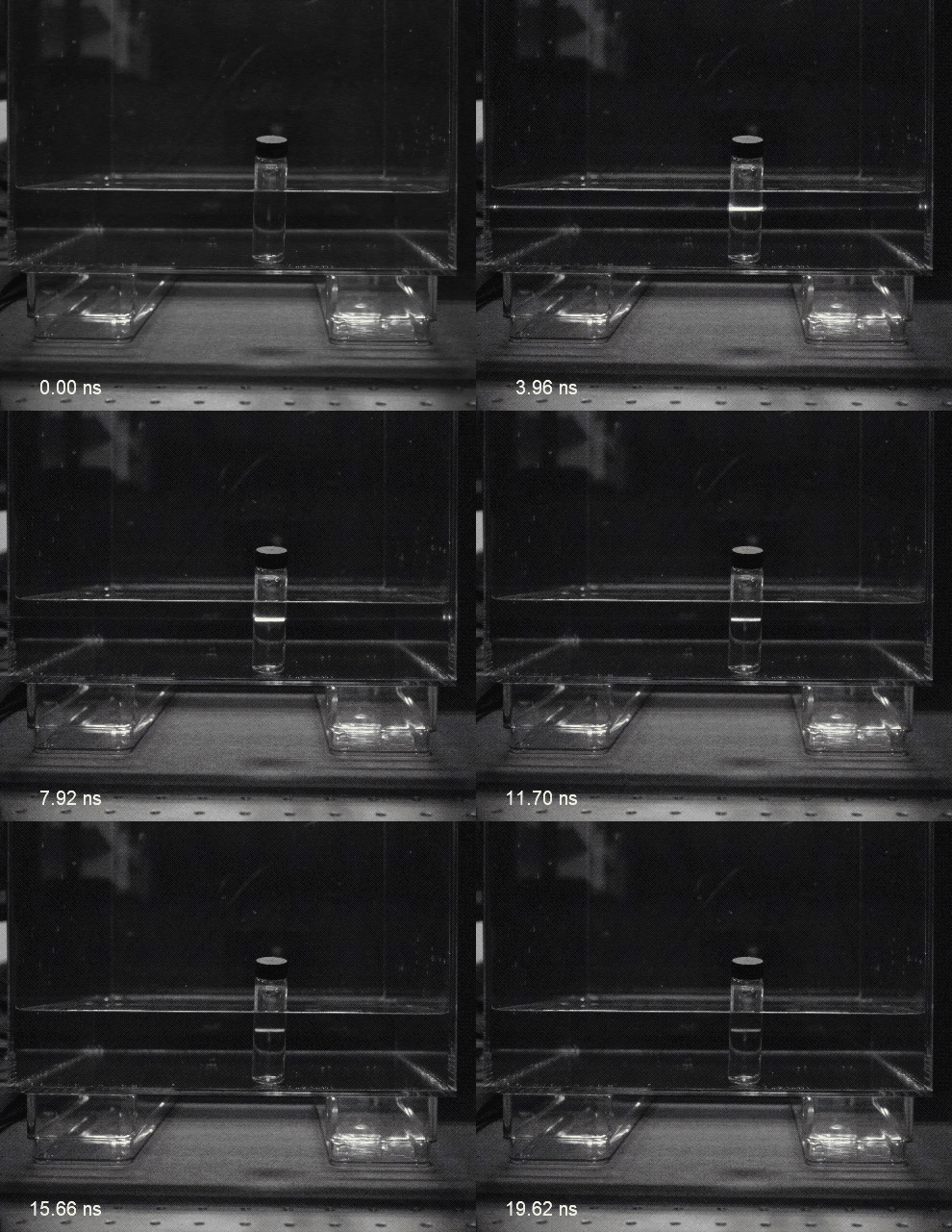
| SPAD512 / SPADα | Area array | 512 x 512 (0.3 MP) | 16.4 µm | Full two-dimensional single-photon imaging with integrated gating | Wide-field FLIM, super-resolution microscopy, quantum imaging, light-in-flight |
In short: choose SPADλ when the measurement is spectral or one-dimensional and speed matters, pSPAD when the priority is photon correlation and timing across a few clean channels, and SPAD512 when the application needs a full two-dimensional image.
SPAD Camera and Array FAQs
What is a SPAD, and how is it different from an APD or a PMT?
A single-photon avalanche diode is a semiconductor detector biased above its breakdown voltage so that a single photon triggers a self-sustaining avalanche, producing a clear digital pulse. Compared with a photomultiplier tube, a SPAD is more sensitive over a wider spectral range, has better timing resolution, and is far more compact and robust. Compared with a conventional avalanche photodiode, a SPAD has higher detection efficiency and generates fewer dark counts, and it counts individual photons directly rather than measuring an analog current.
Which SPAD detector should I choose?
It depends on the shape of the measurement. Choose the linear SPADλ for spectrally resolved detection, flow cytometry, and one-dimensional high-speed work. Choose the small pSPAD array for photon correlation, photon number resolving, and timing experiments that need a few very clean channels. Choose the SPAD512 area array when the application requires a full two-dimensional single-photon image, such as wide-field lifetime imaging or quantum imaging.
What is the difference between time gating and time tagging?
Time gating opens a short detection window at a precise, adjustable delay after a trigger, so stepping the window through time reconstructs a fast signal such as a fluorescence decay. Time tagging instead records the arrival time of every detected photon, producing a timestamped stream used for correlation and lifetime analysis. Gating is well suited to phasor and gated-decay measurements, while tagging suits photon correlation and time-correlated single-photon counting.
What does zero readout noise mean in practice?
Because a SPAD produces a digital pulse for each detected photon rather than an analog signal that must be amplified and read out, there is no read noise added during readout. This means frames can be acquired extremely quickly with no noise penalty, and very faint signals are limited only by photon statistics and dark counts rather than by sensor electronics. It is the property that lets SPAD detectors combine single-photon sensitivity with very high frame rates.
Do SPAD detectors need cooling?
Not necessarily. SPAD dark count rates are low enough that many applications run without deep cooling, and the detectors here specify low dark counts at their operating conditions. Cooling reduces dark counts further and can help in the most demanding low-signal or long-integration measurements, but for high-flux, gated, or high-speed work it is often unnecessary. Match the need for cooling to how faint and how long the measurement is.
What is photon detection probability?
Photon detection probability, or PDP, is the likelihood that a photon reaching the sensor triggers a count, making it the SPAD counterpart to quantum efficiency. It depends on wavelength and on the excess bias applied above breakdown, so raising the bias increases PDP at the cost of more dark counts. When comparing detectors, check PDP at the specific working wavelength rather than the peak value alone.
What applications use SPAD cameras and arrays?
SPAD detectors are used across fluorescence lifetime imaging, confocal and super-resolution microscopy, flow cytometry, Raman and time-resolved spectroscopy, quantum optics and quantum key distribution, single-photon LIDAR and ranging, and high-speed low-light imaging including light-in-flight. The right sensor geometry depends on the application: linear arrays for spectral and scanning work, small arrays for correlation and timing, and area arrays for wide-field imaging.
View our Camera Catalog
 Click to view
Blogs
Scientific Camera Buyers Guide
Imaging with very few photons: EMCCD, sCMOS, and SPAD Detectors
Imaging and measuring fluorescence lifetime with the SPAD512S camera
Watch Our Videos