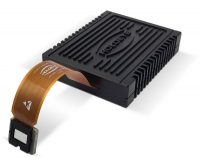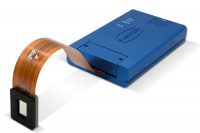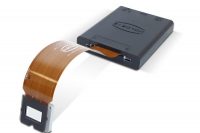


PLUTO-2.1 | Most Versatile 1080p Phase LCOS SLM
Display Type
Reflective LCOS (Phase Only)
Resolution
1920 x 1080
Pixel Pitch
8.0 µm
Fill Factor
93%
Active Area
15.36 x 8.64 mm (0.7" diagonal)
Signal Formats
HDMI - HDTV Resolution
 Description
 Specifications
 Applications
 Videos
 Downloads
 Publications
- Software
- More Information
- Drawings
Discover Advanced Light Control with the PLUTO-2.1 LCOS Spatial Light Modulator
The PLUTO-2.1 LCOS Spatial Light Modulator (SLM) stands out as a versatile and widely applicable product. It’s an adaptable SLM platform with numerous configurations tailored for specific needs, including versions with a dielectric mirror for enhanced reflectivity in high-power applications. The PLUTO hardware has already been successfully integrated into various industrial settings.
The PLUTO-2.1 is a phase-only SLM. It features a driver unit that connects via a standard HDMI digital video interface and a phase-only LCOS (Liquid Crystal on Silicon) microdisplay. This microdisplay boasts Full HD resolution (1920 x 1080 pixels) and an 8 µm pixel pitch, resulting in a 0.7-inch active area diagonal with a 16:9 aspect ratio.
This plug-and-play phase modulator allows users to input phase functions through standard graphics cards, treating it as an extended monitor. The green color channel of the video signal is utilized for addressing 8-bit gray level patterns. Users can address the device using the included Pattern Generator software, the SLM Slideshow Player software, or conventional image viewing software. HOLOEYE also provides an SLM Display Software Development Kit (SDK), which offers APIs (Application Programming Interfaces) for various programming languages.
HOLOEYE offers several display versions compatible with the PLUTO-2.1 driver unit. These different panel versions are optimized for specific wavelength ranges and applications. All versions benefit from fast, fully digital addressing, ensuring high reliability and a compact driver unit by minimizing the required voltage generation.
The PLUTO-2.1 driver uses an HDMI interface for addressing phase functions and a USB connection for communication. This USB connection allows users to adjust parameters like voltage vs. gray level distribution (gamma control) and dynamic range (voltage across the LC cell), enabling calibration for different wavelengths. Additionally, the driver includes a trigger sync output to synchronize the device with external equipment.
A notable feature of the PLUTO-2.1 driver is its dual-core ARM® Cortex™-A9 processor with integrated on-chip memory. This empowers users to program additional functionalities that are processed directly on the SLM device, such as running a slideshow from images loaded via a USB flash drive or internal memory. The dual-core system operates on an embedded Linux™ SMP operating system and includes a library for comprehensive control and supervision of the display and driver board. The PLUTO-2.1 offers access via Serial and Ethernet-over-USB2 (RNDIS) interfaces and can be programmed using a standard Ubuntu™ cross-compile GCC toolchain.
Standard PLUTO displays offer a reflectivity ranging from approximately 65% to 95% (depending on the specific version) and achieve diffraction efficiencies exceeding 80%.
Product Versions:
The PLUTO-2.1 is available in various configurations to optimize performance for specific needs. See more under the “specifications” tab:
- Standard PLUTO-VIS & PLUTO-NIR: Ideal for visible and near-infrared spectrum applications.
- High Retardation (-HR) Versions: Provides increased phase retardation for superior stability in addressing or for executing mod 4π/mod 6π phase functions.
- Wavelength-Optimized Models: Specialized versions are fine-tuned for operation across broad wavelength ranges, from ultraviolet (350 – 500 nm) to short-wave infrared (1700 – 2500 nm).

PLUTO-2.1 Software

Addressing the PLUTO-2.1 is as straightforward as managing an external monitor via its DVI/HDMI interface. The device comes with a suite of intuitive software:
- Configuration Manager Software: Allows for easy adjustment of geometrical settings, brightness, contrast, and electro-optical response.
- HOLOEYE SLM Pattern Generator: Facilitates the creation of computer-generated holograms (CGH) and fundamental optical functions such as lenses, gratings, axicons, and vortices, with the ability to superimpose CGHs.
- SLM Slideshow Player: Included for dynamic presentations and sequence playback.
- SLM Display SDK: A comprehensive Software Development Kit provides APIs compatible with popular programming languages, including LabVIEW, MATLAB, Octave, Python, and C/C++, enabling extensive custom development.
PLUTO 2.1 SLM Kit – Contents
Your PLUTO-2.1 SLM comes with:
- Phase only display including flex cable
- Driver unit
- Device mount
- Display mount
- Power supply + cable
- USB/mini usb cable
- HDMI cable
- Safety instructions & quick start guide (test polarizer inside)
- USB flash drive with software package and documentation