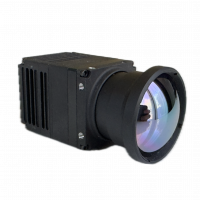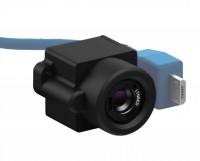


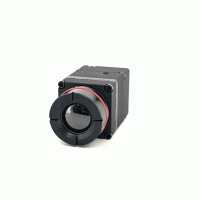


Ernest 6 | VGA 640×480 Low SWaP LWIR Thermal Camera
Spectral range
8 - 14 µm
Resolution - Pitch - FPS
640x480 px - 12 µm - 60 Hz
NEdT
35mk (typ.)
Interface
UVC (USB Video Class)
Radiometry
Optional: -10º to +120ºC
SOM/OS compatibility
Windows 10/11, Linux x64 and ARM, NVIDIA Jetson, Raspberry Pi
HFOVs
86º, 48º, 33º, 23º, 12º, no lens
Available (w/o license) in:
🇺🇸 (ships from 🇺🇸); 🇪🇺,🇨🇦, 🇦🇺, 🇳🇿, 🇮🇸, 🇯🇵, 🇨🇭, 🇬🇧, 🇳🇴 (ships from 🇫🇷)
 Description
 Specifications
 Pictures
 Videos
 Downloads
 Publications
 Software
 Lenses
Meet Ernest 6, member of the SeeCube small thermal camera core family
Introducing the Ernest 6, a standout in Senssight’s SeeCube family, engineered to set a new standard in VGA thermal infrared camera cores. Featuring a 640×480 pixel array with a 12 μm pixel pitch and exceptional thermal sensitivity of 35 mK, this small thermal camera delivers precise imaging in an industry-leading 21 x 21 mm form factor. Equipped with a 60 Hz frame rate, a range of lens options offering 15° to 90° HFOV, and radiometric capabilities covering -10°C to 120°C, the Ernest 6 excels in demanding applications. Its low-power USB interface, optional shutterless calibration, and robust -35°C to 75°C operating range make it an ideal solution for industrial systems, night vision equipment, and unmanned aerial vehicles. Compact yet powerful, the Ernest 6 is designed for professionals who require reliability and performance without compromise.
The Ernest 6 LWIR thermal camera offers three operational modes in a single, streamlined package. Its built-in mechanical shutter ensures precise shuttered performance, while a factory calibration enables exceptional image quality in shutterless mode, thus adapting effortlessly to diverse conditions. Additionally, pixel-level radiometric calibration enables accurate temperature measurements from -10ºC to +120ºC. The Ernest 6 combine cutting-edge technology with a remarkably efficient design, setting a new standard in thermal imaging excellence.
SeeCube family in a nutshell
Which SeeCube Camera Fits Your System?
All three SeeCube cores share the same 12 micron pixel pitch, 60 Hz frame rate, 35 mK thermal sensitivity, USB UVC interface, and three operating modes. Resolution and physical size are the entire decision.
| Model | Resolution | Shared specifications | Choose it when |
|---|---|---|---|
| Eileen 3 | QVGA 320 x 240 | 12 µm pitch, 60 Hz, 35 mK, UVC over USB, shuttered / shutterless / radiometric | Cost and size dominate, and the scene is close or the target is large |
| Ernest 6 (this page) | VGA 640 x 480 | 12 µm pitch, 60 Hz, 35 mK, UVC over USB, shuttered / shutterless / radiometric | The balanced choice: four times the pixels of QVGA in a 21 x 21 mm core, with five USB connector options |
| Niels 12 | SXGA 1280 x 1024 | 12 µm pitch, 60 Hz full frame, 35 mK, USB, shuttered / shutterless / radiometric | Maximum detail or range is required, and the extra size and data rate are acceptable |
Because pixel pitch is identical across the family, moving up in resolution widens the field of view at a given lens rather than magnifying the scene: an Ernest 6 sees four times the area an Eileen 3 sees through the same optic, at the same detail per pixel. Choosing between them is therefore a question of how much scene must be covered at once, not how sharp the image is.
See the full LWIR thermal cameras and cores lineup for radiometric and industrial thermography options beyond the SeeCube family.
-
Redefining low SWaP-C
Optimized for size (21 x 21 mm X,Y), weight (<20 g without lens) and power (<400 mW) with a competitive price tag.

-
3 modes of operation
- Shuttered (PN: E6_xx_xx_xx_N):
- An embedded mechanical shutter located between the sensor and the lens is activated for on-the-fly flat-field corrections (FFC).
- As the sensor temperature changes (time to reach thermal equilibrium, changes in environmental temperature etc), the uniformity of the sensor’s response also changes and a flat-field correction is necessary.
- A flat-field correction essentially consists of an offset and gain correction for each pixel in order to have a homogeneous intensity distribution (or flat-field) when looking at a black body, in this case the metal surface of the mechanical shutter itself.
- The FFC is activated automatically by setting a time delay (ms) or sensor temperature difference (ºC/K) or manually by calling a function of the SDK.

Shutterless (PN: E6_xx_xx_xx_SL+):
- This mode requires a shutterless factory calibration during which the entire camera with its lens is placed in a thermal chamber to simulate a change of environmental temperature (and therefore sensor temperature) in a controlled fashion.
- The thermal chamber temperature is varied between ~+10ºC and +60ºC.
- The calibration consists of acquiring data with the camera facing a black body as the thermal chamber temperature changes.
- The result of this calibration is a unique set of correction files that are specific to each camera.
- These files are contained in a folder called data. When using the camera in shutterless operation, the image quality remains the same despite changes in the sensor temperature.

Radiometric shutterless (PN: E6_xx_xx_xx_R1):
- This mode requires an additional calibration layer on top of the shutterless calibration.
- A black body with a temperature range of ~+5ºC to +120ºC is used to make the correspondence between pixel intensity and absolute temperature (in ºK or ºC).
- The temperature measurement is guaranteed with an accuracy of +/-2°C or 2% (typical). In this mode, the camera returns a thermal frame in 32-bit floats.

-
USB interface
Direct connection to with USB connectivity – No need for an external power supply – multiple USB connector options on Ernest 6 only
 |
 |
 |
 |
 |
| USB-C / female / straight | USB-C / female / right angle | USB-C / male / right angle | USB-A Micro / female / straight | USB flex cable |
-
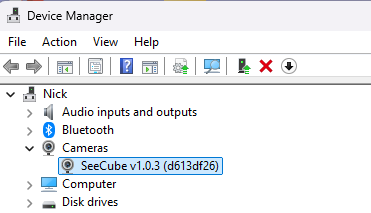
UVC protocol (USB Video Class)
Webcam-like for experience for easy integration and plug-and-play feeling
-
High sensitivity
NEdT of 35 mK w/o denoising or filtering
-
Free C++ SDK with OpenCV sample app
OpenCV based application and C++ API for Windows 10/11, Linux, Linux for ARM (Nvidia Jetson, Raspberry Pi OS)
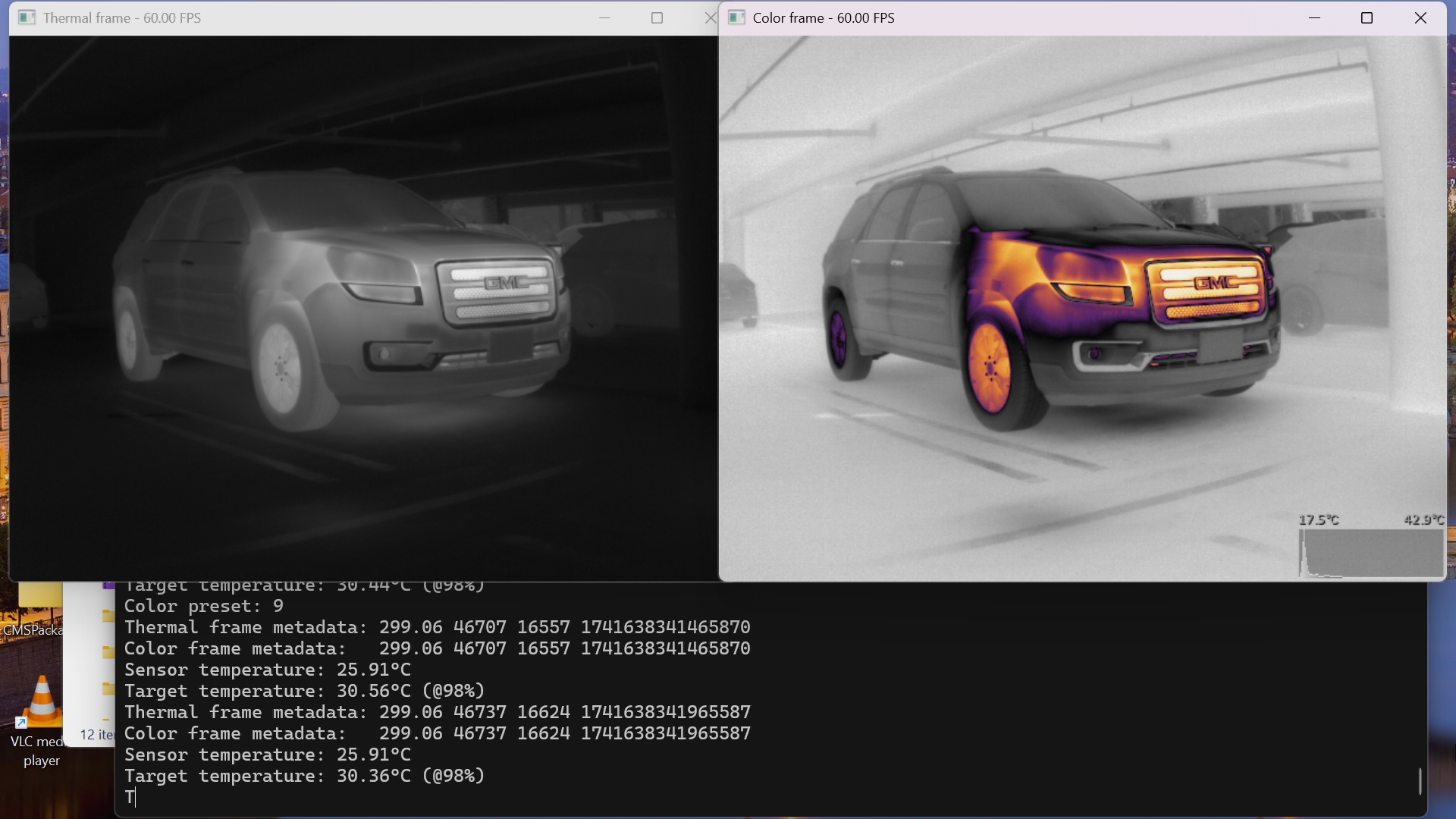
Webcam-like device – UVC (USB Video Class device)
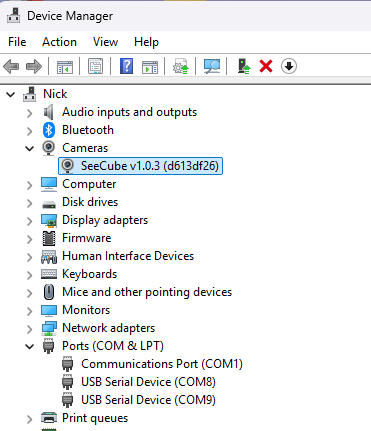
SeeCube OpenCV app (for Windows 10/11, Linux, Linux for ARM)
Easy-to-use app allowing the user to:
- open/close shutter
- enable/disable shutterless correction
- change mapping mode (full scale, automatic min/max, manual, histogram equalization, adaptive mapping)
- change color mapping / LUT
- acquire 1-point NUC by covering the lens
- acquire 1-point NUC by shutter activation
- enable/disable temporal filtering
- save still images (uncompressed + color)
- save videos (uncompressed + color)
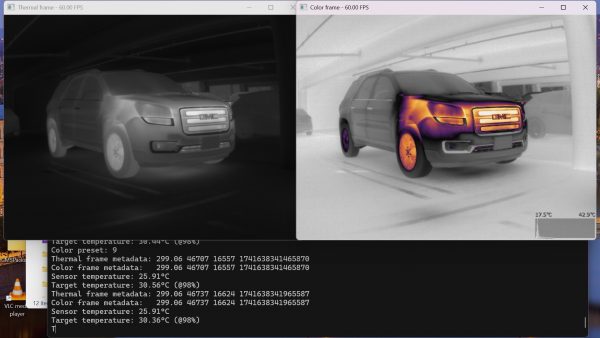
- SeeCube C++ API (for Windows 10/11, Linux, Linux for ARM)
Note: drawings with USB-C straight configuration