






Lambda Beam Series | Compact High-Performance CW Laser | 375 – 1550 nm
Available Wavelengths
375nm - 1064nm
Output Power
Up to 1W
Modulation
Up to 1.5MHz
Polarization
Linear
Power Stability
<1% (10h)
Fiber Coupling
Optional
European Availability
Available at Axiom Optics Europe
 Description
 Specifications
 Applications
 Downloads
 Publications
Lambda Beam CW Laser: A Compact, High-Performance Modulatable Laser
The Lambda Beam CW laser is a high-performance, modulatable laser source with a compact footprint. Made in Germany by RGB Photonics, it delivers output powers up to 1000 mW at more than 50 wavelengths from 375 to 1064 nm, with high durability and excellent beam quality.
Combined with a range of system integration options, the Lambda Beam offers the flexibility to serve industrial, scientific and medical applications alike, from fluorescence excitation and Raman spectroscopy to machine vision, metrology and OEM instruments. Axiom Optics helps you choose the wavelength, power, controller and options for your system.


Key Features
- Adjustable power output, up to 1 W
- Collimated beam output or fiber coupled
- High beam quality and stability
- Temperature-stabilized, fine-tunable wavelength
- Modulation up to 1.5 MHz
- Broad selection of wavelengths
- Long lifetime
- Threads for mounting
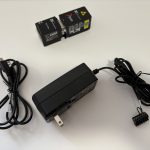
- Power supply included

Lambda Beam wavelength and power finder
51 wavelengths from 375 to 1064 nm. Choose a band, then a wavelength, to see every power version RGB Photonics offers.
Single-mode (TEM00) powers: 20, 70 mW
Multi-mode option: 200 mW.
Diode emission can deviate by about ±5 nm (±1 nm on request) and is fine-tunable by temperature.
No Wavelock version at this wavelength.
Single-mode (TEM00) powers: 50, 120 mW
Diode emission can deviate by about ±5 nm (±1 nm on request) and is fine-tunable by temperature.
No Wavelock version at this wavelength.
Single-mode (TEM00) powers: 40, 75, 125, 175, 200, 300 mW
Multi-mode options: 500, 1000 mW.
Water cooler recommended at 300, 500, 1000 mW.
Diode emission can deviate by about ±5 nm (±1 nm on request) and is fine-tunable by temperature.
Wavelock version available at this wavelength.
Single-mode (TEM00) powers: 50, 120 mW
Diode emission can deviate by about ±5 nm (±1 nm on request) and is fine-tunable by temperature.
No Wavelock version at this wavelength.
Single-mode (TEM00) powers: 50 mW
Diode emission can deviate by about ±5 nm (±1 nm on request) and is fine-tunable by temperature.
No Wavelock version at this wavelength.
Single-mode (TEM00) powers: 120 mW
Diode emission can deviate by about ±5 nm (±1 nm on request) and is fine-tunable by temperature.
No Wavelock version at this wavelength.
Single-mode (TEM00) powers: 50 mW
Diode emission can deviate by about ±5 nm (±1 nm on request) and is fine-tunable by temperature.
No Wavelock version at this wavelength.
Single-mode (TEM00) powers: 50 mW
Diode emission can deviate by about ±5 nm (±1 nm on request) and is fine-tunable by temperature.
No Wavelock version at this wavelength.
Single-mode (TEM00) powers: 50 mW
Diode emission can deviate by about ±5 nm (±1 nm on request) and is fine-tunable by temperature.
No Wavelock version at this wavelength.
Single-mode (TEM00) powers: 50 mW
Diode emission can deviate by about ±5 nm (±1 nm on request) and is fine-tunable by temperature.
No Wavelock version at this wavelength.
Single-mode (TEM00) powers: 50, 100 mW
Multi-mode options: 500, 1000 mW.
Water cooler recommended at 500, 1000 mW.
Diode emission can deviate by about ±5 nm (±1 nm on request) and is fine-tunable by temperature.
No Wavelock version at this wavelength.
Single-mode (TEM00) powers: 75 mW
Multi-mode option: 1000 mW.
Water cooler recommended at 1000 mW.
Diode emission can deviate by about ±5 nm (±1 nm on request) and is fine-tunable by temperature.
No Wavelock version at this wavelength.
Single-mode (TEM00) powers: 50, 100 mW
Diode emission can deviate by about ±5 nm (±1 nm on request) and is fine-tunable by temperature.
No Wavelock version at this wavelength.
Single-mode (TEM00) powers: 50 mW
Diode emission can deviate by about ±5 nm (±1 nm on request) and is fine-tunable by temperature.
No Wavelock version at this wavelength.
Single-mode (TEM00) powers: 50 mW
Diode emission can deviate by about ±5 nm (±1 nm on request) and is fine-tunable by temperature.
No Wavelock version at this wavelength.
Single-mode (TEM00) powers: 50 mW
Diode emission can deviate by about ±5 nm (±1 nm on request) and is fine-tunable by temperature.
No Wavelock version at this wavelength.
Single-mode (TEM00) powers: 100 mW
Diode emission can deviate by about ±5 nm (±1 nm on request) and is fine-tunable by temperature.
No Wavelock version at this wavelength.
Single-mode (TEM00) powers: 50, 200 mW
Diode emission can deviate by about ±5 nm (±1 nm on request) and is fine-tunable by temperature.
No Wavelock version at this wavelength.
Single-mode (TEM00) powers: 75 mW
Diode emission can deviate by about ±5 nm (±1 nm on request) and is fine-tunable by temperature.
No Wavelock version at this wavelength.
Single-mode (TEM00) powers: 75 mW
Diode emission can deviate by about ±5 nm (±1 nm on request) and is fine-tunable by temperature.
No Wavelock version at this wavelength.
Single-mode (TEM00) powers: 25, 75 mW
Diode emission can deviate by about ±5 nm (±1 nm on request) and is fine-tunable by temperature.
No Wavelock version at this wavelength.
Single-mode (TEM00) powers: 50, 80, 120 mW
Multi-mode option: 500 mW.
Water cooler recommended at 500 mW.
Diode emission can deviate by about ±5 nm (±1 nm on request) and is fine-tunable by temperature.
No Wavelock version at this wavelength.
Single-mode (TEM00) powers: 75, 100, 125, 175, 200 mW
532 nm is a DPSS laser, available with the PowerBox controller only; narrow line versions at 125, 175 and 200 mW. Not temperature tunable.
No Wavelock version at this wavelength.
Single-mode (TEM00) powers: 75 mW
Diode emission can deviate by about ±5 nm (±1 nm on request) and is fine-tunable by temperature.
Wavelock version available at this wavelength.
Single-mode (TEM00) powers: 75, 125 mW
Diode emission can deviate by about ±5 nm (±1 nm on request) and is fine-tunable by temperature.
No Wavelock version at this wavelength.
Single-mode (TEM00) powers: 75, 125, 175 mW
Multi-mode options: 250, 500 mW.
Water cooler recommended at 250, 500 mW.
Diode emission can deviate by about ±5 nm (±1 nm on request) and is fine-tunable by temperature.
Wavelock version available at this wavelength.
Single-mode (TEM00) powers: 75, 150 mW
Diode emission can deviate by about ±5 nm (±1 nm on request) and is fine-tunable by temperature.
No Wavelock version at this wavelength.
Single-mode (TEM00) powers: multi-mode only
Multi-mode option: 150 mW.
Diode emission can deviate by about ±5 nm (±1 nm on request) and is fine-tunable by temperature.
No Wavelock version at this wavelength.
Single-mode (TEM00) powers: 75, 120, 200 mW
Diode emission can deviate by about ±5 nm (±1 nm on request) and is fine-tunable by temperature.
No Wavelock version at this wavelength.
Single-mode (TEM00) powers: 15 mW
Multi-mode option: 250 mW.
Water cooler recommended at 250 mW.
Diode emission can deviate by about ±5 nm (±1 nm on request) and is fine-tunable by temperature.
No Wavelock version at this wavelength.
Single-mode (TEM00) powers: 200 mW
Diode emission can deviate by about ±5 nm (±1 nm on request) and is fine-tunable by temperature.
No Wavelock version at this wavelength.
Single-mode (TEM00) powers: 40 mW
Diode emission can deviate by about ±5 nm (±1 nm on request) and is fine-tunable by temperature.
Wavelock version available at this wavelength.
Single-mode (TEM00) powers: 30 mW
Diode emission can deviate by about ±5 nm (±1 nm on request) and is fine-tunable by temperature.
No Wavelock version at this wavelength.
Single-mode (TEM00) powers: 40 mW
Diode emission can deviate by about ±5 nm (±1 nm on request) and is fine-tunable by temperature.
No Wavelock version at this wavelength.
Single-mode (TEM00) powers: 40 mW
Diode emission can deviate by about ±5 nm (±1 nm on request) and is fine-tunable by temperature.
No Wavelock version at this wavelength.
Single-mode (TEM00) powers: 10 mW
Diode emission can deviate by about ±5 nm (±1 nm on request) and is fine-tunable by temperature.
No Wavelock version at this wavelength.
Single-mode (TEM00) powers: 50 mW
Diode emission can deviate by about ±5 nm (±1 nm on request) and is fine-tunable by temperature.
No Wavelock version at this wavelength.
Single-mode (TEM00) powers: 100, 200, 300, 400 mW
Water cooler recommended at 300, 400 mW.
Diode emission can deviate by about ±5 nm (±1 nm on request) and is fine-tunable by temperature.
Wavelock version available at this wavelength.
Single-mode (TEM00) powers: multi-mode only
Multi-mode option: 500 mW.
Water cooler recommended at 500 mW.
Diode emission can deviate by about ±5 nm (±1 nm on request) and is fine-tunable by temperature.
No Wavelock version at this wavelength.
Single-mode (TEM00) powers: 75, 150 mW
Multi-mode option: 1000 mW.
Water cooler recommended at 1000 mW.
Diode emission can deviate by about ±5 nm (±1 nm on request) and is fine-tunable by temperature.
Wavelock version available at this wavelength.
Single-mode (TEM00) powers: 100 mW
Diode emission can deviate by about ±5 nm (±1 nm on request) and is fine-tunable by temperature.
No Wavelock version at this wavelength.
Single-mode (TEM00) powers: 200 mW
Diode emission can deviate by about ±5 nm (±1 nm on request) and is fine-tunable by temperature.
No Wavelock version at this wavelength.
Single-mode (TEM00) powers: 45, 75, 125, 225 mW
Multi-mode option: 1000 mW.
Water cooler recommended at 1000 mW.
Diode emission can deviate by about ±5 nm (±1 nm on request) and is fine-tunable by temperature.
No Wavelock version at this wavelength.
Single-mode (TEM00) powers: 50, 175 mW
Diode emission can deviate by about ±5 nm (±1 nm on request) and is fine-tunable by temperature.
No Wavelock version at this wavelength.
Single-mode (TEM00) powers: 75, 125 mW
Diode emission can deviate by about ±5 nm (±1 nm on request) and is fine-tunable by temperature.
Wavelock version available at this wavelength.
Single-mode (TEM00) powers: 10 mW
Diode emission can deviate by about ±5 nm (±1 nm on request) and is fine-tunable by temperature.
No Wavelock version at this wavelength.
Single-mode (TEM00) powers: 10, 175 mW
Diode emission can deviate by about ±5 nm (±1 nm on request) and is fine-tunable by temperature.
No Wavelock version at this wavelength.
Single-mode (TEM00) powers: 75, 125, 175, 250 mW
Multi-mode option: 1000 mW.
Water cooler recommended at 250, 1000 mW.
Diode emission can deviate by about ±5 nm (±1 nm on request) and is fine-tunable by temperature.
No Wavelock version at this wavelength.
Single-mode (TEM00) powers: 75, 125, 175, 250 mW
Multi-mode option: 200 mW.
Water cooler recommended at 250 mW.
Diode emission can deviate by about ±5 nm (±1 nm on request) and is fine-tunable by temperature.
No Wavelock version at this wavelength.
Single-mode (TEM00) powers: 75, 125, 175, 250 mW
Multi-mode option: 1000 mW.
Water cooler recommended at 1000 mW.
Diode emission can deviate by about ±5 nm (±1 nm on request) and is fine-tunable by temperature.
No Wavelock version at this wavelength.
Single-mode (TEM00) powers: 125, 175, 300, 450 mW
Multi-mode option: 1000 mW.
Water cooler recommended at 300, 450, 1000 mW.
Diode emission can deviate by about ±5 nm (±1 nm on request) and is fine-tunable by temperature.
No Wavelock version at this wavelength.
Choose a wavelength in this band.
From the RGB Photonics Lambda Beam datasheet (February 2023). Tick marks show every available wavelength. Configurations change; Axiom Optics confirms availability with each quote.
Laser Control Options
The Lambda Beam laser head requires a laser controller to provide power and control all operating parameters. For scientific applications and prototyping, Axiom Optics recommends the Power Controller. For industrial integration, the highly compact PowerBox attaches directly to the laser head or connects through a customized cable. The 532 nm DPSS laser is available only with the PowerBox.

The Power Controller has three status indicators, a USB interface, a modulation mode switch and a key switch with time delay; its back panel holds connectors for the laser head, modulation input and power supply. The PowerBox attaches to the laser head with a locking connector; its back panel holds a six-pin screw terminal block, a USB port and two coaxial modulation inputs.

Power Controller or PowerBox?
Choose the Power Controller
A benchtop controller (85 x 85 x 32.5 mm) with three status indicators, USB, a modulation mode switch, a key switch with time delay and interlock. It includes a 100-240 VAC power supply and modulates up to 0.5 MHz.
Choose the PowerBox
A 39 x 39 x 32.5 mm controller that locks directly onto the laser head or connects by custom cable. It takes 12-36 V DC, offers a six-pin screw terminal, USB and two coaxial modulation inputs.
Choose the PowerBox
The PowerBox accepts analog or digital external modulation up to 1.5 MHz. For fast, stable switching of the beam itself, RGB Photonics recommends an acousto-optic modulator.
Choose the PowerBox
The 532 nm DPSS laser is available only with the PowerBox controller.
Choose your setup.
Lambda Beam Wavelock: Highly Stabilized CW Laser for Raman Spectroscopy
The Wavelock option provides exceptionally stable single-mode emission with wavelength stability below 0.015 nm and a spectral linewidth below 0.05 pm, for Raman spectroscopy and other high-resolution applications. Wavelock is available at 405, 633, 638, 640, 658, 685, 785, 808 and 852 nm, and works with either the Power Controller or the PowerBox, as well as Lambda Beam accessories such as a shutter, cooling elements and a fiber coupler.

Convenient Optional Fiber Coupling
Any Lambda Beam system can be equipped with a fiber coupler that launches the collimated beam into a single-mode polarization-maintaining fiber, or into non-polarization-maintaining and multi-mode fibers. Because the best coupling efficiency demands micrometer precision, the coupler carries multiple positioning screws to center the beam on the fiber and to set the focal point on the fiber face.

Beam size and irradiance at distance
Estimate the collimated beam’s size and average irradiance downrange.
Estimate using a 1.2 mm round beam and the <1.2 mrad divergence from the datasheet, added in quadrature. Actual beam size varies by wavelength (elliptical beams of 1.1 x 2.2 to 1.2 x 4.3 mm for some diodes). Always follow laser safety requirements; outputs above 500 mW are Class 4.
Lambda Beam Key Specifications
- Wavelengths
- 375-1064 nm, diode and 532 nm DPSS
- Output power
- Up to 1000 mW (wavelength dependent)
- Beam mode
- TEM00 (except multi-mode versions)
- Divergence
- <1.2 mrad
- Polarization
- Linear
- Noise
- <2% RMS
- Pointing stability
- <5 µrad/K
- Temperature accuracy
- <10 mK
- Modulation
- Up to 1.5 MHz (PowerBox), 0.5 MHz (Power Controller)
- Warm-up
- Ready in 5 s, calibrated operation after 5 min
- Laser head
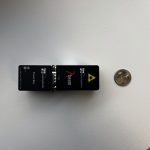
- 63.5 x 31 x 32.5 mm, 94 g
- Operating temperature
- 0 to 45 °C, non-condensing
- Software
- Ltune for Windows, communication protocol for custom software
Values from the RGB Photonics Lambda Beam datasheet.
Lambda Beam FAQ
What is the Lambda Beam CW laser?
Lambda Beam is a compact, high-performance, modulatable continuous-wave laser module made in Germany by RGB Photonics. It is available at more than 50 wavelengths from 375 to 1064 nm with output powers up to 1 W, with collimated or fiber-coupled output.
Which wavelengths are available?
RGB Photonics offers Lambda Beam diode lasers from 375 nm in the UV through blue, green, red and near infrared wavelengths to 1064 nm, plus a 532 nm DPSS laser. Diode wavelengths can deviate by about ±5 nm (±1 nm on request) and can be fine-tuned by temperature.
How fast can the Lambda Beam be modulated?
With the PowerBox controller, analog or digital external modulation reaches 1.5 MHz. The Power Controller supports analog and digital 0-5 V modulation up to 0.5 MHz. For fast, stable switching, an acousto-optic modulator is recommended.
What is the difference between the Power Controller and the PowerBox?
The Power Controller is a benchtop unit for scientific use and prototyping, with status indicators, a key switch, interlock and a modulation mode switch. The PowerBox is a compact 39 x 39 mm controller for industrial integration that locks onto the laser head and supports modulation up to 1.5 MHz. The 532 nm DPSS laser is available only with the PowerBox.
What is the Lambda Beam Wavelock?
Wavelock is a highly stabilized single-mode version with wavelength stability below 0.015 nm and a spectral linewidth below 0.05 pm, for Raman spectroscopy and high-resolution applications. It is available at 405, 633, 638, 640, 658, 685, 785, 808 and 852 nm.
Can the Lambda Beam be fiber coupled?
Yes. An optional fiber coupler couples the collimated beam into a single-mode polarization-maintaining fiber, or into non-polarization-maintaining and multi-mode fibers, with positioning screws to center the beam and set the focus on the fiber face.
What are the Lambda Beam's beam specifications?
RGB Photonics specifies divergence below 1.2 mrad, TEM00 mode except for multi-mode versions, linear polarization, noise below 2% RMS, pointing stability below 5 µrad/K and temperature control accuracy below 10 mK. The laser head measures 63.5 x 31 x 32.5 mm and weighs 94 g.
Can I buy a Lambda Beam online?
Selected Lambda Beam wavelengths and powers are available from the Axiom Optics online store, and every configuration is available by quote.
Configure your Lambda Beam
Send your wavelength, power and integration needs. Axiom Optics will confirm the configuration, controller and options.
CW Laser Applications
Confocal Microscopy

Confocal microscopy is a sophisticated optical imaging technique that creates highly detailed images of samples. This technique employs laser beams for point illumination, directed through an excitation pinhole to then pass through various lenses within the microscope’s optical path to be focused onto a single point of the sample.
Upon excitation, fluorescence emitted from the sample travels back through lenses to a detector. Since a pinhole is placed in front of the detector, only light from the focal point at the sample is imaged, rejecting out-of-focus light, and thus imaging very sharp sections of the sample at a time. By scanning the laser across the sample, complete images can be reconstructed from numerous individual measurements. This process results in high-resolution, detailed visualization of structures like cells or tissues.
Dynamic Light Scattering (DLS) / Photon Correlation Spectroscopy

Dynamic Light Scattering (also known as Photon Correlation Spectroscopy) is a technique used to determine size of particles in a solution. When coherent and monochromatic laser light illuminates particles (such as proteins), it scatters in all directions. An interferometer is then employed to measure the distances between the scattering centers (i.e., the particles). Because particles in a fluid are in constant Brownian motion, their distances continually change, leading to interference patterns and fluctuations in scattering intensity. By analyzing these fluctuations, the speed of the particles and their diffusion coefficient can be determined. The autocorrelation function, derived from these measurements, allows for the calculation of particle parameters, which in turn enables the determination of the particle’s hydrodynamic radius (size) using the Stokes-Einstein equation. These results can indirectly provide information about the molar mass of the measured particles. This technique is widely used in protein analysis.
Michelson Interferometer

The Michelson interferometer, named after physicist Albert A. Michelson, leverages the phenomenon of interference, which is observable with coherent light sources like lasers. Its fundamental design involves splitting a single light wave into two distinct parts. These two waves then travel along different paths, resulting in different propagation times. When they recombine after being reflected by mirrors, interference occurs. By altering the optical path length of one of the waves—for example, by moving one of the mirrors—the phases of the two waves shift relative to each other, thereby changing the interference pattern. Measuring the intensity of the resulting wave allows for the detection of even minute changes in the path difference between the two waves. A practical application of this precision is in measuring the thermal expansion of materials, where even the slightest expansion can be accurately detected.
Flow Cytometry

Flow cytometry is a powerful analytical method for the qualitative and quantitative assessment of cells. In this process, cells are rapidly drawn into a flow system, with over 1000 cells per second individually passing through a path illuminated by a laser beam. Depending on their unique characteristics, these cells emit fluorescence. Different fluorescence wavelengths (e.g., red, yellow, green, blue) can yield various types of information.
A forward scatter detector can be used to measure light diffraction, providing data on the cell’s volume. A side scatter detector, which measures light refraction at right angles, helps determine cell size, the structure of the cell nucleus, the number of vesicles, and cellular granularity. Specialized Fluorescence-activated Cell Sorting (FACS) devices can then separate cells based on these characteristics. An example application of flow cytometry is the separation of sperm cells carrying X or Y chromosomes to influence the sex of an embryo in in vitro fertilization.
Advancements in Raman Spectroscopy

Historically, highly sensitive analyses using Raman spectroscopy often relied on costly and sometimes unreliable methods like Surface-Enhanced Raman Scattering (SERS). However, a recent breakthrough by a materials science research team has led to the development of a method promising a 50-fold increase in performance.
Raman measurements fundamentally involve a laser interacting with a sample placed on a specialized substrate. The research team’s innovation lies in a novel substrate composed of various materials with synergistic properties. This substrate incorporates four plasmonic nanostructures, including gold and silver particles, which generate a strong light-matter interaction known as plasmonic effects. When combined with a photocatalytic titanium-oxide layer, a photocatalytic effect is introduced, intensifying the Raman signal by a factor of 50. This advancement significantly enhances the precision and speed of sample analysis. A notable feature of this substrate is its reusability; it can be cleaned with UV light and used up to 20 times, leading to substantial cost reductions.
Energy Transfer Upconversion (ETU)

Energy Transfer Upconversion (ETU) is a physical phenomenon where a laser-active ion is excited to an energy level higher than what would be achieved by simple absorption of a single pump photon. The additional energy required for this upconversion is transferred from another laser-active ion.
The Institute of Chemistry at the University of Basel, for instance, utilizes a customized Lambda Beam laser system for ETU studies. Through a specific lens arrangement, this laser can achieve a very high power density despite having an output power of only 40mW, making it particularly suitable for upconversion research.
Molography

Molography, specifically focal molography, is a nanotechnology-based technique that ingeniously integrates photolithography, molecular self-assembly, and cutting-edge optical technology.
In this process, a 785nm RGB laser light wave interacts with antibodies. A portion of the light is diffracted (redirected) at a specific angle, which is determined by the spacing of the antibody lines. A patented biosensor developed by lino Biotech AG evaluates the resulting light pattern. This technology finds applications in various fields, including quality control for cell and gene therapies, drug screening in living cells, and point-of-care diagnostics in healthcare.
Ltune Laser Control Software
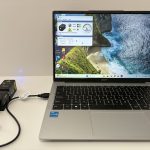
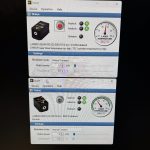
The Lambda Beam uses a USB interface for remote control. The laser can be controlled either via the Ltune Windows application (included) or with the user’s custom software via serial communication.
The Ltune software for Windows can be used to configure and control the laser. The software features:
• Modulation mode selection
• Output power adjustment
• Display of the laser status, configuration and operating hours
• Temperature display and adjustment

Lambda Beam technical drawing
