Hyperspectral Cameras
What is a Hyperspectral Camera?
Hyperspectral cameras are advanced imaging systems that go beyond what the human eye and traditional cameras can perceive. Unlike standard cameras that capture images in three broad color bands (red, green, and blue), a hyperspectral camera collects and processes information from across the electromagnetic spectrum, typically in hundreds of narrow, contiguous spectral bands. This allows for the acquisition of a unique “spectral fingerprint” for every pixel in an image, providing detailed insights into the composition and characteristics of objects and materials. Essentially, a hyperspectral camera combines the power of digital imaging with spectroscopy, yielding a rich, three-dimensional data cube where two dimensions represent spatial extent and the third represents spectral content.
Compare Hyperspectral Cameras
The table below summarizes every hyperspectral camera in the Axiom Optics lineup. Cubert ULTRIS models are snapshot cameras that capture the full spectral data cube in a single exposure, while HinaLea models use fast Fabry-Perot tunable filters that let the user define the bands of interest. Full specifications and datasheets are available on each product page.
| Model | Technology | Spectral range and bands | Spatial resolution and speed | Best suited for |
|---|---|---|---|---|
| ULTRIS X20 | Snapshot light field, GigE | 350 to 1000 nm, 164 bands | 410 x 410 px at 8 Hz | UV-VIS-NIR hyperspectral video from a 20 MP sensor |
| ULTRIS X20 Plus | Snapshot light field, GigE | 350 to 1000 nm, 164 bands | 1886 x 1886 px at 4 Hz | High resolution aerial mapping and drone integration |
| ULTRIS XMR | Snapshot light field, USB | 430 to 910 nm | 1000 x 1000 px at 80 Hz | High spatial resolution and high speed in one compact package |
| ULTRIS 5 | Snapshot light field, GigE | 450 to 850 nm, 51 bands | 290 x 275 px at 75 Hz | Affordable, compact real-time hyperspectral video |
| ULTRIS SWIR 1 | Snapshot light field, USB | 980 to 1650 nm | 200 x 200 px at 80 Hz | Snapshot SWIR imaging for moisture, plastics, and material sorting |
| HinaLea VNIR Pro | Fabry-Perot tunable filter, USB | 400 to 1000 nm, 300 bands at 4 nm | 1920 x 1200 px, 10 to 100 fps | High resolution VIS-NIR imaging with user defined bands for industrial inspection |
| HinaLea VSWIR Pro | Fabry-Perot tunable filter | 500 to 1700 nm, 300 bands at 4 nm | See product page | Broad VIS through SWIR coverage in a single camera |
| HinaLea SWIR Pro | Fabry-Perot tunable filter | 900 to 1700 nm, 108 bands at 10 nm | 640 x 512 px | SWIR imaging with real-time classification |
| HinaLea XSWIR Pro | Fabry-Perot tunable filter | 1300 to 2100 nm, 225 bands at 15 nm | 640 x 512 px | Extended SWIR detection beyond the reach of standard InGaAs |
Also imaging in fewer, targeted bands? See the multispectral cameras lineup, which trades spectral density for speed and simplicity.
Hyperspectral Camera FAQs
What is the difference between hyperspectral and multispectral cameras?
Hyperspectral cameras capture tens to hundreds of narrow, contiguous spectral bands, producing a continuous spectrum for every pixel that can identify materials by their spectral fingerprint. Multispectral cameras capture a handful of discrete, wider bands chosen in advance, which makes them faster, simpler, and more affordable when the application only needs known wavelengths, such as established vegetation indices or a specific contaminant signature.
Should I choose a snapshot or a tunable filter hyperspectral camera?
Snapshot cameras acquire the full data cube in a single exposure, so they handle moving scenes, handheld use, and drone flight without spectral misregistration. Tunable filter cameras scan through wavelengths sequentially and let the user define exactly which bands to record, delivering more bands at finer resolution for stationary samples. Motion favors snapshot; spectral density and flexibility favor tunable filter.
What spectral range do I need?
It depends on where the target materials differ. Color, pigment, and vegetation features appear in the VIS-NIR range of 400 to 1000 nm. Water content, plastics, and many chemical signatures only become visible in the SWIR between 900 and 1700 nm, and some materials require extended SWIR coverage to 2100 nm. When available reference spectra of the target materials are inconclusive, testing samples on candidate cameras settles the question quickly.
Do hyperspectral cameras need special lighting?
They need illumination that contains energy in every band being measured. Broadband halogen sources are the standard choice indoors, and sunlight works well for outdoor and airborne acquisition. Common white LEDs are unsuitable because their output is spiky in the visible and nearly absent in the SWIR. Stable, diffuse, evenly distributed lighting also improves classification repeatability.
How is hyperspectral data analyzed?
Each acquisition produces a data cube with two spatial dimensions and one spectral dimension, so every pixel carries a full spectrum. Analysis typically involves calibrating to reflectance, then applying classification, spectral unmixing, or index calculations to identify and map materials. Both Cubert and HinaLea systems include acquisition and classification software, with SDKs available for building custom processing pipelines, including real-time classification on supported models.
Can hyperspectral cameras fly on drones?
Yes, and snapshot cameras are particularly well suited to it because every frame is a complete, motion-artifact-free data cube. The ULTRIS X20 Plus is designed specifically for UAV integration and high resolution aerial mapping, pairing 1886 x 1886 pixel spatial resolution with the weight and interface constraints of common drone payloads for agriculture, environmental monitoring, and geology.
Diverse Applications of Hyperspectral Cameras
The ability of a hyperspectral camera to identify and quantify materials based on their unique spectral signatures opens up a vast array of applications across numerous industries. These include, but are not limited to:
- Agriculture: Monitoring crop health, detecting early signs of disease or stress, assessing nutrient levels, optimizing irrigation, and predicting yields. It can also be used for seed viability studies and detecting subtle bruises on fruits before they are visually apparent.
- Environmental Monitoring: Tracking changes in land use, vegetation health, water quality, and pollution detection. It aids in conservation efforts and mapping geological features.
- Food Quality & Safety: Identifying contaminants, assessing ripeness, freshness, and quality of food products, detecting adulteration, and ensuring consistent product quality in processing lines.
- Mining & Mineral Exploration: Rapid and non-destructive mapping of mineral deposits, assessing ore grades, and identifying specific mineral compositions, reducing the need for extensive drilling.
- Medical & Biomedical Imaging: Assisting in disease diagnosis, analyzing wounds, and guiding surgeries by providing detailed tissue composition information.
- Recycling & Waste Management: Efficiently sorting various materials like plastics and textiles based on their chemical composition, improving recycling processes.
- Art & Forensics: Analyzing the composition of materials in artworks for authentication and conservation, detecting hidden details, and aiding in forensic investigations by analyzing trace evidence.
- Defense & Security: Enabling reconnaissance and surveillance missions by identifying hidden objects and materials, and assisting in the detection of landmines.
- Industrial Machine Vision: Enhancing quality control and inspection processes by detecting subtle differences in materials and identifying defects invisible to conventional systems.
Introducing Our Range of High-Performance Hyperspectral Cameras
Axiom Optics partners with leading manufacturers to bring you a comprehensive selection of high-performance hyperspectral cameras, designed to meet diverse application needs.
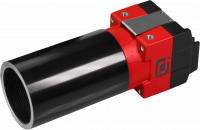
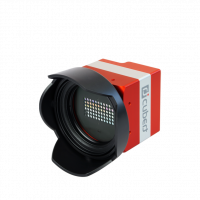
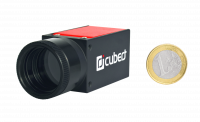
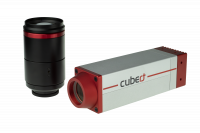
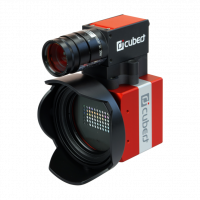
Cubert ULTRIS Hyperspectral Cameras: Leveraging innovative light field technology, Cubert ULTRIS hyperspectral cameras redefine real-time imaging with their exceptional spatial and spectral resolution, compactness, and speed.
- ULTRIS X20 | UV-VIS-NIR Hyperspectral Imaging Camera: This model is the world’s first UV-VIS-NIR hyperspectral video imager, spanning 350-1000 nm with 164 spectral bands and an Ultra-HD 20 MPixel CMOS sensor.
- ULTRIS X20 Plus | High-Resolution Hyperspectral Camera for Drones: An advanced version of the X20, optimized for high-resolution aerial mapping and drone integration.
- ULTRIS XMR | Advanced Hyperspectral Snapshot Camera: This camera provides high spectral and spatial resolution in a robust package, ideal for demanding industrial and scientific applications.
- ULTRIS 5 | Affordable & Compact Hyperspectral Video Camera: A compact and affordable hyperspectral camera featuring a 5 MP sensor and covering 450-850 nm with 51 spectral bands, ideal for real-time analysis in various settings.
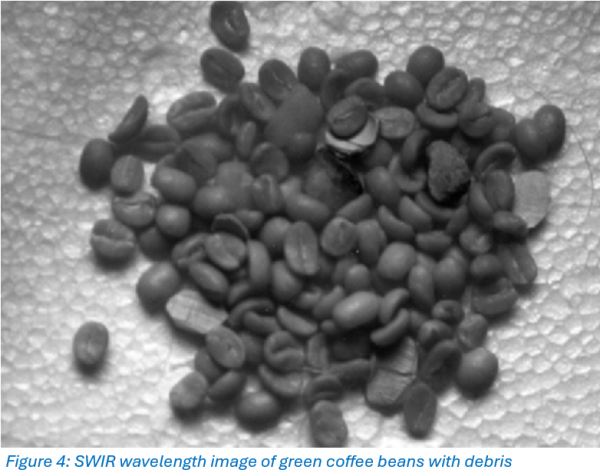
- ULTRIS SWIR 1 | Hyperspectral Snapshot SWIR Camera: This model extends hyperspectral imaging into the Short-Wave Infrared (SWIR) range, enabling applications requiring detection beyond the visible and near-infrared spectrum.
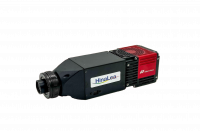
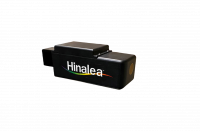
HinaLea Imaging Hyperspectral Cameras: Axiom Optics proudly offers hyperspectral cameras from HinaLea Imaging, which allow the user to define the spectral bands of interests (number and peak wavelength) using a fast Fabry Perot tunable filtering technology.
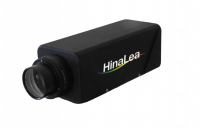
- HinaLea 4250: This hyperspectral camera offers imaging from 400 nm up to 1,000 nm, delivering spectral resolution datasets of 4 nm across 300 spectral bands.
- HinaLea 4200C: This compact and lightweight camera covers the 400-1000 nm spectral range with 300 spectral bands and 4 nm (FWHM) spectral resolution.
- HinaLea 4400 SWIR: This model provides imaging from 900-1700 nm with a spectral resolution of 10 nm across 108 spectral bands, featuring real-time imaging and classification.
- HinaLea 4455 XSWIR: Offering extended capabilities, the 4455 XSWIR provides a spectral resolution of 15 nm across 225 bands from 1120-2100 nm, also with real-time imaging.
Both HinaLea and Cubert ULTRIS models offer cutting-edge solutions for your advanced hyperspectral imaging needs, supported by powerful software and robust SDKs for seamless integration.