Multispectral Cameras
Multispectral Cameras for Advanced Imaging
Our multispectral cameras span visible (VIS), near-infrared (NIR), and SWIR bands to deliver comprehensive imaging solutions. From precision agriculture to environmental monitoring and industrial inspection, these cameras provide unmatched versatility and performance. Browse our range to find the right system for your application.
What is a Multispectral Camera?
A multispectral camera is an advanced imaging device designed to capture light across multiple specific spectral bands, extending beyond the visible light spectrum that human eyes perceive. Unlike standard cameras that typically capture red, green, and blue light, multispectral cameras employ specialized filters, often in a custom Bayer-like mosaic pattern, integrated onto commercial sensors. Each cell in this filter is precisely engineered to capture a distinct spectral band. For example, some models can divide an image into numerous bands within ranges like the Short-Wave Infrared (SWIR). This capability allows them to reveal details and properties of objects or environments that are invisible to the naked eye, leading to enhanced detection, analysis, and precision in various applications.
Applications of Multispectral Cameras
Multispectral cameras are highly versatile tools, providing critical insights across a wide array of fields:
- Agriculture: Essential for precision farming, enabling detailed monitoring of crop health, early detection of plant diseases, assessment of water stress, and optimization of irrigation and fertilization strategies.
- Environmental Monitoring: Used to track ecological changes, monitor forest health, analyze water quality, map pollution, and assess the impact of climate change.
- Military and Defense: Employed for reconnaissance, target identification, camouflage detection, and surveillance by revealing hidden objects or activities through their unique spectral signatures.
- Industrial Machine Vision & Quality Control: Applied in manufacturing for defect detection, material sorting, process monitoring, and ensuring product quality in industries ranging from food processing to semiconductor production.
- Medical Imaging: Provide deeper insights into biological tissues, aiding in disease diagnosis, monitoring treatment efficacy, and non-invasive assessment of various medical conditions.
- Art and Archaeology: Utilized for the non-destructive examination of historical artifacts, revealing faded texts, hidden layers in paintings, and providing insights into artistic techniques or archaeological sites.
- Forensic Analysis: Used in crime scene investigation and laboratory analysis for examining evidence such as bloodstains, fibers, fingerprints, and altered documents.
- Urban Planning & Infrastructure Inspection: Help in analyzing urban green spaces, managing water resources, and inspecting critical infrastructure for maintenance needs.
SILIOS Multispectral Cameras
Axiom Optics parters with SILIOS Technologies to offer a range of high-performance multispectral cameras designed to meet diverse scientific and industrial imaging needs:
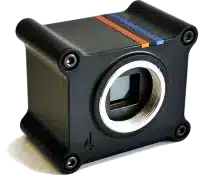
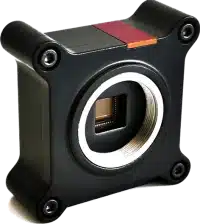
- TOUCAN The TOUCAN is a versatile broadband multispectral camera, ideal for applications requiring a broad spectral analysis across the visible and near-infrared (VIS + NIR) ranges, featuring a CMOS sensor.
- CMS & CMS4 The CMS and CMS4 series offer reliable multispectral imaging solutions specifically designed for visible light (VIS) applications, providing clear and precise data for various analytical tasks with their CMOS sensors.
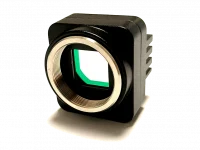
- CICADA The CICADA is a high-resolution SWIR multispectral camera, excelling in applications where detailed analysis within the Short-Wave Infrared spectrum (1100 – 1600 nm) is critical. It features an InGaAs sensor, a resolution of 1296 x 1032 pixels with a 5 µm x 5 µm pixel pitch, a USB interface, and comes in a camera form factor, making it particularly suited for tasks requiring deep material penetration or specific chemical detection.
Compare Multispectral Cameras
All three cameras are made by SILIOS Technologies and use a fixed filter mosaic patterned directly onto the sensor, capturing every band in a single snapshot with no moving parts. They differ in the spectral range they cover and the sensor behind the filter. Full specifications and datasheets are available on each product page.
| Model | Spectral range | Sensor | Resolution and pitch | Best suited for |
|---|---|---|---|---|
| CMS & CMS4 | VIS and NIR (400 to 1000 nm) | CMOS | 1280 x 1024 (1.3 MP), 5.5 µm | Visible and near-infrared multispectral imaging for analysis and inspection |
| TOUCAN | VIS and NIR (400 to 1000 nm) | CMOS | 2048 x 2048 (4.2 MP), 5.5 µm | Broadband VIS-NIR analysis at higher resolution for research and machine vision |
| CICADA | SWIR (1100 to 1600 nm) | InGaAs | 1296 x 1032, 5 µm | SWIR multispectral imaging for moisture, plastics, and chemical detection |
Need a continuous spectrum at every pixel rather than a handful of bands? See the hyperspectral cameras range. For single-band SWIR imaging, see the SWIR cameras lineup.
Multispectral Camera FAQs
What is the difference between multispectral and hyperspectral cameras?
A multispectral camera captures a small number of discrete, deliberately chosen spectral bands, usually fewer than ten, which makes it fast, affordable, and simple to process when the diagnostic wavelengths are already known. A hyperspectral camera captures tens to hundreds of contiguous bands, producing a full continuous spectrum at every pixel for identifying unknown materials by their spectral fingerprint. Multispectral suits known, well-separated features; hyperspectral suits detailed spectral discrimination and material identification.
Which multispectral camera should I choose?
It depends on the wavelength range the application needs. Choose the CMS for general visible and near-infrared multispectral imaging, the TOUCAN when the same VIS-NIR range is needed at higher 4.2 megapixel resolution, and the CICADA when the target features only appear in the shortwave infrared between 1100 and 1600 nm, such as moisture or plastics. Identifying where the materials differ spectrally points directly to the right camera.
How does a snapshot multispectral camera work?
A custom filter mosaic is patterned directly onto the sensor, much like the red, green, and blue Bayer filter of a color camera but with more bands and extending beyond visible light. Each group of pixels captures a different spectral band, so a single exposure records all bands at once with no moving parts. This makes the cameras fast and robust and well suited to moving scenes, at the cost of a fixed band set and resolution shared across the bands.
What spectral range do I need for my application?
Vegetation health, pigments, color, and most surface inspection appear in the visible and near-infrared from 400 to 1000 nm. Moisture content, plastics and polymers, and many chemical signatures only become visible in the shortwave infrared beyond 1000 nm. If the target materials are separable by color or near-infrared reflectance, a VIS-NIR camera like the CMS or TOUCAN is sufficient; if they are distinguished by water or chemistry, the SWIR CICADA is required.
Why does the CICADA use an InGaAs sensor while the others use CMOS?
Silicon sensors become transparent to light beyond roughly 1000 nm, so a CMOS camera cannot detect shortwave infrared. Indium gallium arsenide has a bandgap matched to SWIR wavelengths and efficiently converts 1100 to 1600 nm light into signal, which is why the CICADA uses it to reach into the SWIR while the visible and near-infrared CMS and TOUCAN use CMOS.
What are multispectral cameras used for?
Common applications include precision agriculture and crop health, environmental monitoring, industrial machine vision and quality control, material sorting, medical and biological imaging, art and archaeology, forensic analysis, and infrastructure inspection. The right camera depends on which spectral bands separate the materials of interest, which in turn sets the required wavelength range and sensor type.
Do multispectral cameras need special lighting?
They need illumination that emits across every band being recorded. Broadband sources work for visible and near-infrared cameras, while shortwave infrared imaging with the CICADA needs a source with adequate output beyond 1000 nm, since common white LEDs emit almost nothing there. Stable, even illumination also improves the repeatability of any classification or index calculation, because the measurement compares reflected intensity band by band.
View our Camera Catalog
 Click to view
Blogs
Scientific Camera Buyers Guide