
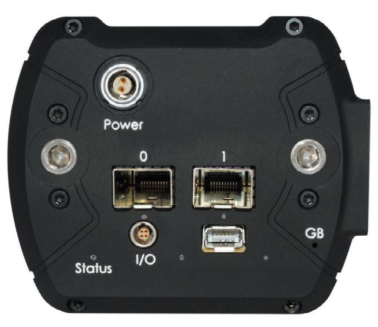

 Description
 Specifications
 QE Curve
 Applications
 Videos
 Downloads
CB2 Global Shutter sCMOS camera, in a nutshell
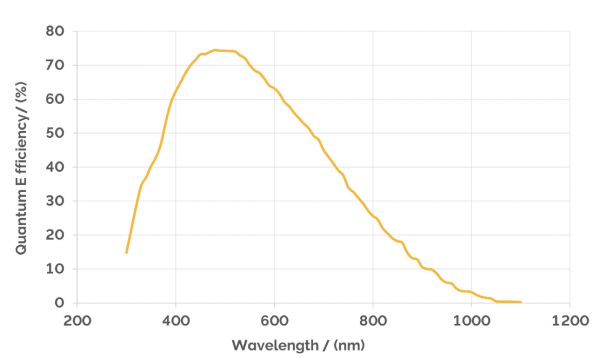
CB2 is an ultra-high performance global shutter sCMOS camera specifically designed for demanding imaging applications in the visible range (400 nm – 1000 nm).
The architecture of the camera has been designed to integrate one of three different new generation sensors: thanks to this flexible design, CB2 is able to cover the largest scope of applications.
The camera can be tailored to be the best pixel size, resolution, and frame rate compromise for your use case:
- CB2 0.5MP: 812×612 pixels, 9 μm pitch, 1594 fps ;
- CB2 1.7MP: 1608×1104 pixels, 9 μm pitch, 662 fps ;
- CB2 7.1MP: 3208×2200 pixels, 4.5 μm pitch, 207 fps.
More Details
The CB2 cameras offer a very low readout noise enabling imaging in ultra-low light conditions, simultaneously with a global shutter architecture, enabling artefact-free acquisitions in dynamic imaging.
Rolling shutter vs. global shutter:
For a CMOS sensor, there are two ways to acquire an image:
- Rolling shutter: The acquisition is made one line after the other, the sensor reads each line of the array sequentially. Pixels are exposed with a temporal shift from one pixel to the next.
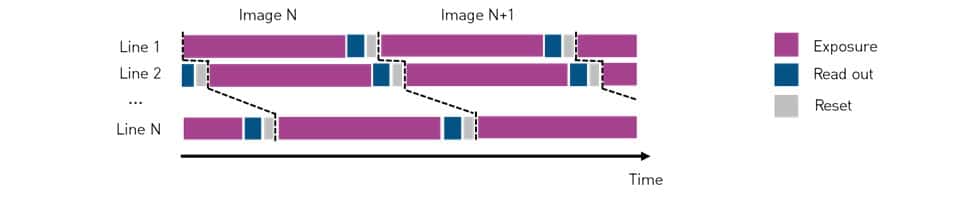
- Global shutter: The full array is exposed entirely at once. All the pixels begin and end the exposure simultaneously. At the end of exposure, the image is transferred to the memory. Then, the image is read-out while the next one is being exposed.
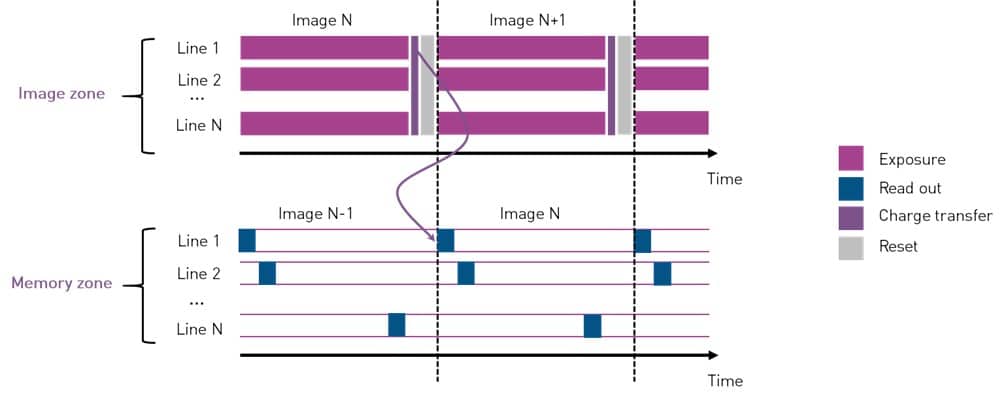
The acquisition mode is an intrinsic characteristic of the camera. However, it is important to understand the differences that will occur in an experimental context when using a camera with rolling or global shutter. Global shutter is highly advantageous for dynamic imaging applications for few reasons:
- Artifact-free: In rolling shutter when the image readout speed cannot match the object’s motion, there is temporal under sampling. A spatial distortion of the moving object, often referred to as the ‘rolling shutter effect’ appears. The larger the object and the faster the movement, the worst is the distortion. Additionally, as the sensor gets larger and with a higher resolution, the readout of the sensor will take longer, hence, the distortion will get worse. This artefact is different from motion blur which occurs in both global and rolling shutter when the integration time is too long compared to the object’s speed.
A well-known example of the rolling shutter effect occurs when imaging the rotation of blades or propellers. The figure below shows images of a rotating fan acquired in both rolling shutter mode (with a Nikon D500 camera) and global shutter mode (with C-BLUE One). Significant spatial distortion of the fan propellers is visible when using rolling shutter. 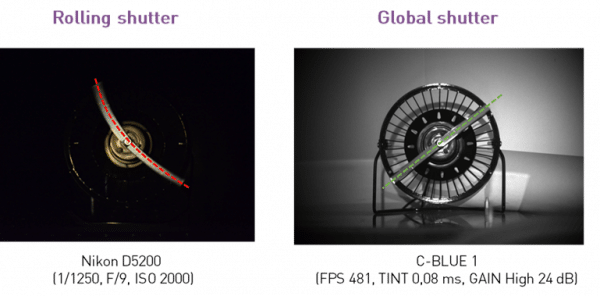 Temporal correlation: Even in the absence of distortion the top and the bottom of an image acquired in rolling shutter will not be captured at the exact same time point. Different regions of the image are not correlated in time to other regions. Whereas with global shutter, all pixels are exposed at the same time, allowing for accurate temporal correlation of different areas of the sensor.
- Simpler and faster synchronization: Synchronizing a rolling shutter camera to other components, such as a light source, can be difficult due to the time delay between the lines of the sensor. This may result in slower cycle times and frame rates relatively to those achievable in global shutter.
Why is the Andor CB2 a game changer?
Rolling shutter uses simpler pixel architecture than global shutter. Therefore usually rolling shutter is less noisy than global shutter, this is why this architecture is used in scientific applications but with all its drawbacks. With CB2, simultaneously and for the first time a global shutter architecture and low noise is made possible, which is a major improvement for fast acquisition scientific applications.
By combining a global shutter and high frame rates (up to 662 fps in full frame) to very low noise, CB2 opens new perspectives for applications that simultaneously require truthful/deformation-free images, high temporal resolution, and high sensitivity. CB2 will open new horizons for low noise high speed visible imaging.
CB2 Global Shutter sCMOS Camera Applications
Physical Sciences:
- HR – Large Sky Surveys (Astronomy)
- HS – Adaptive Optics/Laser Guide Stars
- HR + HS – Quantum Ion Trap & Neural Atom, Tomography (X-Ray Or Neutron), Fluid Dynamics (PIV), Microfluidics
Life Sciences:
- HR – Luminescence, Image Large Samples at Speed
- HS – High Throughput Screening
- HR + HS – Ion Imaging, Cell Motility, Digital Holographic Microscopy
LGS Wavefront Sensing:
- Space debris tracking
- AO assisted satellite tracking
- Ground based space situational awareness
High-End Industry:
- Particle velocimetry
- Rayleigh thermometry
Publications about CB2 Global Shutter sCMOS camera:
- C-BLUE One: a family of CMOS high speed cameras for wavefront sensing. J.L. Gach, D. Boutolleau, T. Carmignani, F. Clop, I. De Kernier, P. Feautrier, M. Florentin, S. Lemarchand, J. Pettigiani, T. Romano, E. Stadler, J. Tugnoli, Y. Wanwanscappel. SPIE ATI Conference. July 2022.
- Performance of a complementary metal-oxide-semiconductor sensor for laser guide star wavefront sensing. Zibo Ke, Felipe Pedreros Bustos, Jenny Atwood, Anne Costille, Kjetil Dohlen, El Hadi, Jean-Luc Gach, Glen Herriot, Zoltan Hubert, Pierre Jouve, et al. HAL Open Science. May 2022.
- C-MORE: the laser guide star wavefront sensor. J.L. Gach, D. Boutolleau, A. Caillat, P. Feautrier, R. Pourcelot, E. Stadler. AO4ELT 6 Conference. June 2019.
White Papers about CB2:
Software
First Light Vision GUI:
First Light Vision software is included with the CB2 global shutter scmos camera and is supported under the Windows and Linux OS. More information regarding the First Light Vision GUI software can be obtained under the “Downloads” tab.
First Light Imaging SDK:
The First Light Imaging SDK can be provided on demand and is compatible with Matlab, Python, C & C++. More information about the First Light Imaging SDK can be obtained under the “Downloads” tab.
Other Software Compatibility:
The CB2 is can also be operated through Micro-Manager, LabVIEW & HALCON software.