
SWIR Cameras
What is SWIR Imaging?
Shortwave infrared (SWIR) imaging detects light in the 900 nm to 2500 nm wavelength range, which is invisible to the human eye. Unlike thermal imaging (MWIR/LWIR) that sees emitted heat, SWIR imaging captures reflected light. This fundamental difference means images taken with SWIR cameras have shadows, contrast, and spatial details much like a standard B&W photograph. Moreover, a key advantage of SWIR light is its ability to penetrate atmospheric obscurants like fog, smoke, and haze better than visible light.
The Technology Behind SWIR Cameras
Standard silicon sensors, found in smartphone cameras, cannot detect light beyond about 1000 nm. However, SWIR imaging cameras rely on specialized sensors mostly made of indium gallium arsenide (InGaAs). InGaAs has a suitable bandgap energy ( eV) allowing to efficiently absorb and convert SWIR photons into an electrical signal.
Compared to long wave thermal imaging (LWIR), the shorter wavelengths of SWIR light allow high resolution imaging, capturing much finer details with the same size optics.
Compare SWIR Cameras
The table below summarizes the SWIR camera lineup by family. Ranges marked VSWIR extend down into the visible on Sony SenSWIR sensors, and XSWIR marks extended range InGaAs reaching beyond the standard 1700 nm cutoff. Full specifications and datasheets are available on each product page.
| Model | Spectral range | Sensor and resolution | Speed and cooling | Best suited for |
|---|---|---|---|---|
| Goldeye Pro | 400 to 1700 nm (VSWIR) | Sony IMX990/992/993, up to 5.3 MP at 3.45 µm | 100 to 250 fps, TEC cooled, 5GigE | High resolution VSWIR over long GigE cable runs for inline inspection |
| FXO SenSWIR series | 400 to 1700 nm (VSWIR) | Sony IMX990/992/993, up to 5.3 MP at 3.45 µm | 100 to 250 fps, TEC cooled or TEC-less | High speed, high resolution semiconductor and solar cell inspection |
| Goldeye VSWIR TE | 400 to 1700 nm (VSWIR) | Sony IMX990 (1.3 MP) or IMX991 (0.3 MP) | Up to 500 fps by model, TEC cooled, GigE or Camera Link | Versatile visible-through-SWIR imaging on a single sensor |
| Goldeye SWIR TE | 900 to 1700 nm | InGaAs, QVGA and VGA, 15 to 30 µm pixels | 100 to 500 fps, TEC cooled, GigE or Camera Link | The classic InGaAs workhorse for industrial and scientific SWIR |
| Goldeye XSWIR | 1100 to 1900 or 1400 to 2200 nm (XSWIR) | Extended InGaAs, QVGA and VGA | 250 to 500 fps, TEC cooled, GigE | Detection beyond 1700 nm for water, hydrocarbons, and material sorting |
| Alvium VSWIR (also as board level cores) | 400 to 1700 nm (VSWIR) | Sony IMX990/991/992/993, up to 5.3 MP | Uncooled, TEC-less, USB or GigE | Lowest SWaP option for drones, handheld systems, and OEM embedding |
| SCION SWIR 640/1280 | 400 to 1700 nm | VISGaAs, 10 µm pixels | Up to 700 Hz | Next generation high speed, low noise SWIR imaging |
| C-RED 3 | 900 to 1700 nm | InGaAs, VGA, 15 µm | 600 fps full frame, uncooled, USB or Camera Link | Low SWaP high speed imaging for FSO, adaptive optics, and tracking |
| C-RED 2 Lite | 900 to 1700 nm | InGaAs, VGA, 15 µm | 500 to 1000 fps, TEC stabilized, USB or Camera Link | Fast, thermally stabilized imaging in a compact package |
| C-RED 2 | 900 to 1700 nm | InGaAs, VGA, 15 µm, <30 e- read noise | 600 fps full frame, TEC cooled, USB or Camera Link | Low light and long exposure work such as EL and PL semiconductor inspection |
| C-RED 2 ER 1.9 and ER 2.2 | 1100 to 1900 or 1400 to 2200 nm (XSWIR) | Extended InGaAs, VGA, 15 µm | 500 to 1000 fps, TEC cooled | High speed imaging in the extended SWIR bands |
| C-RED 1 | 800 to 2500 nm | e-APD MCT, 320 x 256, sub-electron read noise | Over 1000 fps, cryo-cooled | The ultimate sensitivity for astronomy, wavefront sensing, and photon starved FSO |
| C-RED New Space | 900 to 1700 nm | InGaAs camera core | Low SWaP core design | SWIR imaging payloads for satellite and space applications |
Pairing a camera with optics? SWIR requires lenses corrected for these wavelengths; the SWIR lens page includes a field of view calculator to match a lens to your sensor and working distance.
Advancements in SWIR Sensors
Modern SWIR imaging technology has expanded the following sensor capabilities:
- Broader VIS-SWIR Spectrum: Some sensors, like Sony’s SenSWIR™, can detect a wide spectrum from visible light to SWIR (400 nm to 1700 nm) on a single chip. This is useful for applications such as multispectral imaging, laser beam profiling or photonics on chip inspection.
- Extended Wavelength Range: By modifying the InGaAs alloy, “extended-range” sensors can detect up to 2200 nm. This is especially useful for hyperspectral imaging to identify materials based on their unique molecular absorption properties (ex: water or hydrocarbons).
- Noise Trade-offs: As electronic noise increases at longer wavelengths, integrated cooling systems are often required to maintain image quality.
Axiom Optics SWIR Cameras and Solutions
Axiom Optics supplies high-performance InGaAs SWIR imaging cameras for scientific and industrial applications. Our cameras feature:
- High frame rates for capturing fast events: the C-RED cameras are our fastest InGaAs cameras with 600 fps in full VGA resolution and >1,000 fps by windowing the sensor. C-RED cameras are ideal for applications such as free-space optics (FSO), adaptive optics, target tracking, spectroscopy, welding or additive manufacturing.
- High resolution for maximum detail: we offer several SWIR cameras equipped with the latest Sony IMX992 sensor with 5.3 MP and the smallest pixel pitch on the market (3.45 µm). These cameras are ideal for semiconductor and solar cell inspection (with a SWIR microscope setup for instance), laser detection, tracking and space applications.
- High sensitivity with very low noise for low-light conditions. The C-RED 2 camera comes with a readout noise of only <30 e- and a low dark current of ~300 e-/pix/sec. It allows long exposure times for the most photon starved applications such as electroluminescence (EL) and photoluminescence (PL) inspection in semiconductors.
- Compact and lightweight designs for drones and portable systems. The Alvium SWIR imaging cameras with up to 5.3MP are the lowest SWaP cameras we offer. They are available with housing or as bare-board level cameras.
SWIR Camera FAQs
What is the difference between SWIR and thermal imaging?
SWIR cameras image reflected light between 900 and 2500 nm, producing sharp, photograph-like images with shadows and contrast, while MWIR and LWIR thermal cameras detect heat emitted by objects themselves. Because SWIR wavelengths are much shorter, SWIR delivers far higher spatial resolution with the same size optics, and it can read features thermal imaging cannot, such as moisture content and material differences.
Why do SWIR cameras use InGaAs instead of silicon sensors?
Silicon becomes transparent to light beyond roughly 1000 nm, so ordinary CMOS and CCD sensors simply cannot detect SWIR photons. Indium gallium arsenide has a bandgap matched to SWIR energies, efficiently converting 900 to 1700 nm light into signal, and modified InGaAs alloys extend detection to 2200 nm. Hybrid designs like Sony’s SenSWIR add visible response, covering 400 to 1700 nm on a single chip.
Do I need a cooled SWIR camera?
It depends on exposure time and spectral range. Cooling suppresses dark current, so short exposures in well lit industrial scenes work fine uncooled, while long exposures for photon starved applications such as electroluminescence inspection benefit from TEC cooling, and extended range sensors beyond 1700 nm effectively require it. Cryogenic cooling is reserved for extreme sensitivity instruments like the C-RED 1.
What can SWIR cameras see that visible cameras cannot?
Water absorbs strongly in the SWIR, so moisture, bruising in produce, and fill levels behind opaque plastic stand out clearly. Silicon is transparent in the SWIR, enabling inspection through wafers and of solar cells. SWIR also penetrates fog, haze, and smoke better than visible light, distinguishes materials that look identical to the eye, and images laser lines at telecom wavelengths around 1550 nm.
What is the difference between SWIR, VSWIR, and extended SWIR?
Standard SWIR cameras cover 900 to 1700 nm on InGaAs. VSWIR cameras built on Sony SenSWIR sensors extend response down to 400 nm, capturing visible and SWIR together. Extended SWIR (XSWIR) uses modified InGaAs to reach 1900 or 2200 nm, unlocking absorption features of water, hydrocarbons, and plastics that sit beyond the standard cutoff.
Do SWIR cameras need special lenses?
Yes. Standard visible lenses use glasses and antireflection coatings optimized below 700 nm, so they lose transmission and shift focus in the SWIR. Lenses designed and coated for SWIR, or for the full VIS-SWIR span when using SenSWIR sensors, preserve resolution and light throughput. Matching lens image circle and resolving power to small pixel sensors like the 3.45 micron IMX992 is especially important.
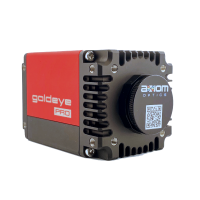
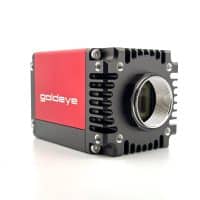
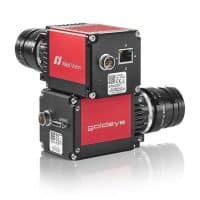
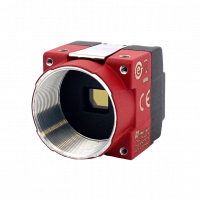
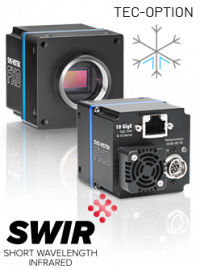
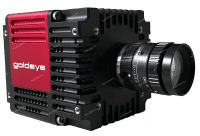
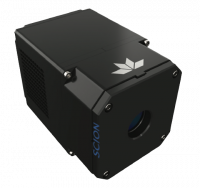
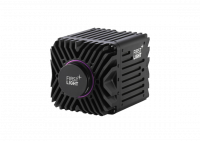
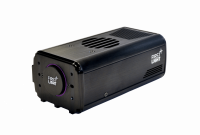
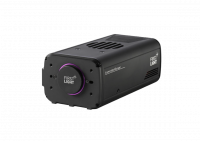
Goldeye SWIR Cameras Portal - Why Choose Goldeye? Pick your Goldeye, Quick downloads and more
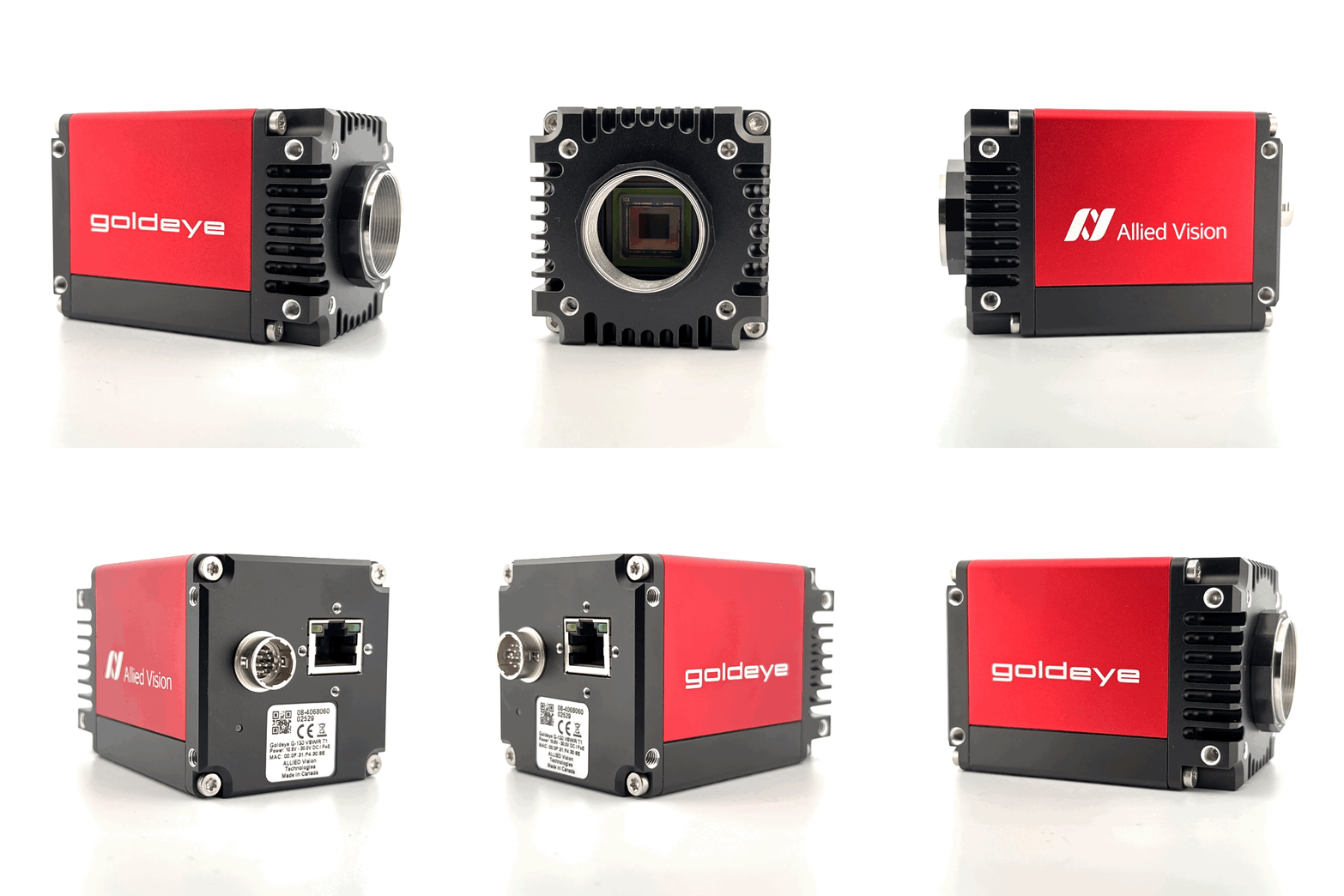 Visit the Goldeye Portal
SWIR Lenses (with new lens calculator)
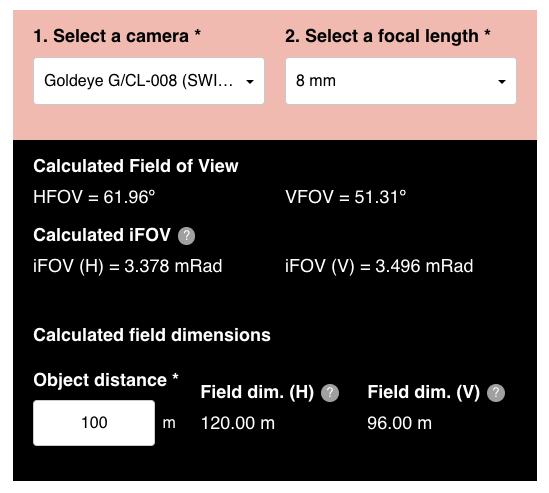 Select a Lens
Blogs

Profiling laser beams between 400 & 1700nm made easy with the new Alvium + RayCi combo
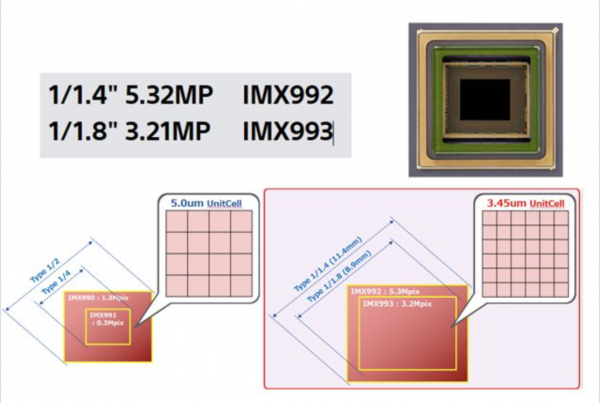
Sony's IMX992 InGaAs Sensor: A Quantum Leap in High-Resolution SWIR Imaging
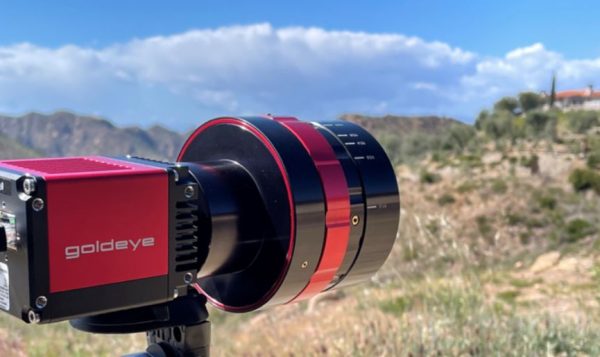
5 Ways To Compare SWIR Cameras on the Market
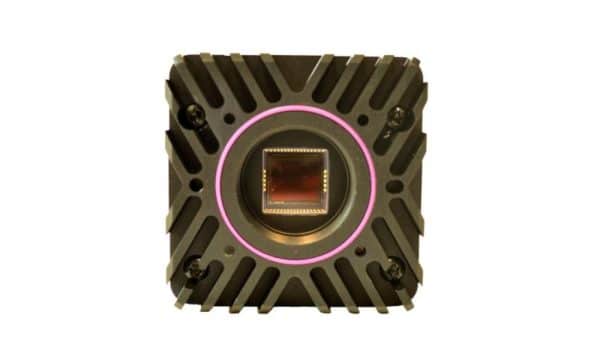
Top 5 Applications of SWIR Cameras Today

To cool or not to cool? - Do I need cooling for my SWIR camera?
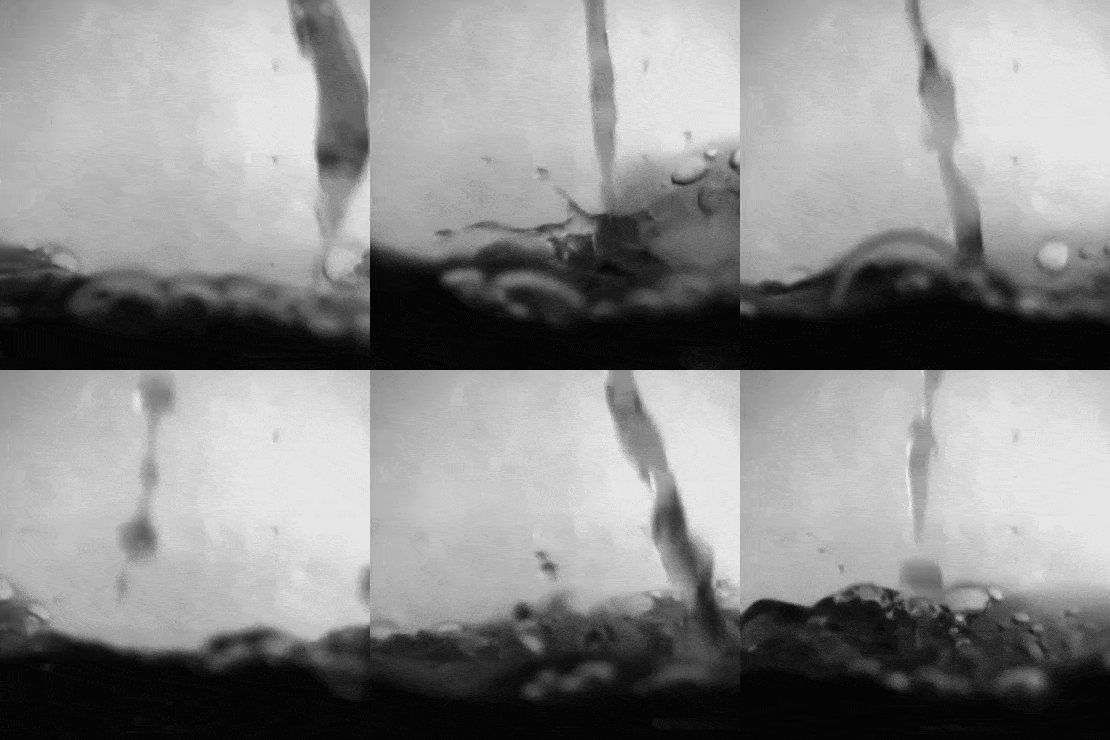
Need For Speed - How to select a high-speed SWIR InGaAs camera?
Watch our SWIR videos


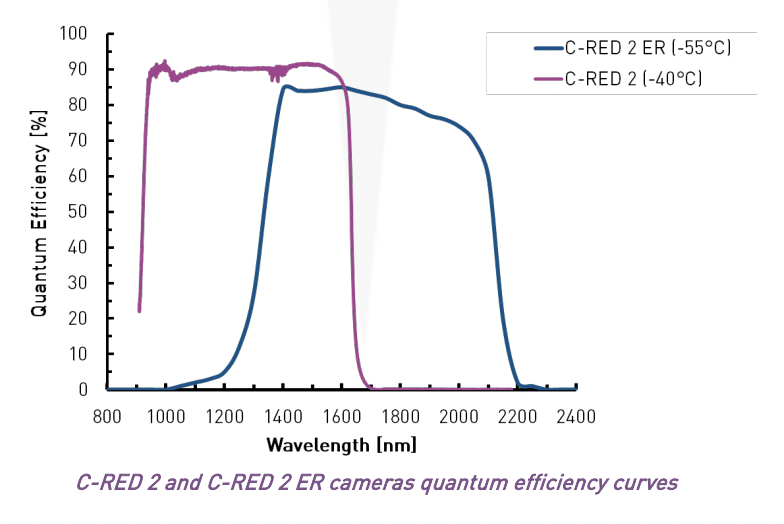 Extended range SWIR imaging
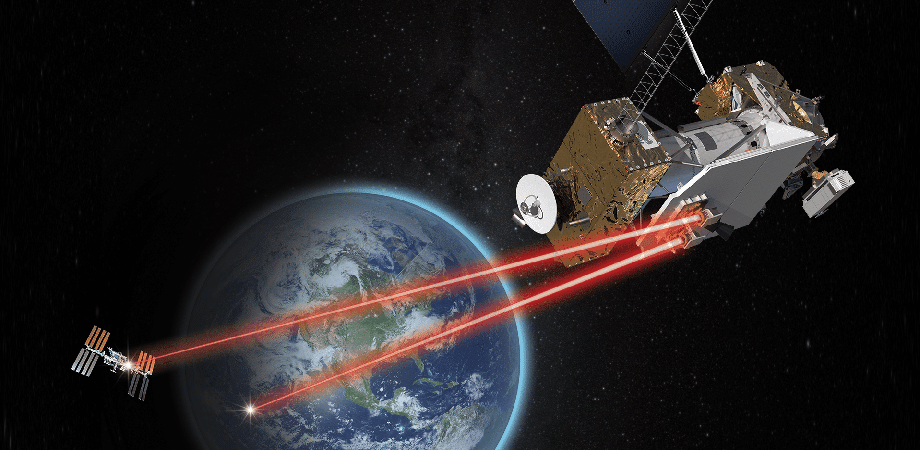 FSO & AO
 Long exposure times up to 2 min