







FLOWlab | Educational PIV System
Light Source
500mW or 5W Laser Diode Pulsing System
Imaging Rate
Up to 160 fps (80 fps double frame)
Flow Velocity
Up to 0.4 m/s
Software
PIVlab (open source)
Measurement Section
140 mm x 125 mm x 200 mm
Water Tank Dimensions
1200 mm x 150 mm x 300 mm
 Description
 Specifications
 Software
Educational PIV Measurement System by OPTOLUTION
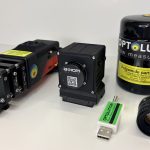
The OPTOLUTION FLOWlab is an educational PIV system that features a small circulating water tunnel for education. It is bundled with a 500 mW (Laser class 3B) or 5W (Laser class 4) pulsed laser with synchronizer and sheet optics, and the OPTOcam 2/80 (160 fps, 2 megapixels, USB 3.0) with a band pass filter. These components offer unparalleled PIV performance in a cost-effective eduPIV package. Inside the water tunnel, a powerful thruster generates a velocity up to 0.4 m/s. Several flow straighteners rectify the flow in the test section measuring 140 x 125 x 200 mm. Three example flow bodies are supplied that can be examined by the students. In the near future, OPTOLUTION will also provide scripts for practical courses that involve the analysis of the vortex shedding frequency of cylinders, the circulation (lift) of flat and cambered wings, and more common tasks dealing with PIV in general.
Furthermore, by using bandpass filters in the camera, the experimental lab does not need to be darkened, making it an ideal tool for an educational setting.

All-Inclusive, Ready to Go
- Circulating channel / aquarium: Water tank (approx. 1200 mm x 150 mm x 300 mm) with thruster (200 W) and flow bodies (cylinder, wing sections, custom objects can easily be integrated by 3D printing). The measurement section is 140 x 125 x 200mm, similar to the historical Prandtl water channel
- Laser: With options including a low-energy pulsed laser featuring 500mW @638nm, or a 5W pulsed laser @450nm.
- Laser sheet optics: every light source includes adjustable light sheet optics.
- Camera: with 2.35 megapixel and frame rate of 160 fps (USB 3.0).
- Lens and bandpass filter: F1.4 f 16 mm, 2/3″ sensor, low distortion lens with included bandpass filter.
- Optional laser warning sign: automatically activates with direct wireless control by PIVlab.
Completely Integrated Educatioanl PIV System For Use With PIVlab
The Educational PIV FLOWlab system was developed specifically for PIVlab (open source software) for complete control, image acquisition, and analysis. PIVlab is a free and open-source PIV software and is currently the most frequently cited PIV tool on the market. PIVlab is developed and maintained by William Thielicke, and is available as stand-alone app or Matlab toolbox. It can be used to calculate the velocity distribution within imported (or captured) images. It also controls OPTOLUTION’s lasers, cameras and synchronizers, and derives, displays and exports multiple parameters of the flow pattern. The simple graphical user interface makes PIV data acquisition and data post-processing fast and efficient.
A Myriad of Resources for PIV Education
A paper with educational experiments designed for our FLOWlab educational PIV system is available here: https://arxiv.org/abs/2508.02147 (preprint, accepted for publication in “DGLR-Fachsymposium der STAB – Deutsche Strömungsmechanische Arbeitsgemeinschaft”, 13. – 14. November, Regensburg, Germany)
Example data from the FLOWlab can be downloaded from Google Drive.
Extensive series of measurements on the wake of cylinders, flat plates and profiles at different angles of attack can be found here: https://doi.org/10.5281/zenodo.13982681
A Compact Yet Powerful Flow Setup
The OPTOLUTION FLOWlab is a small circulating water tunnel for educational Particle Image Velocimetry (PIV). Inside the water tunnel, a powerful thruster generates a velocity up to 0.4 m/s. Several flow straighteners rectify the flow in the test section measuring 140 x 125 x 200 mm. Three example flow bodies are supplied that can be examined by the students. OPTOLUTION also provides scripts for practical courses that involve the analysis of the vortex shedding frequency of cylinders, the circulation (lift) of flat and cambered wings, and more common tasks dealing with PIV in general.
Software: PIVlab
PIVlab is an easy-to-use application that calculates velocities in image data (movies, pictures). It uses a method called ‘Particle Image Velocimetry’. This method is typically used to calculate velocities in fluids, but there are also many other possibilities.
PIVlab is available as stand-alone app, or as toolbox for Matlab: https://www.PIVlab.de
PIVlab is developed by OPTOLUTION employee William Thielicke, and OPTOLUTION supports the software development of PIVlab. OPTOLUTION’s PIV systems maximize the potential of PIVlab by enabling full control of compatible PIV hardware, which has resulted in the development of the most simple to use PIV measurement suite. Our pulsed laser diodes, synchronizers, several cameras and the seeding generator can all be remote controlled directly from PIVlab.

PIVlab Tutorials: