
Particle Image Velocimetry (PIV) Systems and Components

Axiom Optics offers complete Particle Image Velocimetry (PIV) systems developed by OPTOLUTION and William Thielicke, the creator of PIVlab. Our PIV systems are tailored to be used with PIVlab, a free and open-source tool for Particle Image Velocimetry. PIVlab is the simplest PIV measurement software and the most cited PIV tool on the market, trusted by thousands of researchers around the world. Furthermore, our PIV systems can also be integrated and used with third party components, without using PIVlab.

We offer complete PIV hardware for PIVlab: pulsed laser diodes, synchronizers, several cameras and a seeding generator, all can be remote controlled directly from PIVlab.

The OPTOLUTION PIV systems consist of several building blocks that can be combined to get the most suitable PIV system:
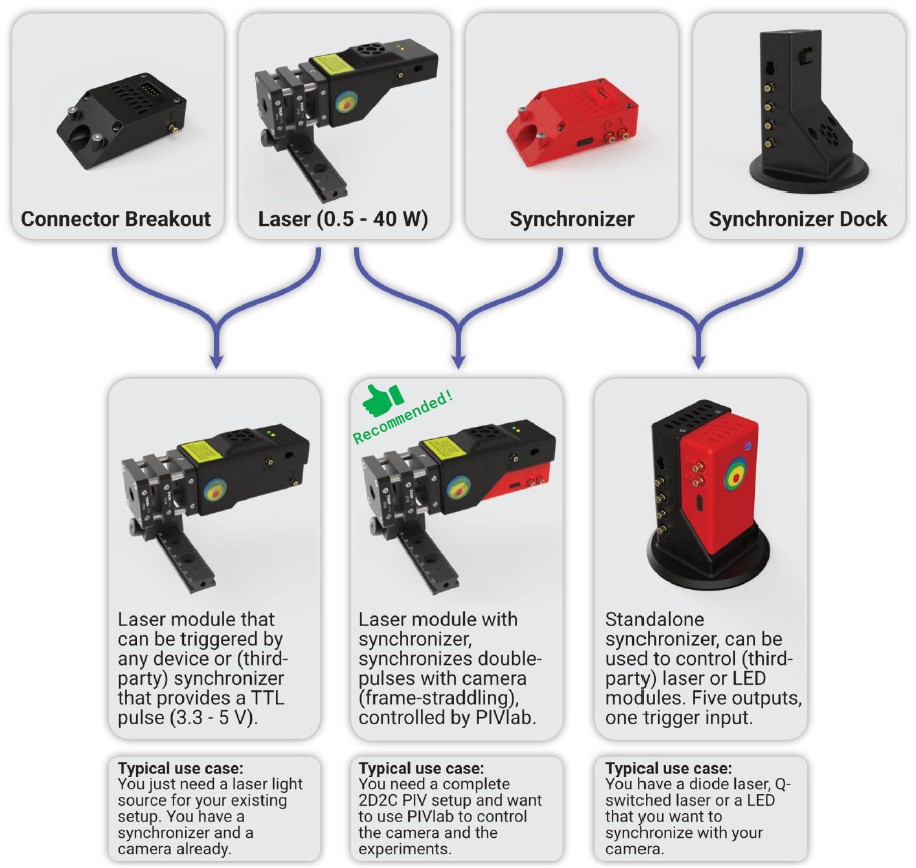
Components of the OPTOLUTION PIV system.

PIV System Components

  • PIV Lasers
  • Synchronizer
  • Cameras
  • PIV data acquisition and analysis software
  • Seeding
  • Laser warning sign

What Goes Into a PIV System

Particle Image Velocimetry measures the velocity of a whole flow field at once by seeding a fluid with tracer particles, illuminating them with a pulsed laser sheet, capturing image pairs with a synchronized camera, and cross-correlating the frames to produce a vector field. The OPTOLUTION systems Axiom Optics offers are modular, so these building blocks combine into the configuration a given experiment needs. All of it is controlled directly from PIVlab, the free, open-source, most-cited PIV software.

Building block Role in the measurement Options
PIV lasers (LD-PS) Generate a bright, thin pulsed light sheet to illuminate the tracer particles Laser diode pulsing systems at 500 mW, 5 W, 20 W, 40 W, and 400 W peak power; integrated sheet optics; adjustable pulse spacing and length
Synchronizer Times the laser pulses to the camera frames so particle displacement is captured over a known interval OPTOLUTION synchronizer, controlled from PIVlab, or a third-party pulse generator
Camera Records the image pairs of illuminated particles for cross-correlation Several cameras available; the OPTOcam 2/80 delivers 2 MP at 160 fps over USB 3.0
Seeding generator Introduces tracer particles that faithfully follow the flow Seeding generator for air or particle seeding for water
Software Cross-correlates image pairs into velocity vector fields and controls the hardware PIVlab, free and open source, with direct control of lasers, synchronizers, and cameras

Two ways to start

For research and diagnostics, a complete PIV system is assembled from the blocks above to match the flow, the medium, and the field of view. For teaching, the FLOWlab educational system is a turnkey bundle: a small circulating water tunnel reaching 0.4 m/s in a 140 x 125 x 200 mm test section, paired with a 500 mW pulsed laser, synchronizer, sheet optics, and the OPTOcam camera, plus ready-made lab scripts for vortex shedding, wing circulation, and other classic experiments.

The PIV lasers are also listed under laser sources. For the cameras used in demanding PIV, see the high-speed scientific cameras.

PIV System FAQs

What is Particle Image Velocimetry?

Particle Image Velocimetry, or PIV, is a non-intrusive optical technique that measures the velocity of an entire flow field at once. The fluid is seeded with small tracer particles, a pulsed laser sheet illuminates them, and a synchronized camera captures image pairs at a known time interval. Software then cross-correlates the pairs to determine how far the particles moved, producing a two-dimensional map of velocity vectors across the measurement plane.

What components make up a PIV system?

A PIV system combines a pulsed laser with sheet optics to illuminate the flow, tracer particles introduced by a seeding generator, a synchronizer to time the laser to the camera, a camera to capture the image pairs, and analysis software to turn those pairs into velocity fields. In the OPTOLUTION systems these are modular building blocks, all controlled from the free PIVlab software, so a configuration can be tailored to the specific flow and budget.

What is PIVlab?

PIVlab is a free, open-source application that calculates velocities from image data using Particle Image Velocimetry, and it is the most cited PIV software available. It achieves the same measurement quality as commercial packages with much simpler operation, and it has been extended to directly control cameras, synchronizers, and lasers, which greatly simplifies running a PIV setup. The OPTOLUTION hardware Axiom Optics offers is designed to work directly with it.

What laser power do I need for PIV?

It depends on the medium, the field of view, and the camera settings. Small water tunnels and educational setups work well at 500 mW, while larger measurement areas, air flows, and high-speed capture need more power to keep the light sheet bright enough, which is why the laser diode pulsing systems are offered at 500 mW, 5 W, 20 W, 40 W, and 400 W. The laser should illuminate the particles clearly across the whole sheet at the exposure and frame rate being used.

Can I use PIV in both air and water?

Yes. PIV works in both, but the medium changes the setup. Water flows are slower and seed and scatter light readily, so they suit lower laser powers and standard frame rates, while air flows are faster and harder to seed and generally require more laser power and higher camera speeds. The seeding method also differs, with a generator dispersing particles into air and particles suspended directly in water.

Is there a PIV system suitable for teaching?

Yes. The FLOWlab educational system is a turnkey bundle built for the classroom: a compact circulating water tunnel that reaches 0.4 m/s in a 140 by 125 by 200 mm test section, paired with a 500 mW pulsed laser, synchronizer, sheet optics, and a suitable camera. It ships with example flow bodies and ready-made scripts for classic experiments such as vortex shedding behind cylinders and the circulation of wings, making it a cost-effective way to introduce students to PIV.

Do I need multiple cameras for PIV?

Not for most measurements. A single camera viewing a laser sheet measures two velocity components in a plane, which answers a large share of research and teaching questions and is what these systems and PIVlab provide. Measuring the third velocity component or resolving a full volume requires additional cameras and more involved calibration, so it is worth confirming that a planar two-component measurement meets the need before adding that complexity.
Particle Image Velocimetry (PIV) Systems and Components

Axiom Optics offers complete Particle Image Velocimetry (PIV) systems developed by OPTOLUTION and William Thielicke, the creator of PIVlab. Our PIV systems are tailored to be used with PIVlab, a free and open-source tool for Particle Image Velocimetry. PIVlab is the simplest PIV measurement software and the most cited PIV tool on the market, trusted by thousands of researchers around the world. Furthermore, our PIV systems can also be integrated and used with third party components, without using PIVlab.

We offer complete PIV hardware for PIVlab: pulsed laser diodes, synchronizers, several cameras and a seeding generator, all can be remote controlled directly from PIVlab.

The OPTOLUTION PIV systems consist of several building blocks that can be combined to get the most suitable PIV system:

Components of the OPTOLUTION PIV system.

PIV System Components

  • PIV Lasers
  • Synchronizer
  • Cameras
  • PIV data acquisition and analysis software
  • Seeding
  • Laser warning sign

What Goes Into a PIV System

Particle Image Velocimetry measures the velocity of a whole flow field at once by seeding a fluid with tracer particles, illuminating them with a pulsed laser sheet, capturing image pairs with a synchronized camera, and cross-correlating the frames to produce a vector field. The OPTOLUTION systems Axiom Optics offers are modular, so these building blocks combine into the configuration a given experiment needs. All of it is controlled directly from PIVlab, the free, open-source, most-cited PIV software.

Building block Role in the measurement Options
PIV lasers (LD-PS) Generate a bright, thin pulsed light sheet to illuminate the tracer particles Laser diode pulsing systems at 500 mW, 5 W, 20 W, 40 W, and 400 W peak power; integrated sheet optics; adjustable pulse spacing and length
Synchronizer Times the laser pulses to the camera frames so particle displacement is captured over a known interval OPTOLUTION synchronizer, controlled from PIVlab, or a third-party pulse generator
Camera Records the image pairs of illuminated particles for cross-correlation Several cameras available; the OPTOcam 2/80 delivers 2 MP at 160 fps over USB 3.0
Seeding generator Introduces tracer particles that faithfully follow the flow Seeding generator for air or particle seeding for water
Software Cross-correlates image pairs into velocity vector fields and controls the hardware PIVlab, free and open source, with direct control of lasers, synchronizers, and cameras

Two ways to start

For research and diagnostics, a complete PIV system is assembled from the blocks above to match the flow, the medium, and the field of view. For teaching, the FLOWlab educational system is a turnkey bundle: a small circulating water tunnel reaching 0.4 m/s in a 140 x 125 x 200 mm test section, paired with a 500 mW pulsed laser, synchronizer, sheet optics, and the OPTOcam camera, plus ready-made lab scripts for vortex shedding, wing circulation, and other classic experiments.

The PIV lasers are also listed under laser sources. For the cameras used in demanding PIV, see the high-speed scientific cameras.

PIV System FAQs

What is Particle Image Velocimetry?

Particle Image Velocimetry, or PIV, is a non-intrusive optical technique that measures the velocity of an entire flow field at once. The fluid is seeded with small tracer particles, a pulsed laser sheet illuminates them, and a synchronized camera captures image pairs at a known time interval. Software then cross-correlates the pairs to determine how far the particles moved, producing a two-dimensional map of velocity vectors across the measurement plane.

What components make up a PIV system?

A PIV system combines a pulsed laser with sheet optics to illuminate the flow, tracer particles introduced by a seeding generator, a synchronizer to time the laser to the camera, a camera to capture the image pairs, and analysis software to turn those pairs into velocity fields. In the OPTOLUTION systems these are modular building blocks, all controlled from the free PIVlab software, so a configuration can be tailored to the specific flow and budget.

What is PIVlab?

PIVlab is a free, open-source application that calculates velocities from image data using Particle Image Velocimetry, and it is the most cited PIV software available. It achieves the same measurement quality as commercial packages with much simpler operation, and it has been extended to directly control cameras, synchronizers, and lasers, which greatly simplifies running a PIV setup. The OPTOLUTION hardware Axiom Optics offers is designed to work directly with it.

What laser power do I need for PIV?

It depends on the medium, the field of view, and the camera settings. Small water tunnels and educational setups work well at 500 mW, while larger measurement areas, air flows, and high-speed capture need more power to keep the light sheet bright enough, which is why the laser diode pulsing systems are offered at 500 mW, 5 W, 20 W, 40 W, and 400 W. The laser should illuminate the particles clearly across the whole sheet at the exposure and frame rate being used.

Can I use PIV in both air and water?

Yes. PIV works in both, but the medium changes the setup. Water flows are slower and seed and scatter light readily, so they suit lower laser powers and standard frame rates, while air flows are faster and harder to seed and generally require more laser power and higher camera speeds. The seeding method also differs, with a generator dispersing particles into air and particles suspended directly in water.

Is there a PIV system suitable for teaching?

Yes. The FLOWlab educational system is a turnkey bundle built for the classroom: a compact circulating water tunnel that reaches 0.4 m/s in a 140 by 125 by 200 mm test section, paired with a 500 mW pulsed laser, synchronizer, sheet optics, and a suitable camera. It ships with example flow bodies and ready-made scripts for classic experiments such as vortex shedding behind cylinders and the circulation of wings, making it a cost-effective way to introduce students to PIV.

Do I need multiple cameras for PIV?

Not for most measurements. A single camera viewing a laser sheet measures two velocity components in a plane, which answers a large share of research and teaching questions and is what these systems and PIVlab provide. Measuring the third velocity component or resolving a full volume requires additional cameras and more involved calibration, so it is worth confirming that a planar two-component measurement meets the need before adding that complexity.
Read More

Contact Us

No Fields Found.

Tech Support

Contact Us

Scroll to Top