This blog briefly highlights the capabilities of a high-speed Mid-Infrared spectrometer platform based on upconversion/dispersive technology and highlights key differences compared to conventional Fourier Transform Infrared (FTIR) systems.
Mid-infrared (MIR) spectroscopy in the 2–5 µm wavelength range provides access to strong fundamental molecular vibrations, enabling highly specific identification of chemical bonds such as C–H, O–H, N–H, and C=O. These features make Mid-Infrared spectroscopy an essential analytical tool across industrial process monitoring, materials science, laser diagnostics, and environmental sensing.
1. Technology Overview
1.1 Mid-IR Spectroscopy in the 2–5 µm Range
The 2–5 µm spectral region covers strong fundamental vibrational absorption bands of ubiquitous chemical bonds such as hydrocarbons (C–H bonds), water and alcohols (O–H bonds), carbonyl compounds (C=O stretch), and many industrial gases (CO₂, CO, CH₄, etc.) In modern dispersive Mid-IR spectroscopy systems using nonlinear upconversion detection, such as in the NLIR Mid-Infrared Spectrometer, Mid-IR light is converted to shorter wavelengths. Subsequent detection is performed with fast, low-noise silicon sensors, and consequently thermal noise typical of direct Mid-IR detectors is significantly reduced. The result is high-speed, high-sensitivity spectral acquisition without cryogenic cooling.
1.2 How Upconversion Technology Differs from FTIR
While FTIR spectrometers are widely used for broadband, high-resolution measurements, they are inherently slow due to their reliance on a mechanically scanned interferometer (typically a Michelson interferometer). In FTIR systems, spectral information is acquired sequentially as the moving mirror scans different optical path differences, requiring multiple measurements to reconstruct a full spectrum via Fourier transform. This mechanical motion limits acquisition speed and can introduce sensitivity to vibrations. In contrast, upconversion spectrometers uses nonlinear optical processes (e.g., sum-frequency generation) to convert infrared signals into the visible or near-infrared, enabling detection with fast, low-noise silicon detectors and often allowing real-time, single-shot spectral acquisition without moving parts. Beyond speed, upconversion systems typically offer superior sensitivity due to lower detector noise and reduced thermal background, whereas FTIR systems excel in spectral resolution, wavelength accuracy, and broad spectral coverage.
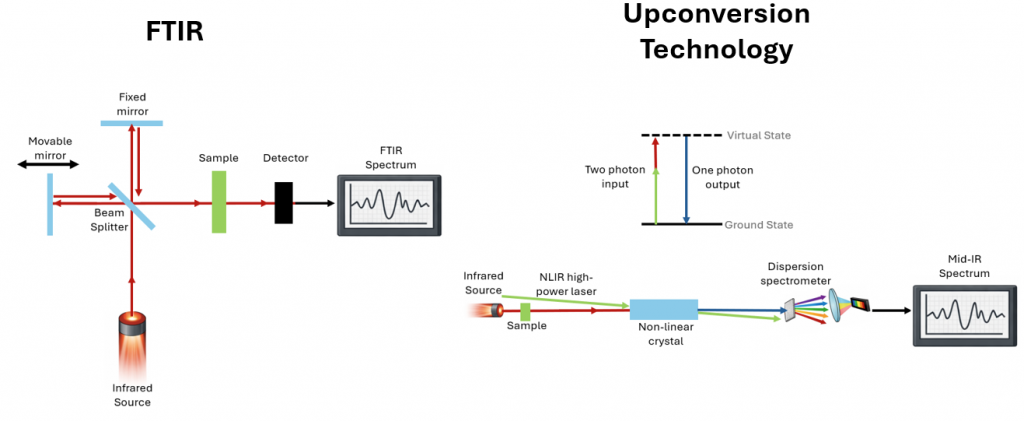
Key Technical Differences
| Feature | Upconversion Spectrometer | Conventional FTIR |
| Spectral Acquisition | Direct dispersive (single shot) | Interferometric scan + Fourier transform |
| Speed | Up to kHz frame rates | Typically ms–seconds per scan or longer |
| Moving Parts | None | Moving mirror required |
| Detector Noise | Reduced via upconversion | Thermal noise (often requires cooling) |
| Dynamic Process Monitoring | Excellent | Limited by scan speed |
| Mechanical Stability | High (no interferometer) | Sensitive to vibration |
FTIR excels in broadband laboratory spectroscopy, while high-speed 2–5 µm spectrometers excel in dynamic, real-time measurements and industrial integration.
2. Application Areas — Advantages of Upconversion Spectrometers
2.1 Real-Time Process Monitoring
Example Applications:
Polymer curing, chemical reaction kinetics, inline liquid concentration monitoring, industrial quality control.
Why Use Upconversion Spectrometer?
- Microsecond–millisecond time resolution
- Continuous spectral streaming
- External trigger compatibility
- Overall real-time feedback and process control capability.
FTIR Limitations
FTIR systems typically require sequential interferogram acquisition, limiting their ability to monitor rapid transient events or high-speed modulation processes.
2.2 Laser Source Characterization
Example Applications:
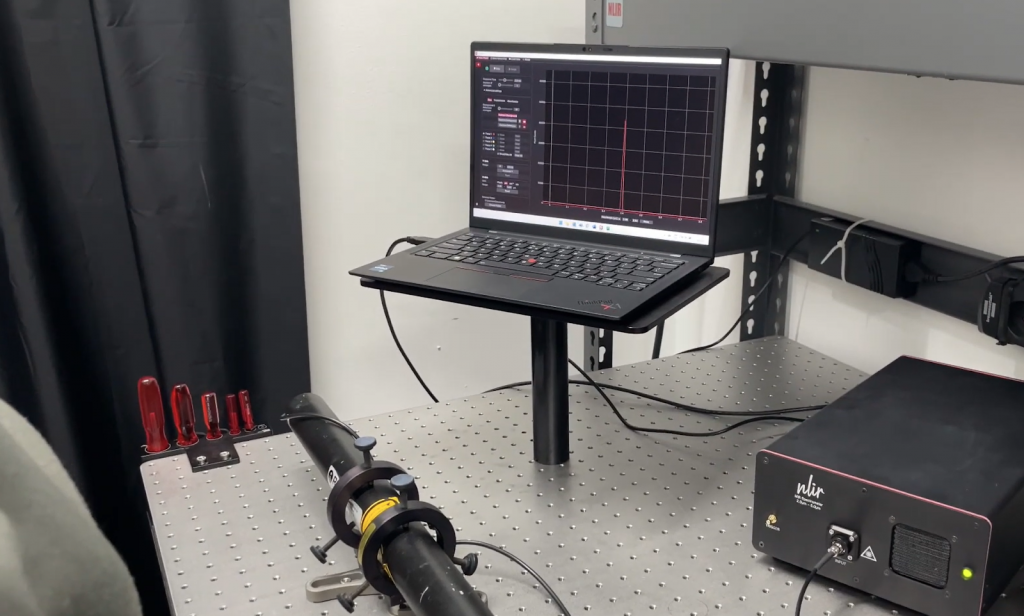
Pulsed Mid-IR laser diagnostics, wavelength tuning monitoring, spectral stability measurement.
Why Use Upconversion Spectroscopy?
Upconversion Mid-IR spectrometers can capture spectral shifts on a pulse-to-pulse basis, providing time-resolved spectral diagnostics.
FTIR Limitations
FTIR systems average over interferometric scans and are generally unsuitable for high-repetition pulsed laser characterization.
2.3 Polymer and Thin Film Identification and Manufacturing
Example Applications:
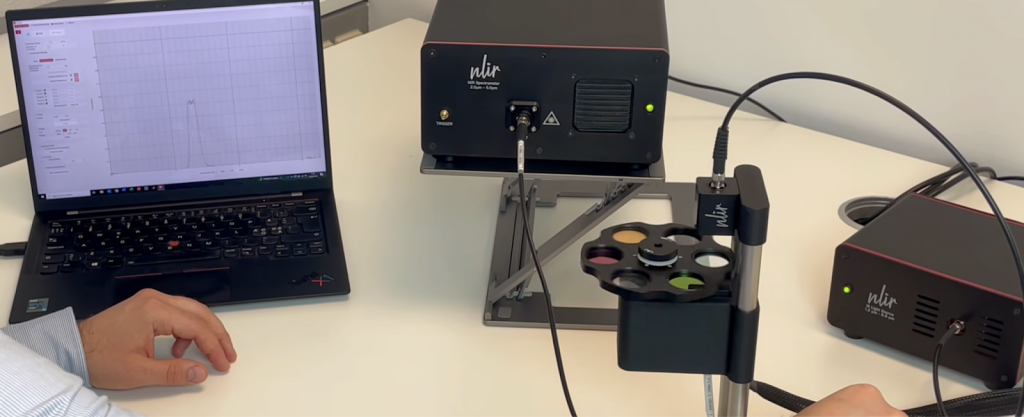
PET, PS, and engineering plastics identification, thin film thickness evaluation, coating uniformity inspection. Both FTIR and upconversion systems detect characteristic absorption bands.
Why Use Upconversion Spectroscopy?
Upconversion technology provides measurements in real time and allows fiber coupling, which makes it industry-ready for high throughput, in-line, applications.
Why Use FTIR?
Wider spectral coverage (e.g., 2.5–25 µm) might be required in some applications.
2.4 Gas Sensing & Environmental Monitoring
Example Applications:
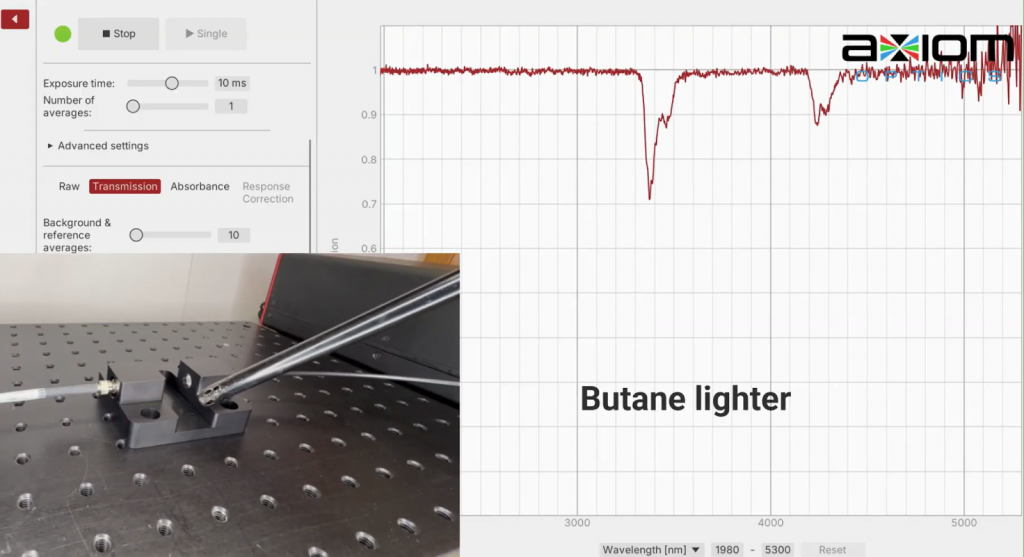
Since many gases have strong absorption lines in the 2–5 µm region, IR spectroscopy can be used for applications involving greenhouse gases and atmospheric monitoring, industrial emissions, indoor air quality assessment, methane leak detection, Volatile Organic Compound (VOC) analysis, etc.
Why Use Upconversion Spectroscopy?
Continuous monitoring, fast detection of transient leaks, compact OEM integration.
FTIR Limitations
FTIR gas analyzers are common in laboratories and stack monitoring but are generally larger, slower, and less suited for compact embedded systems or semi-portable applications.
3. System-Level Advantages of Upconversion Over FTIR
3.1 No Moving Parts
FTIR relies on a scanning mirror inside an interferometer. This introduces mechanical wear, vibration sensitivity, and thus more maintenance requirements. Dispersive/upconversion spectrometers have no moving parts, improving robustness in industrial environments, field deployment, and OEM integration.
3.2 Higher Temporal Resolution
FTIR time resolution is fundamentally limited by mirror scan speed. High-speed Mid-IR spectrometers based on upconversion provide kHz frame rates, fast triggered acquisition, and burst capture. This enables applications such as combustion studies, plasma diagnostics, fast chemical reactions, and laser pulse analysis.
3.3 Reduced Cooling Requirements
Traditional mid-IR detectors (for example, MCT) in FTIR systems require thermoelectric or liquid nitrogen cooling. Upconversion-based detection uses silicon sensors, minimizing thermal background and reducing overall system complexity. No cooling is required. This simplifies integration and lowers operational overhead.
4. When to Choose FTIR vs. Upconversion-based High-Speed Spectroscopy
Choose FTIR if:
- You require very broad spectral range (>5 µm)
- You need highest spectral resolution for fine structural analysis
- Laboratory-based, static sample analysis is sufficient
- Speed is not an issue
Choose NLIR Upconversion Spectroscopy if:
- You need real-time monitoring
- Your process changes rapidly
- You require inline industrial integration
- You are characterizing pulsed or modulated MIR sources
- Mechanical robustness is critical
- Maintaining a cooling system is prohibitive or challenging in your setup
- The 2-5µm band provides the spectral information that you need
- You need a semi-portable solution
5. Conclusion
Using a mid-infrared spectrometer in the 2–5µm range provides powerful molecular insight into materials, gases, and dynamic processes. While FTIR remains a gold standard for broadband laboratory spectroscopy and high resolution, high-speed dispersive mid-IR spectroscopy systems — such as those exemplified by the NLIR Mid-IR spectrometer — offer distinct advantages in real-time monitoring, industrial robustness, laser pulse diagnostics, inline process control, and compact OEM deployment. In environments where speed, stability, and integration matter more than ultra-broad spectral coverage and ultra-high resolution, the NLIR Mid-Infrared spectrometer provides a compelling alternative in the 2-5µm range to conventional FTIR technology.
Related Products
This post was written by:
Rodrigo Sanchez Gonzalez, Technical Sales Engineer