


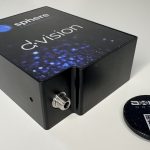
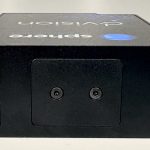
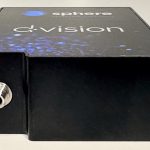
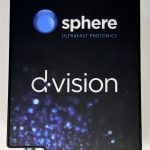
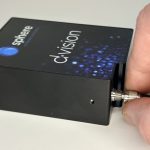


d-Vision SWIR Spectrometer | 500nm – 1700nm
Available Wavelength Range
500nm - 1700nm
Resolution
0.7nm - 3.1nm
Sensor
InGaAs CMOS
Integration Time
10μs - 1s
AD Converter
16-bit
Interface
USB Type-C
 Description
 Specifications
 Applications
 Downloads
d-Vision VIS – SWIR Spectrometer: Single-Sensor Broadband Coverage From 500nm to 1700nm
Experience the full spectral landscape with Sphere Photonics‘ d-vision, an advanced single-sensor spectrometer engineered for comprehensive VIS – SWIR spectroscopic analysis. Covering an expansive wavelength range from 500 to 1700 nm in a single acquisition, d-vision eliminates the need for detector switching or time-consuming spectrum stitching. This is made possible by its high-performance InGaAs spectrometer sensor array, which is precisely engineered to deliver excellent sensitivity across the SWIR and visible range. The result is faster measurements, simplified workflows, and consistently reliable data across the entire spectral band, critical for demanding analytical and industrial SWIR applications.

At the heart of d-vision VIS – SWIR spectrometer is a precision-optimized optical design that combines broadband performance with exceptional spectral fidelity. Its carefully engineered architecture ensures high signal quality and outstanding stability, making it ideal for demanding analytical, industrial, and research applications requiring accurate SWIR measurements. With various grating options, users can tailor performance to their needs, achieving spectral resolutions from 1 nm to 3 nm depending on configuration. This flexibility allows d-vision to adapt seamlessly to applications ranging from fine spectral feature identification to broad material characterization.
Despite its powerful capabilities, d-vision maintains a compact footprint. The integrated single-InGaAs sensor approach reduces system complexity while enhancing robustness and alignment stability—delivering dependable operation in both laboratory and OEM environments. Its streamlined mechanical and optical design ensures long-term reliability without compromising measurement precision.
Where the d-Vision Fits Among Axiom Spectrometers
The d-Vision is a broadband VIS-SWIR spectrometer from Sphere Photonics. Its distinguishing move is covering 500 to 1700 nm on a single InGaAs sensor, so it captures both visible color information and near-infrared molecular absorption in one acquisition, with no detector switching or spectrum stitching. That makes it the reach-into-the-SWIR option in the Axiom spectrometer range: the handheld IndiGo instruments stop around 1000 nm, while the mid-infrared instruments begin at 2 microns. The table below shows how the d-Vision sits between them.
| Instrument | Wavelength range | Detector | Best suited for |
|---|---|---|---|
| d-Vision SWIR (this product) | 500 to 1700 nm | InGaAs CMOS | Broadband VIS-SWIR in a single acquisition |
| IndiGo VIS | 380 to 780 nm | CMOS | General visible spectroscopy, handheld |
| IndiGo NIR | 720 to 1050 nm | CMOS | Near-infrared measurement, handheld |
| IndiGo VIS-NIR | 400 to 1000 nm | CMOS | Combined visible and near-infrared, handheld |
| MIDWAVE | 2 to 5 µm | Upconversion to silicon | Mid-infrared molecular fingerprinting |
Configuring the d-Vision: grating and range options
The d-Vision covers its full 500 to 1700 nm span with selectable gratings, and the grating is chosen to trade total range against resolution. A broad grating captures the widest band at coarser resolution, while a narrow grating concentrates on a smaller window at finer resolution. The options below are representative; other configurations are available on request.
| Range option | Spectral bandwidth | Resolution |
|---|---|---|
| 500 to 1670 nm | 1170 nm | 3.1 nm |
| 800 to 1700 nm | 900 nm | 2.4 nm |
| 500 to 1250 nm | 750 nm | 2.0 nm |
| 650 to 1400 nm | 750 nm | 2.0 nm |
| 950 to 1680 nm | 730 nm | 2.0 nm |
| 980 to 1080 nm | 100 nm | 0.7 nm |
For measurements that fall entirely within the visible, one of the handheld IndiGo spectrometers may be the better fit; for the mid-infrared, see the mid-IR and SWIR spectrometers. The full range is in the spectrometers category.
Key Features at a Glance
-
Broadband VIS–SWIR Coverage (500–1700 nm) – Capture the full spectrum using a single InGaAs Spectrometer
-
Single High-Performance InGaAs Sensor Architecture– No detector switching or spectral stitching required using a single InGaAs sensor approach
-
High Spectral Resolution (1–3 nm) – Selectable gratings for application-specific optimization
-
Compact Design – High performance in a space-saving footprint for easy integration
-
High Signal Integrity & Stability – Precision optics for accurate, repeatable results
-
Flexible Integration – Ideal for laboratory setups, industrial systems, and OEM applications requiring InGaAs-based analysis
-
Intuitive Software Platform – Real-time visualization and SDK for SWIR applications requiring integration
d-Vision SWIR Spectrometer FAQs
What wavelength range does the d-Vision cover?
The d-Vision covers 500 to 1700 nm, spanning the visible and the short-wave infrared (SWIR), and it does so on a single InGaAs sensor in one acquisition. Because the range captures both visible color information and near-infrared molecular absorption features, a single measurement supports material discrimination, chemical composition analysis, and non-destructive testing without changing instruments.
Why is a single-sensor spectrometer better than switching detectors or stitching spectra?
Broadband measurements are often assembled by switching between detectors or stitching together spectra from separate instruments, which adds time, complexity, and potential inconsistency at the joins. The d-Vision uses one high-performance InGaAs sensor to cover the full 500 to 1700 nm span in a single acquisition, so there is no detector switching and no spectral stitching. The result is faster measurements, simpler workflows, and consistent data across the entire band, with the added robustness and alignment stability of a single-sensor design.
What spectral resolution can the d-Vision achieve?
Resolution depends on the grating configuration and ranges from about 0.7 nm to 3.1 nm. A broad grating captures the widest span, up to roughly 500 to 1670 nm, at coarser resolution near 3.1 nm, while a narrow grating concentrates on a smaller window, such as 980 to 1080 nm, at finer resolution near 0.7 nm. Selectable gratings let the instrument be tuned toward either broad material characterization or fine spectral feature identification.
Which grating or range configuration should I choose?
The choice is a tradeoff between total span and resolution. If the goal is to survey a wide range and identify broad features, a full-span configuration is appropriate; if the goal is to resolve fine, closely spaced features in a specific band, a narrower configuration with finer resolution is the better fit. Representative options run from 500 to 1670 nm at 3.1 nm down to a focused 980 to 1080 nm at 0.7 nm, and other configurations are available on request, so the instrument can be matched to the wavelengths and feature spacing the application actually requires.
What applications is the d-Vision used for?
The VIS-SWIR range suits a broad set of analytical and industrial uses. These include material identification and characterization such as polymer and plastic identification, mineral analysis, thin-film and coating characterization, and semiconductor inspection; agriculture and food analysis such as moisture, sugar, fat, and protein measurement and quality grading; chemical and pharmaceutical work such as raw material verification, process monitoring, and blend uniformity; industrial process control such as inline quality control and recycling sorting; environmental monitoring; and research uses such as optical component characterization and reflectance and transmittance measurement.
What sensor and interface does the d-Vision use?
The d-Vision is built around an InGaAs CMOS detector with 512 pixels, paired with a 16-bit analog-to-digital converter and integration times from 10 microseconds to 1 second. It connects over USB Type-C using the USB 2.0 protocol, and its compact 85 by 67 by 30 mm body makes it straightforward to integrate into both laboratory setups and OEM systems.
Does the d-Vision include software, and can it be integrated into a custom system?
Yes. The d-Vision software platform provides real-time spectral visualization, streamlined data acquisition, and analysis tools in a single interface. For system integration and custom development, an optional SDK for Windows and Linux gives full control of the spectrometer’s functions, so developers and OEM partners can build the d-Vision directly into proprietary software, automation platforms, and industrial systems.
How do I get pricing for the d-Vision?
The d-Vision is configured to the application, since the grating and range options affect both span and resolution, so it is supplied on a quote basis rather than at a fixed catalog price. Requesting a quote through the product page, with the wavelength range and resolution the measurement needs, is the fastest way to get an accurate configuration and price.
d-Vision Software and SDK
Complementing the InGaAs spectrometer hardware is the intuitive d-vision software platform, designed to balance simplicity with analytical capability. The software delivers real-time spectral visualization, streamlined data acquisition, and comprehensive analysis tools within a clean, user-friendly interface. From quick routine measurements to advanced spectral evaluations, users benefit from an efficient workflow that reduces setup time and maximizes productivity.

For seamless system integration and custom application development, an optional SDK for Windows and Linux is available. The SDK provides full control of spectrometer functions, enabling developers and OEM partners to integrate d-vision directly into proprietary software environments, automation platforms, and industrial systems. This flexibility ensures that d-vision not only performs exceptionally as a standalone solution but also adapts effortlessly to advanced, application-specific requirements.
With d-vision, broadband VIS–SWIR spectroscopy becomes more accessible, efficient, and precise—transforming wide-range spectral measurement into a seamless, high-performance experience.
d-Vision spectrometer dimensions (mm)
