
When you’re looking at a thermal camera spec sheet, it is easy to confuse ‘resolution’ (the total number of pixels) with the ‘spatial resolution’ (how much actual physical detail you can see on a target). This blog aims at breaking down how pixel size and optics define your detail on the target and how the total pixel count dictates your overall awareness of the scene or context when using a high resolution thermal camera.
How pixel pitch and optics define iFOV
To understand detail on a target, we have to look at exactly what a single pixel ‘sees’. This is called spatial resolution, though engineers usually refer to it as the instantaneous field of view or iFOV. Imagine projecting a laser beam backwards from a single pixel on the sensor of a high resolution thermal camera, out through the lens, and onto your target. The iFOV is the angular width of that beam. When that beam hits a target at a specific distance, it covers a physical area called the spot size.
The formula for calculating iFOV in milliradians (mrad) is:
iFOV = d / f
where d is the pixel pitch in micrometers (µm) and f the lens focal length in millimeters (mm).
If you want to put more pixels on a target far away with your high resolution thermal camera, you need a smaller iFOV. You achieve this by either increasing the focal length (longer focal lengths tend to me more expensive and bulkier/heavier) or decreasing the pixel pitch (smaller pixels on the sensor).
The evolution of thermal microbolometer pixel sizes is a decades-long drive to reduce the size, weight, power, and cost of cameras and their expensive lenses. Starting from bulky 50µm pixels in the 1990s, the industry steadily shrank the standard to 25µm, then 17µm, and down to the highly popular 12µm pitch used in today’s compact drones (click here to browse 12 µm pitch uncooled LWIR cameras with QVGA, VGA and SXGA resolution). Currently, manufacturers are pushing the limits with 10µm and 8µm pixels to create ultra-compact HD sensors, for the next generation of high resolution thermal cameras, though this extreme miniaturization is finally bumping up against the physical boundaries of light diffraction.
How the number of pixels influences field of view
If the iFOV is a single tile in a mosaic, the number of pixels (the camera’s resolution) dictates how many total tiles you have to build the final pictures. This defines the field of view (FOV), often given in degrees (º). Adding more pixels to a sensor does not magnify the image or change the spot size on the target (assuming the pixel pitch and lens remain the same). Instead, it simply adds more pixels to the edges of the sensor, widening your window to the world.
You can calculate your horizontal field of view (HFOV) in degrees using this formula:
HFOV = 2 x arctan ( (n x d) / (2 x f) )
where d is the pixel pitch, n is the number of pixels horizontally and f the lens focal length.
Note that you can also use:
HFOV = n x iFOV x 180/3,140
At constant iFOV, the higher the resolution is, the greater field of view is:
| Lens focal length | iFOV | HFOV (º) for QVGA | HFOV (º) for VGA | HFOV (º) for SXGA |
|---|---|---|---|---|
| 60 mm | 0.2 mrad | ~3.5º | ~7.3º | ~15º |
| 35 mm | 0.34 mrad | ~6.3º | ~12º | ~25º |
| 19 mm | 0.63 mrad | ~11.5º | ~23º | ~46º |
| 9 mm | 1.33 mrad | ~24.5º | ~48º | ~97º |
Real-world example #1 using the Niels 12 high resolution thermal camera
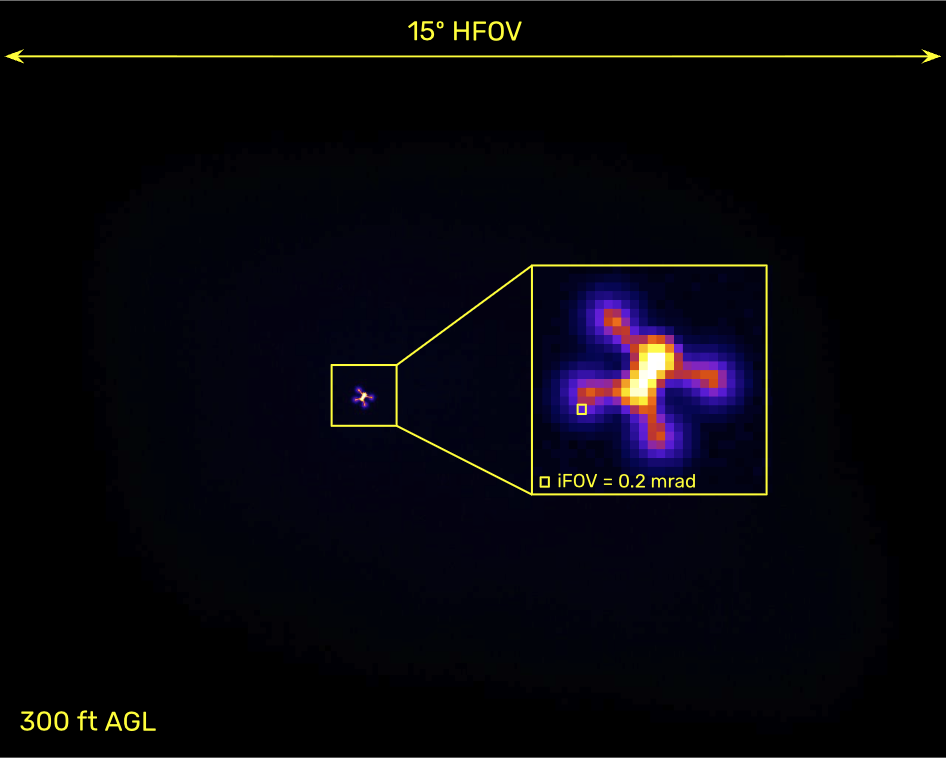
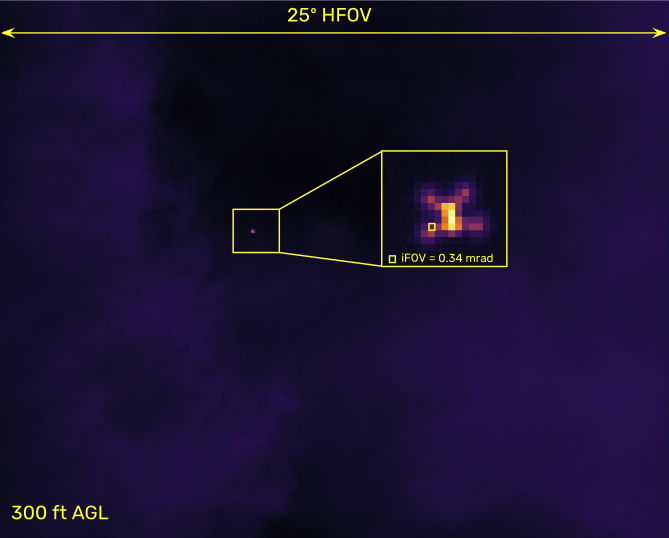
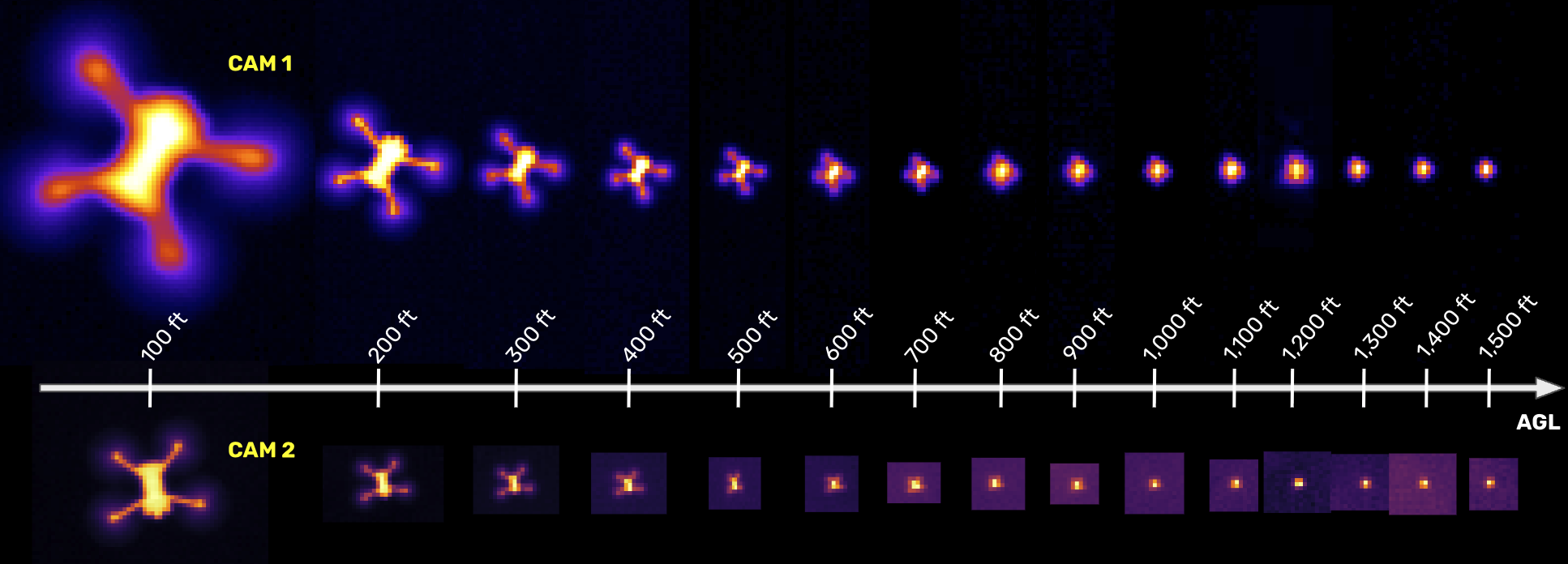
Using a 12 µm pixel pitch, let’s look at a flying drone at increasing altitude (from 100 ft to 1,500 ft) with two different lenses. At constant pixel pitch, the iFOV of a high resolution thermal camera is dictated 100% by the lens focal length.
The longer the focal length, the smaller the iFOV. At constant resolution (here 1280 px horizontally), a smaller iFOV means more pixels on target.
Camera 1: Niels 12
- Resolution = 1280 x 1024 px (SXGA resolution)
- Pixel pitch = 12 µm
- Lens focal length = 60 mm
- Field of view = 15º
- iFOV = 0.2 mrad
Camera 2: Niels 12
- Resolution = 1280 x 1024 px (SXGA resolution)
- Pixel pitch = 12 µm
- Lens focal length = 35 mm
- Field of view = 25º
- iFOV = 0.34 mrad
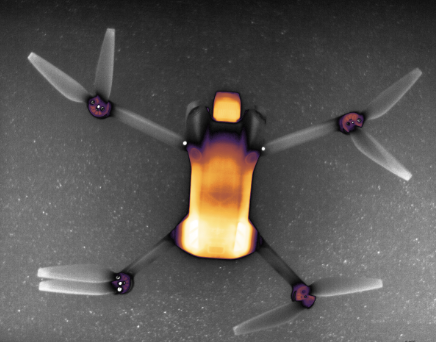
Target: DJl Mini Pro 4
Dim.: 298 × 373 mm (LxW)
How iFOV dictates DRI
DRI stands for Detection, Recognition, and Identification. It is based on Johnson’s Criteria, a standard developed by the military to determine how much resolution is needed to distinguish a target (like a human or a vehicle) on a screen.
Instead of measuring range in abstract terms, DRI translates high resolution thermal camera performance into practical, real-world usefulness based on the number of pixels covering the target:
-
Detection: “I see something warm.” You know an object is present, but not what it is. (Usually requires 1.5 to 2 pixels across the target).
-
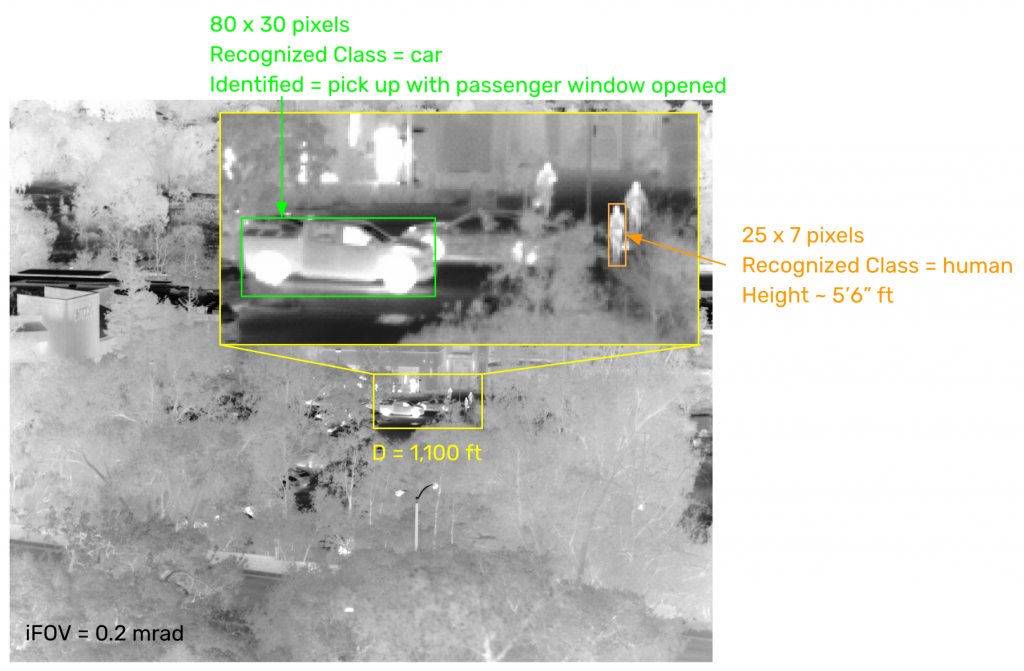
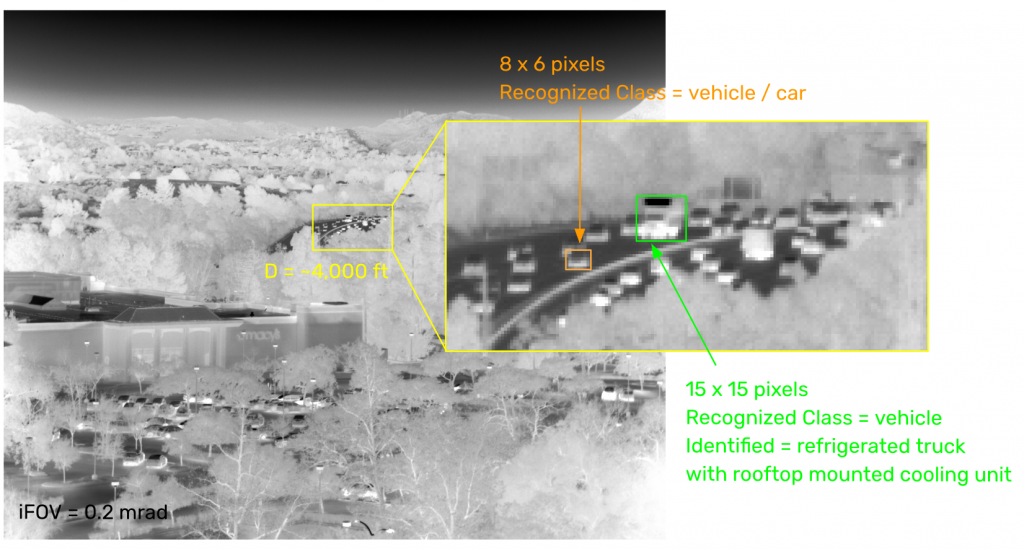
Recognition: “It’s a person, not an animal or a car.” You can determine the class of the object. (Usually requires 6 to 8 pixels across the target).
-
Identification: “It’s a person holding a shovel, not a rifle.” You can determine specific characteristics. (Usually requires 12 to 14+ pixels across the target).
The relationship between the two is straightforward: You use the iFOV to calculate how many pixels will land on your target at any given distance. Once you know the number of pixels on the target, you compare it to Johnson’s Criteria to find your DRI ranges for a specific high resolution thermal camera model.
Here is how they interact in practice:
-
Calculating Distance: If you are trying to “Recognize” a standard human (roughly 1.8 meters tall and 0.5 meters wide), you know you need about 6 pixels across their body. If your camera has a very small iFOV (high resolution), those 6 pixels will cover the human at a much greater distance.
-
Lens and Sensor Dependency: iFOV is determined by the physical size of the pixels on the thermal sensor (pixel pitch) divided by the focal length of the lens. Upgrading to a lens with a longer focal length makes your iFOV smaller, which puts more pixels on the target, pushing your DRI distances further out.
-
The Trade-off: A smaller iFOV gives you excellent DRI ranges (you can identify targets much further away), but it usually means your overall Field of View (FOV) is narrower. It’s the thermal equivalent of looking through a zoomed-in telephoto lens on a high resolution thermal camera.
Real-world example #2
Discover the SeeCube Thermal cameras
This post was written by:
Nick Lechocinski, Co-founder & IR Sales Manager at Axiom Optics Inc