
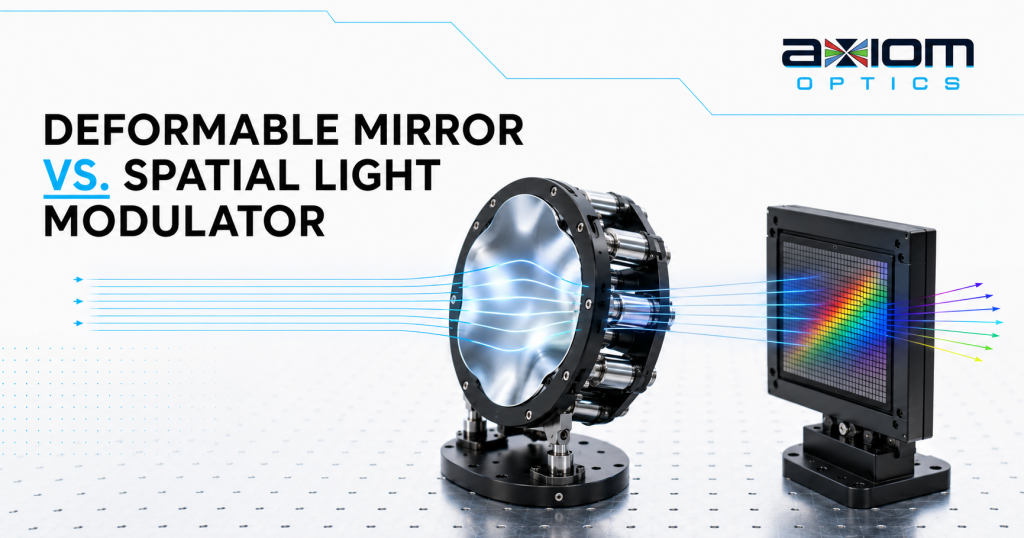
Deformable Mirror vs. Spatial Light Modulator: Which Wavefront Shaper Does Your System Need?
Both devices sculpt the phase of light, yet they solve very different problems. This guide compares actuator counts, stroke, speed, efficiency, and power handling, then helps you match the right technology to your application.
The one-minute answer
Choose a deformable mirror when the job is correcting aberrations: it offers large stroke, kHz-class response, achromatic and polarization-independent operation, and coatings that survive high power lasers. Choose a spatial light modulator when the job is creating complex light fields: with millions of pixels, an SLM generates holograms, multi-spot patterns, vortex beams, and arbitrary phase masks that no mirror surface can reproduce.
Many advanced systems use both, with the DM handling fast, large-amplitude correction and the SLM handling fine spatial structure. The full comparison below explains why.
How Each Technology Works
Deformable mirrors and spatial light modulators are the two workhorse wavefront shapers in modern photonics. Both impose a controllable phase profile on a beam, but they do it through opposite physical strategies: one bends a continuous surface, the other addresses a dense grid of pixels.
A continuous surface, reshaped by actuators
A deformable mirror carries a reflective membrane or faceplate whose shape is controlled by an array of actuators, typically between 19 and a few hundred. Because the path length change happens in reflection, the phase modulation is doubled, achromatic, and independent of polarization.
- Actuator technologies: electromagnetic (fast, large stroke, compact), mechanical (large apertures, extreme damage thresholds), and piezoelectric (high speed focus control).
- Stroke: tens of microns peak to valley, enough to remove strong defocus and low order aberrations in one pass.
- Speed: hundreds of hertz to kHz-class response, suited to closed loop adaptive optics.
- Surface quality: best-in-class devices flatten to a few nanometers RMS, such as the muDM at better than 3 nm RMS.
Millions of pixels, each a tiny phase shifter
A liquid crystal on silicon (LCOS) SLM places a birefringent liquid crystal layer over a reflective CMOS backplane. Each pixel applies an independent, voltage-controlled phase delay to linearly polarized light, so the device behaves like a programmable diffractive optic or computer-generated hologram.
- Resolution: one to ten million pixels, from 1080p panels up to 4K devices like the GAEA-2.1.
- Stroke: roughly one wavelength of phase (2π), extended in practice by phase wrapping.
- Speed: video-rate refresh, typically tens to a couple hundred hertz depending on the model.
- Constraints: requires linearly polarized light, is calibrated per wavelength, and diverts some energy into unwanted diffraction orders.
Interactive: One Aberration, Two Correction Strategies
Drag the slider to increase the wavefront error entering the system, then watch how each device builds its correction. The DM bends a smooth surface; the SLM approximates the same profile with discrete, phase-wrapped pixels.
Deformable Mirror
Continuous surface, large stroke, no wrapping. Dots mark actuator positions.
Spatial Light Modulator
Discrete pixels with 2π phase wrapping: fine detail, limited stroke per pixel.
Head-to-Head Comparison
The table below summarizes how the two technologies differ on the parameters that decide real system performance. Typical values are given for commercial devices; individual models vary, and datasheets on each deformable mirror and spatial light modulator product page carry the exact numbers.
| Parameter | Deformable Mirror | Spatial Light Modulator |
|---|---|---|
| Spatial resolution | Tens to hundreds of actuators; smooth, low order profiles | 1 to 10 million pixels; arbitrary high frequency patterns SLM |
| Phase stroke | Tens of microns PV, doubled in reflection DM | About 2π per pixel, extended by phase wrapping |
| Temporal response | Hundreds of Hz to kHz-class closed loop bandwidth DM | Video-rate refresh, typically 60 to 180 Hz, with liquid crystal settling time |
| Wavelength behavior | Achromatic; works with broadband and ultrafast sources DM | Calibrated per wavelength; dispersion affects broadband beams |
| Polarization | Independent DM | Requires linear polarization aligned to the LC director |
| Optical efficiency | Mirror coating reflectivity, typically above 95 percent DM | High, but reduced by fill factor and light in unwanted diffraction orders |
| Power handling | Dielectric coatings survive high power and high energy beams DM | Limited by liquid crystal heating; moderate CW power with heat sinking |
| Pattern complexity | Smooth Zernike-type shapes only | Holograms, vortex beams, multi-spot arrays, gratings, arbitrary CGH SLM |
Which Device Wins in Your Field?
Specifications only matter in context. Select an application area to see which technology dominates there, and which Axiom Optics products are proven in that use case.
Restoring resolution deep inside tissue
Sample-induced aberrations in two-photon, confocal, and super-resolution microscopy are dominated by smooth, low order modes such as defocus, astigmatism, and spherical aberration. A compact electromagnetic DM at the objective pupil corrects them with large stroke and negligible photon loss, which matters when every fluorescence photon counts.
The muDM and Mirao 52e anchor the AOKit Bio for multiphoton systems, while the transmissive Delta 7 phase plate drops in line at the pupil with no fold in the beam path. SLMs still earn a place here for structured illumination and point spread function engineering, where fine pattern control is the goal rather than correction.
Correcting at full power, from thermal lensing to petawatt focal spots
Liquid crystal layers cannot tolerate the fluence inside a high energy laser chain, so this arena belongs to mirrors. Mechanical DMs accept dielectric high damage threshold coatings, correct at full beam power, and scale to very large apertures. In ultra-intense laser facilities, flattening the wavefront directly raises the Strehl ratio and on-target intensity.
The ILAO Star covers beams from 16 mm to 500 mm for exactly this purpose, and the Zwobbel shifts focus 20 mm in 2 ms for laser welding, cutting, and structuring, replacing mechanical z-stages entirely.
Sculpting light fields a mirror cannot form
Holographic optical tweezers, computer-generated holography, laser beam splitting, vortex and Bessel beam generation, and two-photon holographic photostimulation all demand phase patterns with spatial frequencies far beyond any actuator array. Millions of independently addressed pixels make the SLM the only practical tool for these jobs.
The 4K GAEA-2.1 delivers maximum diffraction angle and hologram fidelity, the analog-addressed ERIS-1.1 provides flicker-free phase stability for interferometry and trapping, and the PLUTO-2.1 and compact LUNA cover general purpose beam shaping from the visible to the near infrared.
Beating turbulence in real time
Atmospheric turbulence evolves on millisecond timescales, so telescope adaptive optics and free space optical communication links demand correction bandwidths that only deformable mirrors provide. A DM in closed loop with a fast wavefront sensor keeps a satellite downlink coupled into a single mode fiber or a stellar image at the diffraction limit.
The CIAO platform packages this loop for SATCOM and astronomy. SLMs remain valuable on the bench in these fields, acting as programmable turbulence simulators that replay Kolmogorov phase screens for hardware-in-the-loop testing before a terminal ever sees real sky.
When the Right Answer Is Both
The comparison is not always a competition. In woofer-tweeter architectures, a deformable mirror removes the large, fast, low order errors while an SLM layers fine, high resolution structure on top, each device operating where it is strongest. Microscopy platforms increasingly pair a DM for system and sample aberration correction with an SLM for holographic stimulation or structured illumination in the same optical train.
Whichever architecture fits, the control side is shared. HASO wavefront sensors close the loop, WaveTune software drives deformable mirrors and spatial light modulators alike, and the WaveKit SDK exposes C++, Python, and LabVIEW interfaces for custom loops, including sensorless image-based optimization. Complete closed loop bundles are available as the AO Kit DM and the AO Kit SLM.
DM or SLM? Answer Five Questions
Recommendation
The Axiom Optics Wavefront Shaping Lineup
Deformable Mirrors
muDM
91 actuators, 15 mm pupil, 300 Hz, better than 3 nm RMS flat. Single USB 3.0 cable, no external controller.
View muDM →Mirao 52e
52 electromagnetic actuators with ±50 µm stroke for closed loop bio-imaging, ophthalmology, and beam shaping.
View Mirao 52e →ILAO Star
Mechanical DM for ultra high intensity lasers. Beams from 16 to 500 mm, full power correction, high damage threshold coatings.
View ILAO Star →Delta 7
Transmissive deformable phase plate, 63 actuators, in-line correction at the microscope pupil with no fold mirror.
View Delta 7 →Zwobbel
Focusing DM at 532 or 1020 nm. 20 mm of focus travel in 2 ms for laser welding, cutting, and structuring.
View Zwobbel →Spatial Light Modulators
GAEA-2.1
4K phase-only LCOS with over 10 million pixels for maximum hologram fidelity and diffraction angle.
View GAEA-2.1 →ERIS-1.1
Analog-addressed 2.4 MP phase SLM with flicker-free stability for interferometry and optical trapping.
View ERIS-1.1 →PLUTO-2.1
The most versatile 1080p phase SLM, with variants spanning visible to telecom wavelengths.
View PLUTO-2.1 →LC 2012
Transmissive XGA SLM for amplitude and phase modulation in education and prototyping.
View LC 2012 →Deformable Mirror vs. SLM: FAQs
In the broadest textbook sense, yes: any device that spatially modulates a light field qualifies. In laboratory and industry usage, however, SLM almost always means a pixelated liquid crystal device, while deformable mirror refers to a continuous reflective surface driven by actuators. This article follows the practical convention, since the two technologies are specified, purchased, and integrated very differently.
For closed loop adaptive optics, the deformable mirror is the standard choice. Its large stroke, kHz-class response, achromatic behavior, and polarization independence match the demands of correcting real, evolving aberrations. An SLM can perform adaptive optics with monochromatic, polarized light at modest speeds, and its high resolution is attractive for correcting complex static aberrations, but its refresh rate and wavelength dependence limit it in dynamic loops.
Only within limits. Absorption in the liquid crystal layer and backplane heats the device, which shifts calibration and can cause permanent damage. Heat-sunk and water-cooled SLM variants extend operation to moderate CW powers, but high energy pulses and kilowatt-class beams belong on deformable mirrors with dielectric coatings, such as the ILAO Star, which is engineered specifically for ultra high intensity laser chains.
Phase modulation in an LCOS device relies on the birefringence of the liquid crystal molecules. Only the component of light polarized along the liquid crystal director experiences the voltage-controlled refractive index change, so the input beam must be linearly polarized and aligned to that axis. Deformable mirrors change the physical path length instead, which is why they work with any polarization state.
Each SLM pixel can only delay light by about one wavelength, roughly 2π of phase. To represent larger wavefront excursions, the drive pattern subtracts whole multiples of 2π, producing the sawtooth Fresnel-style profiles visible in the interactive demo above. Wrapping works perfectly at the design wavelength but introduces errors for other wavelengths, which is one reason broadband systems favor deformable mirrors and their tens of microns of true mechanical stroke.
They can. WaveTune adaptive optics software calibrates and drives Imagine Optic deformable mirrors and common LCOS spatial light modulators in closed loop with HASO wavefront sensors, and the WaveKit SDK provides C++, Python, and LabVIEW interfaces for building custom correction loops around either device. That shared control layer makes hybrid DM plus SLM systems far easier to integrate.
Not Sure Which Wavefront Shaper Fits Your Beam?
Axiom Optics has supported researchers and engineers in adaptive optics, microscopy, high power lasers, and holography for over a decade. Share your wavelength, beam diameter, power, and correction goals, and the team will recommend the right deformable mirror or spatial light modulator, complete with sensors and software.
Talk to an Optics ExpertOr call the Cambridge, MA lab at (617) 221-6636