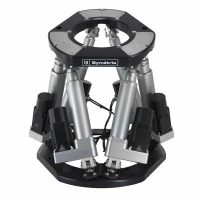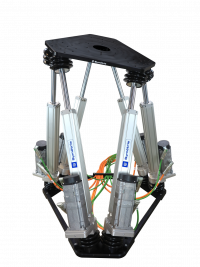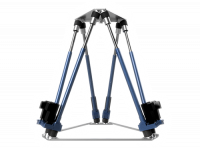
Motion Hexapods
Main advantages & features:
- High speed: Equipped with actuators designed for fast response and high velocities, enabling them to simulate rapid movements, up to 2 m/s.
- High acceleration: Optimized for high acceleration and deceleration rates to simulate dynamic forces accurately, up to 1 g.
- Wide payload capability: Designed to carry heavy payloads up to 5 tonnes, such as vehicle components or passenger cabins, while maintaining dynamic performances.
- Durable design: They are built to withstand repetitive high-force impacts and stresses common in dynamic applications, and are often run continuously for days or even weeks.
- Software control: Sym_Motion advanced GUI and API allows hexapod control through predefined motion patterns or dynamic responses to real-time input, such as joystick commands or sensor data. It is also capable of real-time adjustments to the hexapod’s position and orientation based on input signals, typically used for motion compensation applications.
Symetrie motion hexapods are ranked by maximum payload capability, from the bench-top HEGOA with a maximum payload of 50 kg, to the AQUILON capable of carrying payloads up to 6 tonnes (and more on request.)
Compare the Motion Hexapods
All five Symetrie motion hexapods deliver dynamic movement across six degrees of freedom; the choice comes down to how much payload must move, how far it needs to travel and rotate, and the platform size the setup allows. The table summarizes the range from the bench-top HEGOA up to the six-tonne AQUILON, ordered from lowest to highest payload. Speed, acceleration, and accuracy figures are model specific and listed on each product page.
| Model | Max payload | Linear travel | Angular travel | Platform diameter |
|---|---|---|---|---|
| HEGOA | 50 kg | > ±100 mm | ±23° | 500 mm |
| NOTUS | 100 to 200 kg | See product page | ±25° | 1200 mm |
| MISTRAL | > 1,000 kg | ±400 mm | ±30° | 2278 mm |
| SIROCCO | 2000 kg | ±600 mm | ±40° | 3350 mm |
| AQUILON | 6000 kg | ±800 mm | ±40° | 2100 mm |
Need precise static alignment instead of dynamic motion? See the positioning hexapods, or view the full hexapods range.
How to Choose a Motion Hexapod
Every model in this range is built for dynamic, six-degree-of-freedom motion, so selecting one is less about whether it moves fast enough and more about matching a specific unit to the payload, the amplitude of movement, and the space available. The steps below work through that decision.
Start with payload
Because the range is organized by payload capability, this is the fastest way to narrow the field. The bench-top HEGOA carries up to 50 kg, the NOTUS handles 100 to 200 kg, and the MISTRAL, SIROCCO, and AQUILON step up through more than 1,000 kg, 2,000 kg, and 6,000 kg respectively. Size the hexapod to the full moving mass, including the test article, its fixture, and any cabling, and leave headroom so dynamic performance holds under load.
Match travel to the movement you need to reproduce
Motion simulation only works if the hexapod can reach the full extent of the movement being reproduced, in both translation and rotation. Linear travel runs from more than plus or minus 100 mm on the HEGOA up to plus or minus 800 mm on the AQUILON, while angular travel spans roughly plus or minus 23 degrees to plus or minus 40 degrees across the range. Map the required amplitudes of the sea state, flight profile, or vehicle motion to a model that covers them with margin.
Confirm platform size and footprint
Platform diameters range from 500 mm on the HEGOA to 3350 mm on the SIROCCO, so the mounting surface has to accommodate the payload while the overall footprint fits the test cell or installation. Larger units carry more but need more floor space and infrastructure, so confirm both the top-plate size and the surrounding clearance early.
Weigh dynamic performance and control
Once payload, travel, and size are settled, compare the dynamic figures of the shortlisted models, since speed and acceleration vary by unit and determine how faithfully fast movements are reproduced. These are listed on each product page. Consider also how the hexapod will be driven: the Sym_Motion software supports both predefined motion patterns and real-time response to external input such as joystick or sensor data, which matters for closed-loop testing and motion-compensation applications.
Application fit
Finally, sanity-check the choice against the intended use. Smaller units such as the HEGOA and NOTUS suit test benches and compact motion setups, while the larger MISTRAL, SIROCCO, and AQUILON are built for vehicle and cabin testing, sea-state simulation, and flight or driving simulators where both heavy payloads and continuous operation are required. The hexapod applications page has more detail on these use cases.
Motion Hexapod FAQs
What is a motion hexapod?
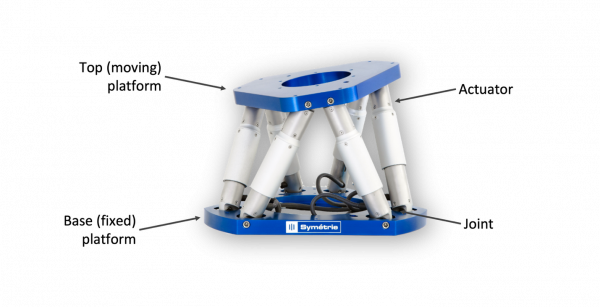
A motion hexapod, also called a dynamic hexapod, is a Stewart platform built to move a payload rapidly and smoothly through all six degrees of freedom rather than simply holding it in a precise position. Six coordinated actuators drive the platform in translation and rotation at high speed and acceleration, which lets it reproduce real-world movement for testing and simulation.
How is a motion hexapod different from a positioning hexapod?
The two share the same six-actuator architecture but are optimized for opposite priorities. A positioning hexapod focuses on precision, resolution, and stable fine alignment, while a motion hexapod prioritizes speed, acceleration, and continuous dynamic movement. If the goal is to reproduce or simulate motion, a motion hexapod is the fit; if the goal is exact static placement, a positioning hexapod is the better choice.
What are motion hexapods used for?
They reproduce the movement of vehicles, aircraft, and ships so that onboard instruments and systems can be tested, and they drive flight and driving simulators for training. Common applications include vehicle and component testing, multi-axis test benches, sea-state and swell simulation, and motion compensation, where the hexapod counteracts external movement in real time. Engineers use them wherever a controlled, repeatable dynamic motion is needed.
How do I choose the right motion hexapod?
Start with the payload, since the range is organized by capacity from the 50 kg HEGOA up to the 6,000 kg AQUILON. Then confirm the linear and angular travel needed to reproduce the target movement, check that the platform diameter and footprint suit the payload and the space, and finally compare the speed and acceleration of the shortlisted models against the requirement. The comparison table and selection guide on this page walk through each step.
What payloads can motion hexapods carry?
The range spans a wide payload envelope, from 50 kg on the bench-top HEGOA up to 6,000 kg, or six tonnes, on the AQUILON, with higher capacities available on request. This makes it possible to move loads ranging from instrument packages and small assemblies up to vehicle components and passenger cabins while maintaining dynamic performance.
How are motion hexapods controlled?
Symetrie motion hexapods are driven by the Sym_Motion software, which provides a graphical interface and an API. It can run predefined motion patterns or respond in real time to external input such as joystick commands or sensor data, and it supports real-time adjustment of position and orientation for motion-compensation applications. This makes the hexapods suitable for both scripted test sequences and closed-loop, interactive use.
Can motion hexapods run continuously?
Yes. Motion hexapods are built to withstand the repetitive high-force impacts and stresses of dynamic use and are designed to run continuously for days or even weeks at a time. This durability is what makes them suitable for extended test campaigns and long-duration simulation.