
Plane-parallel windows, dichroic filters, and coated flats are some of the hardest parts to certify with a Fizeau interferometer. The back surface adds its own reflection to the fringe pattern, a single laser wavelength may not match the part’s design wavelength, and vibration can wash out the fringes before a measurement is complete. Double-pass wavefront sensing, as implemented in the MESO metrology system from Imagine Optic, takes a different route: a Shack-Hartmann sensor measures wavefront slopes with an incoherent source, so none of those effects corrupt the raw signal.
This article compares the two approaches for plane-parallel, coated, and strongly curved optics, using experimental results from Imagine Optic France. For a broader, instrument-level comparison, see our guide to Shack-Hartmann vs. interferometer wavefront measurement.
Key takeaways
- Fizeau interferometry still leads on height resolution (sub-nanometer) for optical flats and mirrors in a controlled lab.
- Double-pass wavefront sensing reaches about 3 nm height resolution while tolerating vibration, turbulence, and large surface errors.
- With an incoherent source, the back-surface reflection of a plane-parallel optic creates no interference artifacts, and the patented POP method uses it to recover both surfaces and the transmitted wavefront in one setup.
- Up to four wavelengths from 405 to 1064 nm let you measure coated optics at their design wavelength.
How a Fizeau Interferometer Measures a Surface
An interferometer is a phase-sensitive instrument that converts differences in optical path length (OPL) into measurable intensity variations. Its operation rests on the superposition of coherent electromagnetic waves. For a monochromatic plane wave, the electric field can be written as:
E(r, t) = E0 cos(k·r − ωt + φ)
When two coherent waves E1 and E2 overlap, the detected intensity is proportional to the time-averaged square of the total field:
I ∝ ⟨|E1 + E2|2⟩
which expands to:
I = I1 + I2 + 2√(I1I2) cos Δφ
where Δφ is the phase difference between the two beams. That phase difference is set directly by the optical path difference (OPD):
Δφ = (2π / λ) · Δ(OPL), with OPL = n · L
where n is the refractive index and L is the geometric path length. A path change of only a fraction of a wavelength therefore produces a measurable fringe shift. For visible light at λ ≈ 633 nm, a 2π phase shift corresponds to one wavelength of path change, and phase interpolation techniques push displacement sensitivity below a nanometer.
In a Fizeau interferometer, one of the classical instruments for optical surface testing, the interference forms between a reference surface and the test surface (Figure 1).
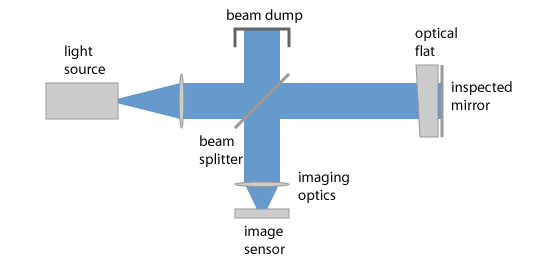
The Fizeau interferometer’s main strength is resolution, and its stability and surface-figure accuracy make it a standard tool for testing optical flats and mirrors. Its dynamic range is limited, however: phase ambiguity makes large surface errors and steep features difficult to resolve. It is also highly sensitive to vibration, which blurs the interference pattern, and to temperature changes, so it often needs a controlled environment.
Interferometers remain the standard for sub-nanometer metrology. High-performance, factory-calibrated Shack-Hartmann wavefront sensors (SHWFS) typically reach about 3 nm height resolution and offer three advantages over single-wavelength interferometry: larger dynamic range, lower sensitivity to environmental noise, and faster, simpler operation suited to industrial settings. For background on the technique, see our brief history of Shack-Hartmann wavefront sensing.
Double-Pass Wavefront Sensing with the MESO System
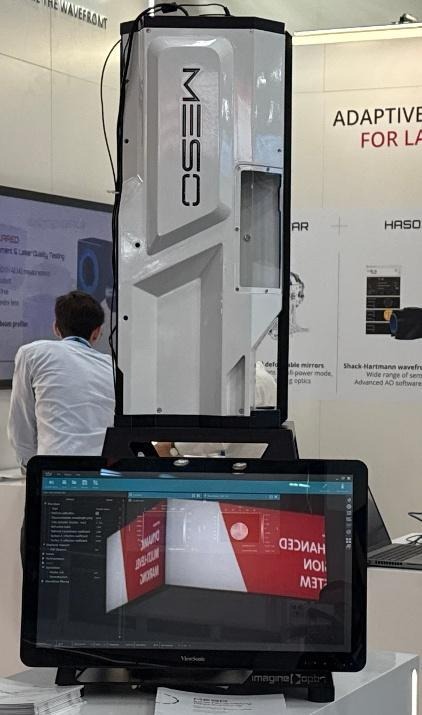
MESO is a compact metrology system for plane-parallel optics built on Shack-Hartmann wavefront sensing, designed as a robust alternative to traditional interferometry. Its main capabilities:
- Multi-wavelength wavefront sensing
- Tolerance to air turbulence and vibration
- No back-surface reflection artifacts on plane-parallel optics
- Front and rear surface characterization with one click
- Optical zoom that keeps full resolution across 1.5 to 6 inch optics
Conventional wavefront sensors need an external beam. MESO integrates its illumination in a double-pass configuration (the “double-path” setup in this article’s address), so the wavefront is measured after propagating through the optical element. A microlens array measures wavefront slopes from centroid positions to reconstruct a full phase map, while the LIFT (Linearized Focal-plane Technique) enhances resolution up to 16 times by also analyzing the intensity distribution within each centroid. With single-frame acquisition of about 20 ms, strong vibration resistance, and a very short optical path, MESO delivers fast, stable, high-precision measurements in demanding environments.
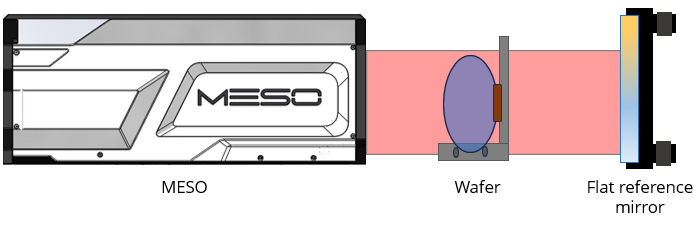
The sections below compare MESO double-pass wavefront sensing with traditional Fizeau interferometry, illustrated with experimental results from Imagine Optic France.
Multi-Wavelength Wavefront Sensing: Measure at the Design Wavelength
The most fundamental advantage of MESO is multi-wavelength measurement. Because the measurement principle does not rely on interference, it needs no long-coherence laser. That opens the door to compact, cost-efficient light sources available at almost any wavelength, with up to four combined in a single system.
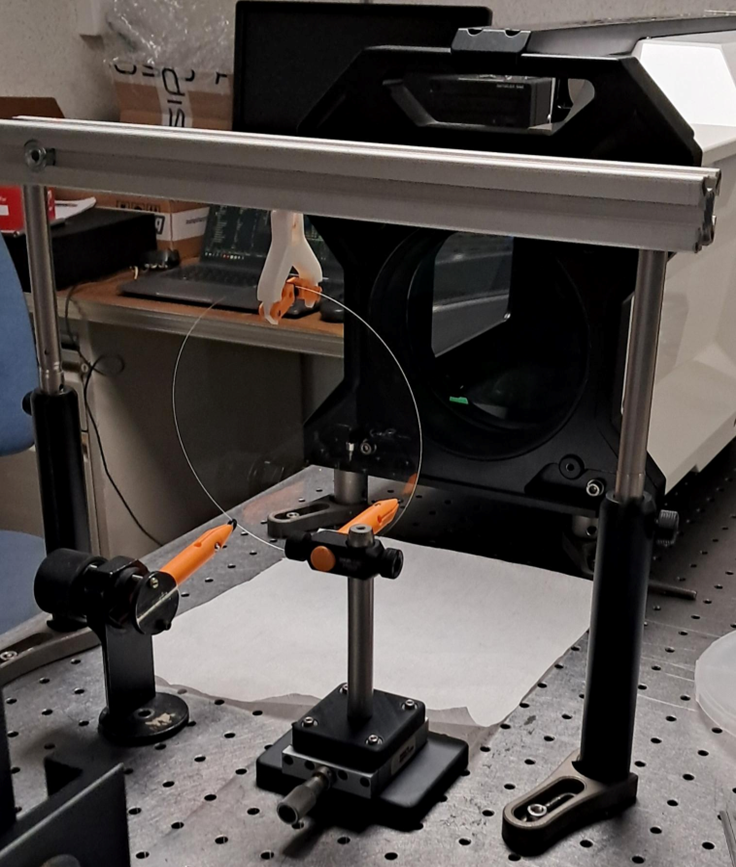
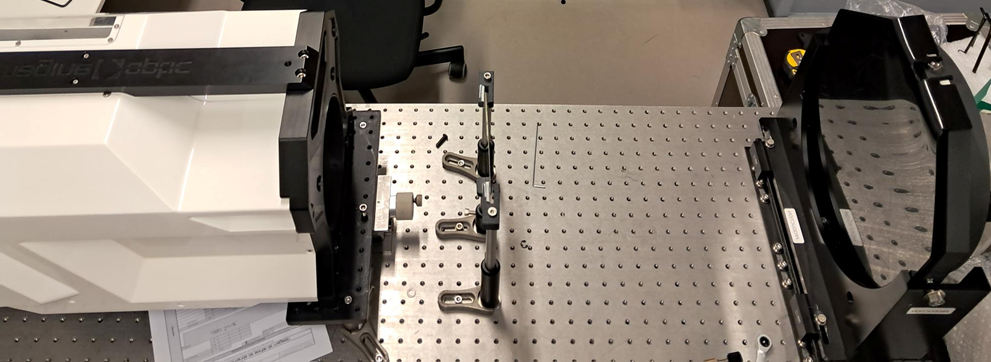
Measuring at the exact wavelength a component was designed for removes assumptions about its spectral behavior. It also lets the instrument adapt to the part: MESO can characterize coated flat optics such as dichroic components by switching to the wavelength that returns a usable signal, rather than struggling with weak reflections. One wavelength can measure transmitted wavefront error (TWE) while another measures reflected wavefront error (RWE), each with a single click.
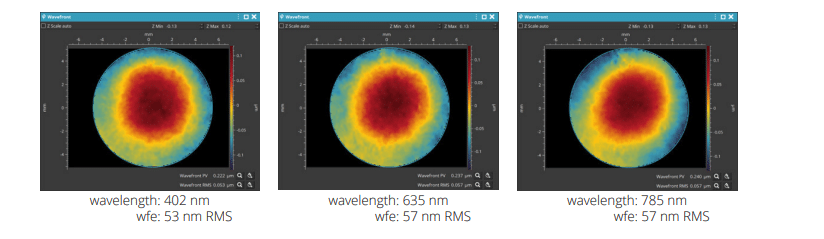
An achromatic implementation supports this from 405 to 1064 nm. In Figure 4, the same component was measured at three wavelengths (402, 635, and 785 nm) without any system realignment, and the results agree closely across all three. For a related approach that pairs a wavefront sensor with a broadband source, see multi-wavelength optical metrology with a supercontinuum laser.
Vibration and Air Turbulence: Why Wavefront Sensing Stays Stable
Air turbulence introduces random fluctuations in refractive index, causing tiny but rapid changes in optical path. Interferometers rely on stable phase across the entire aperture, so they are highly sensitive to these fluctuations: if the optical path difference shifts by even a fraction of a wavelength, the fringes wash out, and any vibration or airflow can destroy coherence.
Shack-Hartmann wavefront sensing is well suited to hostile environments, including those with vibration or turbulence from motors, pumps, blowers, or even people working nearby. Unlike Fizeau and many other interferometric techniques, these disturbances do not corrupt the raw signal that must be analyzed. The robustness comes from speed: the sensor captures each measurement on a timescale of tens of microseconds (about 20 µs), which effectively freezes the instantaneous wavefront before environmental perturbations can degrade the raw data.
Turbulence or vibration can still add a temporary effect, such as a small tilt component in the measured wavefront, but the measurement itself remains valid. Averaging several acquisitions then reduces the environmental noise while preserving the underlying optical information.
Test case: a mirror in a running vacuum chamber
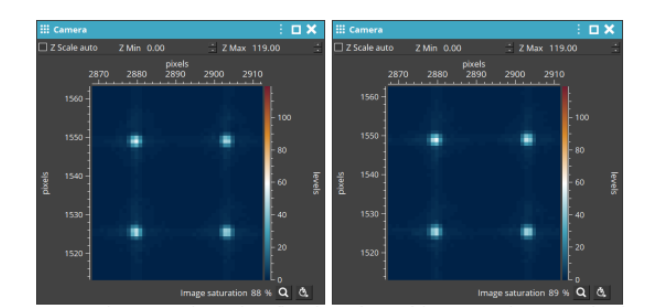
To demonstrate this, a mirror placed inside a vacuum chamber was measured with MESO before and after the vacuum pump was switched on (Figures 5 to 7).
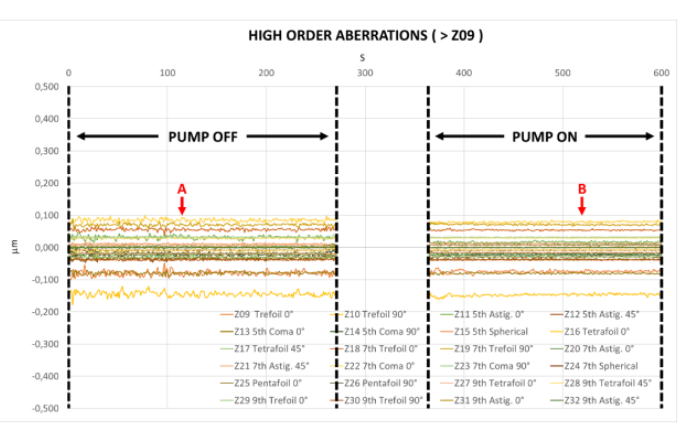
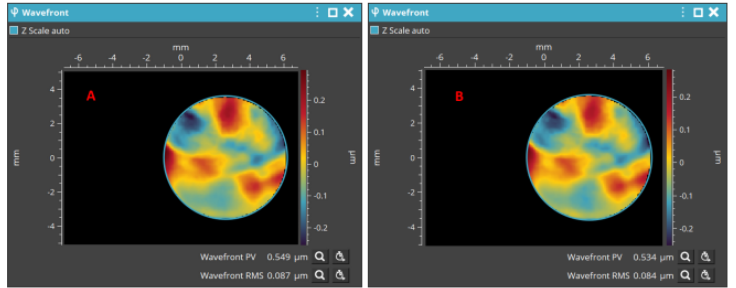
As the Zernike plot predicts, the two wavefront maps match: the wavefront error is 87 nm RMS with the pump off and 84 nm RMS with the pump on. That 3 nm difference, or λ/170, sits well within the accuracy and repeatability of the instrument.
The raw signal is not compromised either. Centroid size and intensity distribution are the same whether the pump is off or on (Figure 7).
Why Plane-Parallel Optics Are Hard to Measure with a Fizeau Interferometer
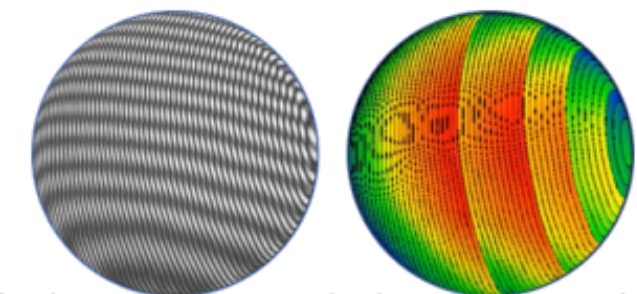
Plane-parallel optics such as windows, wafers, and filters are a well-known challenge for established metrology tools, laser interferometers included. Light reflects from both the front and the back surface, and in an interferometer the unwanted back-surface reflection joins the interference pattern as a third beam. The fringes then mix information from both surfaces and leave artifacts in the reconstructed phase map, as Figure 8 shows.
How other optical metrology approaches compare
Several other techniques are used on plane-parallel and precision optics, each with its own trade-off:
- Laser interferometry provides high-precision surface measurement, but fringe ambiguity and strong sensitivity to alignment errors make parallel optics difficult.
- Multi-wavelength or tunable interferometry resolves phase ambiguity by combining wavelengths, at the cost of added system complexity and sensitivity to environmental noise.
- Deflectometry measures surface slope instead of height, which reduces fringe issues, but it requires complex reconstruction and has limited absolute height accuracy.
- Scanning probe methods deliver very high accuracy and direct surface measurement, but they are slow and not suited to large-area optics.
- Optical coherence techniques improve depth discrimination and reduce ambiguity, but come with higher cost and limited lateral resolution.
- Confocal microscopy enables depth-resolved measurement with good vertical resolution, but has a limited field of view and slower acquisition over large surfaces.
The POP Method: Measure Both Surfaces Without Flipping the Part
Wavefront sensing handles parallel optics through POP (Plane Parallel Optics), a patented method developed by Imagine Optic. Instead of trying to cancel the back reflection from the second surface, POP uses it.
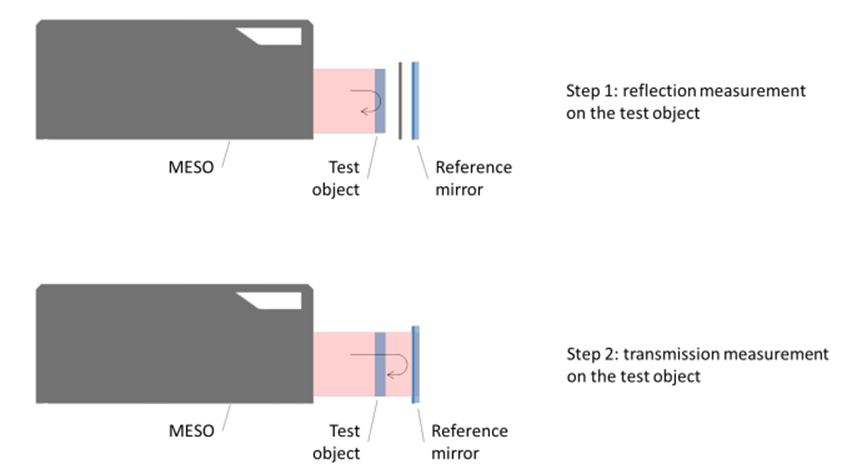
The procedure has two steps (Figure 9). First, the optic, already aligned in double pass, is measured in reflection. The acquired signal (the centroids) combines light reflected by the first and the second surface. That is not a problem here, because the wavefront sensor uses a temporally incoherent source, so no destructive interference forms to compromise the signal. Second, a measurement is taken in transmission, again in double pass, using a flat reference mirror.
Combining the two measurements, and assuming a homogeneous substrate, recovers the profiles of the front and rear surfaces (reflected wavefront, RW) and the transmitted wavefront (TW, which is the second measurement itself). The sample never moves between steps, which avoids differential aberrations from handling or flipping it, and both acquisitions share the same reference frame, so no fiducials are needed to register them. For a worked example on thin glass wafers, see our double-sided metrology procedure for thin plane-parallel optics.
MINI MESO for Strongly Curved Surface Measurements
MINI MESO offers a dynamic curvature range from about 0.008 m to infinity (a plane wave). This range, enabled by compatible wavefront sensors, lets the system measure strongly curved surfaces as well as plane-parallel optics.
Highly curved optics are a real problem for conventional interferometry. As curvature increases, the interference fringes become very dense, which leads to fringe crowding, reduced fringe contrast, and harder phase unwrapping and reconstruction. In extreme cases the fringe density exceeds the spatial resolution of the detector, and accurate phase retrieval becomes unreliable or impossible.
MINI MESO does not rely on fringe density for phase reconstruction. It captures the wavefront slope directly within its dynamic range, which keeps measurements robust on steep or strongly curved surfaces, removes the fringe-crowding limit, and simplifies alignment and data processing. It is also compact and lightweight: because it needs no large collimated beam at the input, it needs no long-focal-length optics, and the footprint shrinks without giving up measurement capability. Curvature data is useful for alignment too; see optical alignment using radius of curvature measurement.
Fizeau Interferometry vs. Double-Pass Wavefront Sensing at a Glance
Fizeau interferometry remains the reference for sub-nanometer surface figure on optical flats and mirrors. Double-pass wavefront sensing with a Shack-Hartmann sensor, as implemented in MESO, trades a small amount of resolution for wider dynamic range, robustness to vibration, multi-wavelength capability, and speed.
| Dimension | Fizeau / laser interferometry | Double-pass wavefront sensing (Shack-Hartmann, MESO) |
|---|---|---|
| Measurement principle | Interference between a reference surface and the test surface, with surface error encoded in the fringe phase | A microlens array measures wavefront slopes from centroid positions and reconstructs a full phase map, with no interference required |
| Height resolution | Sub-nanometer | About 3 nm for factory-calibrated sensors, with the LIFT technique enhancing resolution up to 16 times |
| Dynamic range | Limited; phase ambiguity makes large surface errors and steep features difficult | Large; slope is captured directly without relying on fringe counting |
| Vibration and air turbulence | Highly sensitive; fringes wash out and a controlled environment is often required | Robust; each capture takes tens of microseconds, freezing the wavefront, and averaging reduces residual tilt |
| Acquisition speed | Slower, and typically needs a stable setup | Single-frame acquisition in about 20 ms |
| Light source and wavelength | Long-coherence, typically single-wavelength | Temporally incoherent source, up to four wavelengths from 405 to 1064 nm with an achromatic response, so parts are measured at their design wavelength in transmitted or reflected wavefront error |
| Plane-parallel optics | Back-surface reflection adds a third beam that creates artifacts in the reconstructed phase map | Handled by the patented POP method, which uses the back-surface reflection instead of canceling it, in a two-step reflection and transmission measurement |
| Curved or steep surfaces | Fringe crowding, reduced contrast, and difficult phase unwrapping as curvature increases | MINI MESO captures slope directly across a curvature range from about 0.008 m to infinity, with no fringe crowding |
| Footprint and setup | Needs a large collimated beam and long-focal-length optics, plus a controlled environment | Compact and lightweight with a very short optical path; MINI MESO needs no large collimated input beam |
| Typical best fit | Optical flats and mirrors, sub-nanometer surface figure in controlled labs | Plane-parallel and coated optics, multi-wavelength testing, and fast measurement in industrial or hostile environments |
Explore the MESO metrology system, the full range of turnkey multi-wavelength metrology systems and wavefront sensors, or browse wavefront sensing applications.
Conclusion: Which Method Fits Your Part?
If your work is sub-nanometer surface figure on optical flats and mirrors in a stable lab, a Fizeau interferometer is still the right reference. If you measure plane-parallel windows, wafers, or coated optics, need results at a specific design wavelength, or work where vibration and airflow cannot be eliminated, double-pass wavefront sensing is the more practical fit.
The experimental data shows what MESO delivers in those conditions: consistent results across three wavelengths without realignment, a 3 nm RMS difference with a vacuum pump running, and front surface, rear surface, and transmitted wavefront from one setup without moving the sample. Together with flexible measurement distances and one-click double-surface characterization, it simplifies optical testing that is slow or impractical with conventional interferometry.
Measuring plane-parallel, coated, or curved optics? Contact Axiom Optics to discuss your parts and measurement requirements with our wavefront metrology team.
Plane-Parallel Optics Metrology FAQs
Why are plane-parallel optics difficult to measure with a Fizeau interferometer?
Light reflects from both the front and the back surface of a plane-parallel optic. In a Fizeau interferometer, the back-surface reflection adds a third beam to the interference pattern, so the fringes mix information from both surfaces and the reconstructed phase map shows artifacts.
What is double-pass wavefront sensing?
In a double-pass configuration, light travels through or off the optic under test and returns to a Shack-Hartmann wavefront sensor, so the measured wavefront carries the optic’s aberrations. The MESO system integrates its own illumination this way instead of needing an external beam like a conventional wavefront sensor. A microlens array measures local wavefront slopes from centroid positions, and the software reconstructs a full phase map from those slopes.
How does the POP method measure both surfaces without flipping the optic?
POP uses the back-surface reflection instead of canceling it. MESO first measures the optic in reflection, capturing light from both surfaces, then measures it in transmission in double pass against a flat reference mirror. Because the source is temporally incoherent, the two reflections do not interfere. Combining the two measurements, and assuming a homogeneous substrate, recovers the front and rear surface profiles and the transmitted wavefront, with no handling of the sample between steps and no fiducials needed to register the data.
Can one instrument measure both transmitted and reflected wavefront error on coated optics?
Yes. MESO supports up to four wavelengths from 405 to 1064 nm with an achromatic response, so one wavelength can measure transmitted wavefront error (TWE) and another reflected wavefront error (RWE) on the same coated part, such as a dichroic. Measurements of one component at 402, 635, and 785 nm agreed closely with no realignment.
How accurate is wavefront sensing when vibration is present?
Each capture takes on the order of tens of microseconds, which freezes the instantaneous wavefront, so vibration and airflow do not corrupt the raw signal. Residual effects such as a small tilt can be averaged out over several acquisitions. In one test, a mirror in a vacuum chamber measured 87 nm RMS with the pump off and 84 nm RMS with the pump on, a 3 nm difference that sits within the instrument’s accuracy and repeatability.
When is a Fizeau interferometer still the better choice?
When the priority is the finest possible height resolution on optical flats and mirrors in a controlled, vibration-isolated lab. Interferometry reaches sub-nanometer surface figure accuracy, while factory-calibrated Shack-Hartmann sensors typically reach about 3 nm, improved further by the LIFT technique. For an instrument-level comparison beyond plane-parallel optics, see Shack-Hartmann vs. Interferometer.
What can MINI MESO measure that an interferometer struggles with?
Strongly curved surfaces. MINI MESO covers a curvature range from about 0.008 m to infinity. Interferometers struggle as curvature increases because the fringes crowd together, contrast drops, and phase unwrapping becomes unreliable. MINI MESO captures wavefront slope directly, so fringe density is not a limit, and it stays compact because it needs no large collimated input beam.
This post was written by:
Anastasia Sklia, Technical Sales Engineer