
Raman spectroscopy is a powerful analytical technique used to provide detailed information about a sample, particularly in terms of its chemical composition and structure. At the heart of every Raman system is the Raman laser, a critical component that has a direct impact on the quality and sensitivity of spectroscopic measurements.
Understanding the Role of the Raman Laser
The fundamental principle of Raman spectroscopy relies on the inelastic scattering of monochromatic light, typically from a laser source. When a Raman laser interacts with a sample, most of the light is scattered elastically (Rayleigh scattering) at the same wavelength as the incident light. However, a small fraction of the light undergoes inelastic scattering (Raman scattering), where the photons gain or lose energy from molecular vibrations. This shift in energy provides a unique spectral fingerprint for the molecules within the sample.
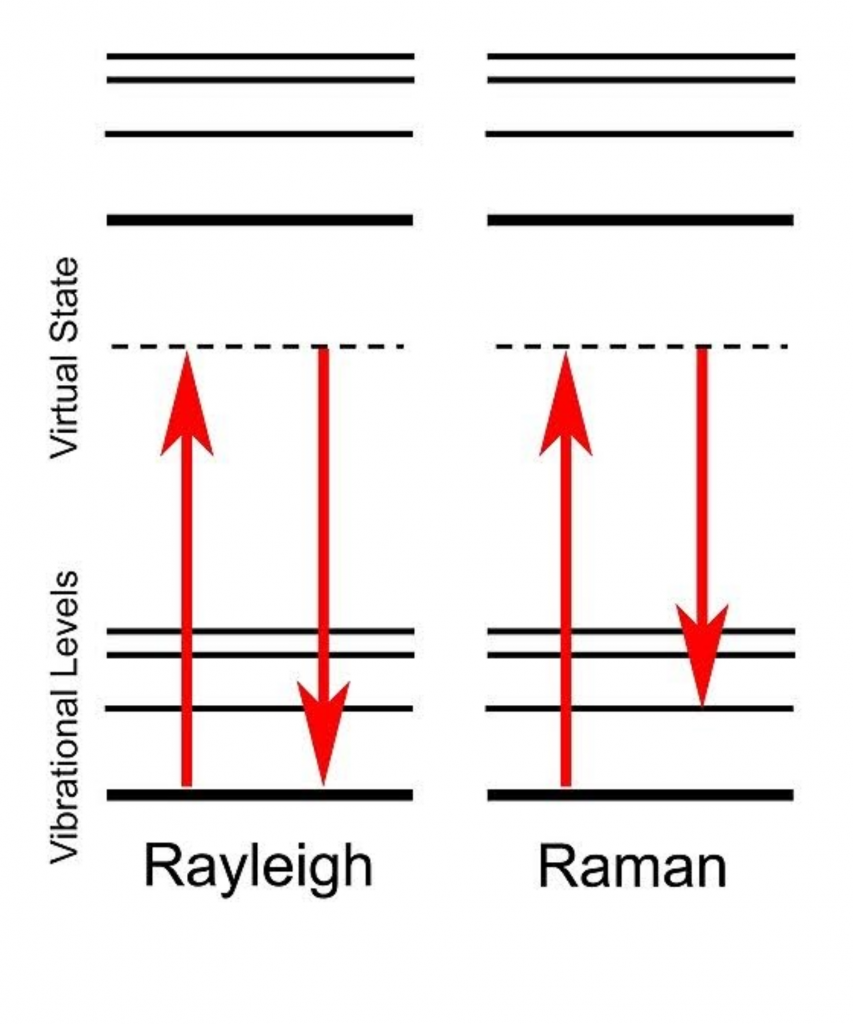
Figure 1. Energy level diagram showing inelastic Raman scattering vs. elastic scattering (Rayleigh).
The choice of Raman laser is critical because its characteristics directly influence several key aspects of the measurement:
- Wavelength: Different laser wavelengths can affect the efficiency of Raman scattering, the degree of fluorescence interference, and the penetration depth into the sample. Common wavelengths include 532 nm (green), and 785 nm (near-infrared).
- Power: Higher laser power generally leads to stronger Raman signals, but it can also induce sample heating or damage, especially with sensitive materials. Careful power management is essential.
- Stability: A stable Raman laser with consistent output power and wavelength is crucial for reproducible and accurate measurements.
- Linewidth: A narrow laser linewidth ensures that the excitation energy is well-defined, leading to sharp and well-resolved Raman peaks.
Common Raman Laser Wavelengths and Their Applications
The selection of a specific wavelength is often dictated by the sample’s properties and the analytical goals.
| Wavelength (nm) | Advantages | Disadvantages | Typical Applications |
|---|---|---|---|
| 532 | High Raman scattering efficiency, good for inorganic materials | High fluorescence interference, can cause sample heating | Semiconductors, carbon materials, geological samples |
| 633 | Reduced fluorescence compared to 532 nm | Moderate Raman scattering efficiency | Art and archaeology, pigments, polymers |
| 785 | Significantly reduced fluorescence, deeper penetration | Lower Raman scattering efficiency | Biological samples, pharmaceuticals, food analysis |
| 1064 | Minimal fluorescence interference, ideal for highly fluorescent samples | Very low Raman scattering efficiency, more expensive detectors | Highly fluorescent biological tissues, oils, highly colored samples |
Advancements in Raman Laser Technology
The development of new Raman laser technologies continues to push the boundaries of what is possible with Raman spectroscopy. Miniaturized lasers, tunable lasers, and fiber-coupled lasers are making Raman systems more portable, versatile, and user-friendly. These advancements are expanding the application of Raman spectroscopy into new fields, from point-of-care medical diagnostics to on-site environmental monitoring. For example, the Lambda Wavelock from RGB is a CW laser that provides an exceptionally stable single mode emission with a wavelength stability <0.015 nm and a spectral linewidth as small as <0.05pm, it is super compact and can be fiber coupled to facilitate its use in a variety of setups.
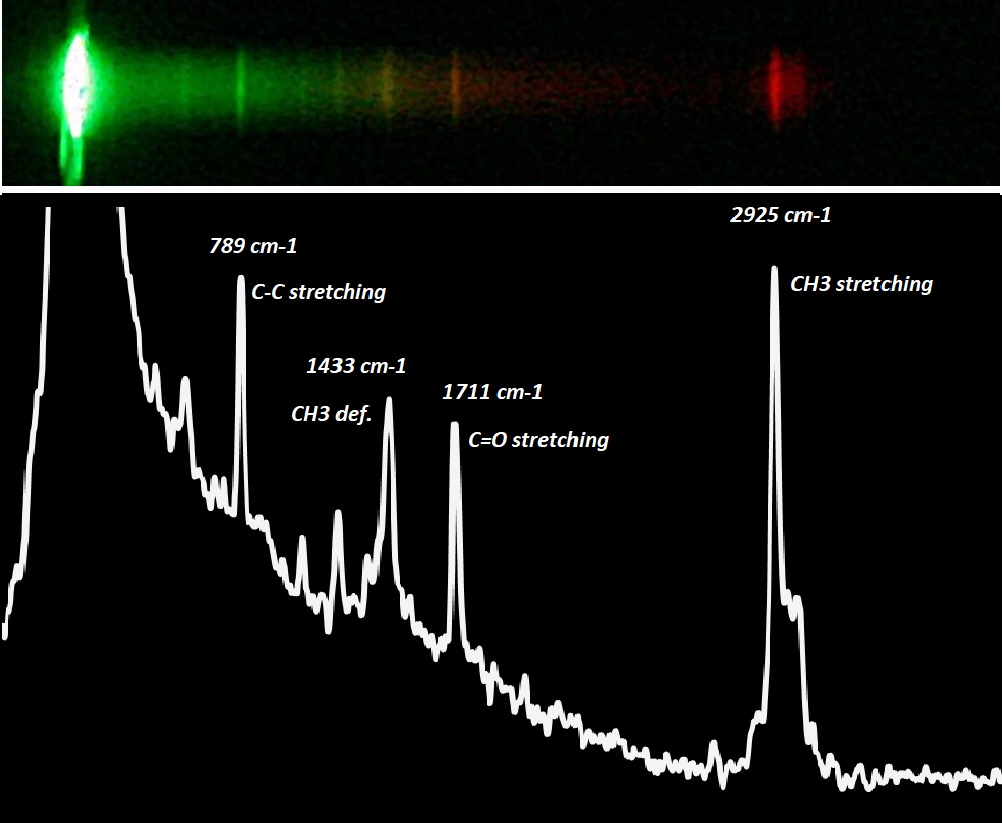
Figure 2. Acetone Raman spectrum obtained using a green laser.
Conclusion
As laser technology continues to evolve, we can expect even more sophisticated and accessible Raman systems. Advancements in compact, stable, and more powerful lasers, coupled with improved detectors and data analysis techniques, are leading to higher sensitivity, faster acquisition times, and broader applicability. The integration of Raman spectroscopy with other analytical techniques and the development of portable, handheld devices are further solidifying its role as an indispensable analytical tool in the scientific world, pushing the boundaries of what we can understand at the molecular level.
Related product:
This post was written by:
Rodrigo Sanchez Gonzalez, Technical Sales Engineer