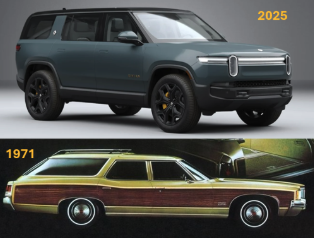
Imagine yourself back in 1971: You were excited because you had a new floppy drive to use with your new Altair 8800, but it will be another couple of years before either email or a word processor exists. Maybe you were driving around in the brand new Oldsmobile Grand Safari Wagon…and maybe you were using the latest laser invention: a He-Cd Laser. Lasers were new and exciting: the first commercial He-Ne laser came out in the 60s, followed by the CO2 laser, but in 1971 the first commercial He-Cd laser came out. The problem is, like that Oldsmobile station wagon, it has not changed much since 1971. It is big, loud, thirsty for power and a lot of work to maintain. Today one can purchase a DPSS UV Laser (Diode-Pumped Solid-State), which to continue the analogy is more like a modern, high-performance electric sports car: compact, incredibly efficient, and virtually maintenance-free.
While both machines can get you to the ultraviolet spectrum, their approach is worlds apart. It’s the ultimate photonics grudge match!
He-Cd Laser:
The Helium-Cadmium laser (He-Cd) delivers its signature wavelengths—primarily the desirable UV at λ=325 nm and blue at λ=442 nm—by running an electric discharge through a mixture of helium gas and cadmium vapor.
PROS:
- Pioneering Technology: One of the original ways to get Continuous Wave UV light at λ=325 nm.
- Clean Beam: Often provides a high-quality beam profile.
CONS:
- Bulk: He-CD Lasers require a large, heavy tube and a separate, noisy power supply.
- Efficiency: Extremely poor wall-plug efficiency (as low as 0.007%). It uses hundreds of Watts of electricity to produce a few milliwatts of light and often needs water cooling to manage the excess heat.
- Toxicity: Contains the hazardous heavy metal cadmium inside the plasma tube.
- Maintenance: Requires a long warm-up time to stabilize, and the tubes have a limited lifespan (often ~2,000 hours) and the device requires recalibration.
DPSS UV Laser:
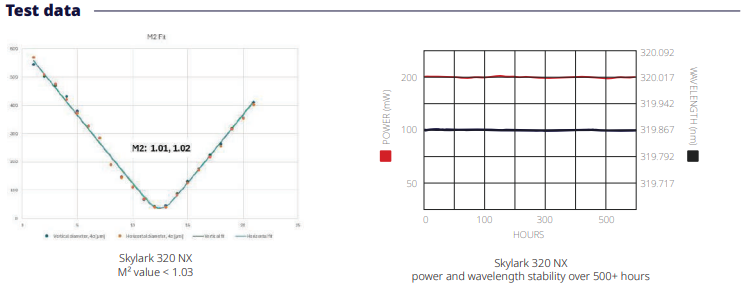
The DPSS laser starts with a reliable, efficient laser diode (the pump source), which excites a solid gain medium. The excited medium then emits coherent light, which can be frequency-converted using nonlinear optical components to achieve various wavelengths, including UV, like λ=320 nm.
PROS:
- Efficiency: Excellent wall-plug efficiency (0. 35% or better).
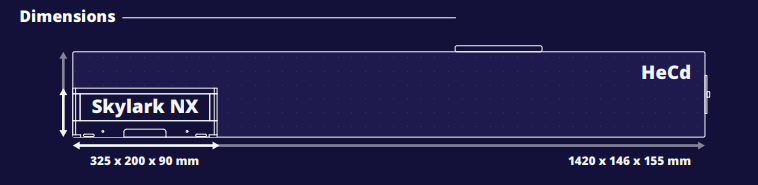
- Compact Size: Housed in a single, shoebox-sized unit. Minimal footprint, maximum flexibility.
- Low Maintenance: Long diode lifespan (often >5,000 hours) and no toxic materials.
- Ultra-stable output: Consistent output power and wavelength with minimal drift over long laser operation and lifetime and excellent pointing stability.
- True single frequency: Readily available DPSS UV wavelengths are λ=320nm, 349nm and 355 nm. All lasers have a single wavelength output.
CONS:
- Wavelength Limits: While DPSS lasers can deliver absolute wavelengths, they are not widely tunable
- Limited lifetime: Typical DPSS UV lasers are only offered with output power up to 50 mW and the lifetime is limited by UV-induced contamination of the internal components. New technological advances are mitigating this issue for DPSS UV lasers.
The Final Analysis:
| Feature | He-Cd Laser | DPSS UV Laser |
|---|---|---|
| Technology Era | 1970s Gas Laser | Modern Solid-State |
| Primary UV Wavelengths | 325 nm (and 442 nm Blue) | 320 nm, 349 nm & 355 nm (most common), |
| Output Power | 50mW | 200mW |
| Spatial Mode | TEM00 | TEM00 |
| Beam Quality (M2) | Not Specified | <1.2 |
| Beam Pointing Stability | ≤ 25 μrad/0C | ≤ 5 μrad/0C |
| Spectral Line Width | 1.0 GHz | 0.0005 GHz |
| Coherence Length | 0.3m | >100m |
| Power Noise (30kHs-10MHz) | ≤ 4.0% RMS | ≤ 0.3% RMS |
| Power Stability | ≤ 2.0% (4 hours) | ≤ 2.0% (8 hours) |
| Wall-Plug Efficiency | Poor (700+ W for 50 mW output) | Excellent (~70 W for 50 mW output) |
| Cooling | Water-cooled. (or very large fan/heatsink) | Air-cooled w/ TEC (water cooling optional) |
| Size & Weight | Bulky (Large tube & power supply) | Compact (Single unit) |
| Toxicity | Cadmium (Hazardous material) | None |
If you’re still specifying a He-Cd laser, you’re embracing the noise, the heat, the power bill, and the cadmium. If your specific application absolutely needs the 325 nm line, the He-Cd is a tough act to replace, but for almost everything else, the DPSS UV laser is the clear winner…or maybe you just like bell-bottoms and cathode ray tubes…
This post was written by:
Scott Phillips, Sr. Technical Sales Engineer