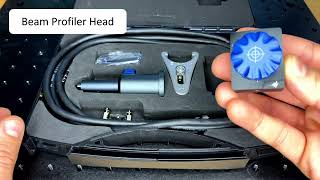
Laser Beam Profilers (UV,VIS,NIR)

Femto Easy BeamPro laser beam profiler series

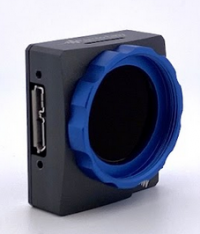
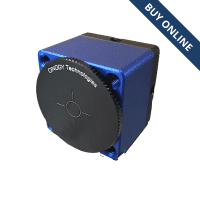
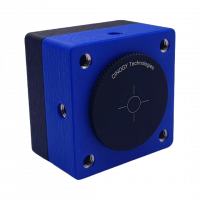
A camera-based laser beam profiler records the full two-dimensional intensity distribution of a laser beam in a single frame, revealing beam diameter, centroid position, ellipticity, and the hot spots or side lobes that a power meter cannot see. Axiom Optics offers camera beam profilers for UV, visible, and near-infrared lasers from Femto Easy (BeamPro) and CINOGY Technologies (CinCam), covering focused spots of about 10 microns, large collimated beams on sensors up to 25 mm across, CW and pulsed sources, and compact heads built for integration into tight optical setups.

Compare Laser Beam Profilers

The table below summarizes every camera beam profiler in this category. Full specifications, model variants, and datasheets are available on each product page.

Model Sensor and shutter Resolution and pixel Spectral range Best suited for
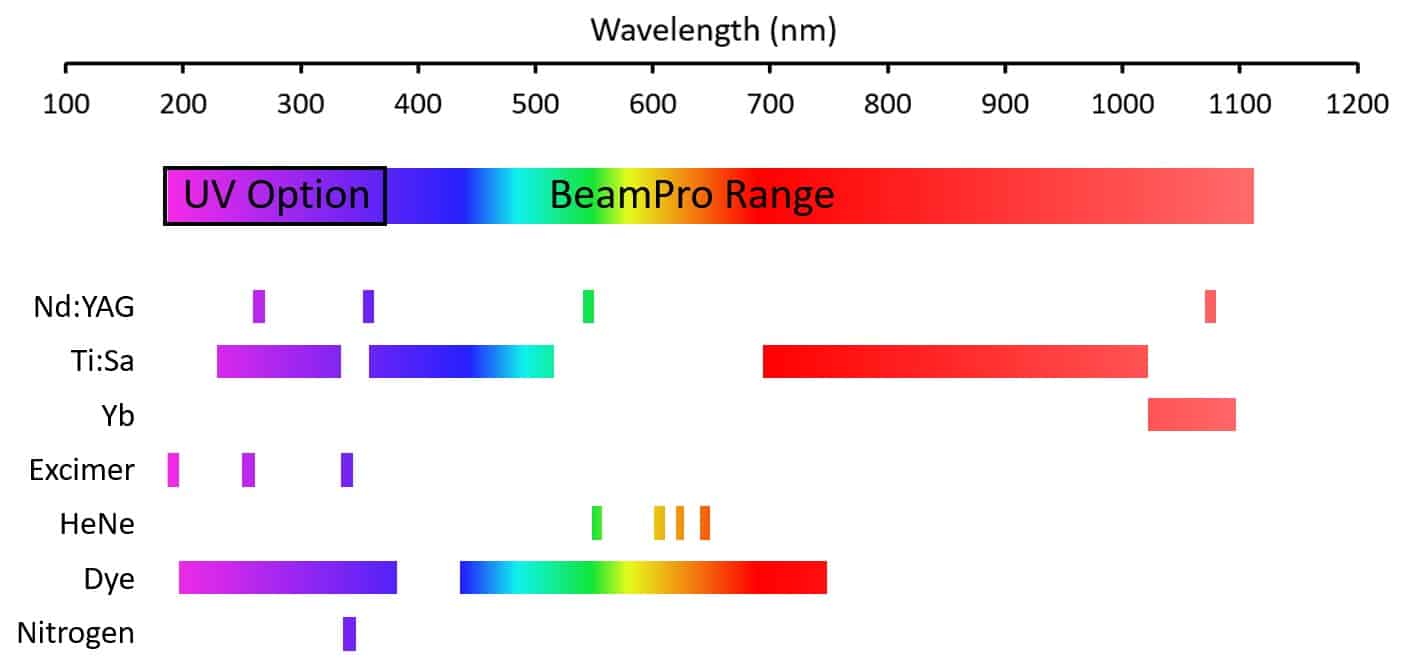
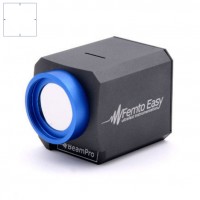
BeamPro Small Pixel CMOS, rolling shutter 3864 x 2176, 1.45 µm 375 to 1100 nm, 190 nm with UV option Focused spots down to about 10 µm, measured directly without magnifying optics
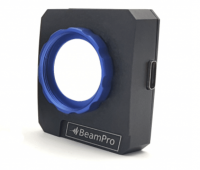
BeamPro Compact Footprint CMOS, global shutter 1920 x 1200, 3.45 µm 375 to 1100 nm, 190 nm with UV option Confined spaces, with a 10 mm thin head and optional triggered single-pulse capture
BeamPro Large Area CMOS, global shutter 2048 x 2048, 5.5 µm (11.2 mm square) or 12.65 µm (25 mm round) 375 to 1100 nm, 190 nm with UV option Large collimated beams on an active area up to 25 mm across, without beam-reduction optics
CinCam CMOS Nano & Pico CMOS, global shutter (Nano) or rolling shutter (Pico) Up to 2048 x 2048 at 5.5 µm (Nano); 2560 x 1920 at 2.2 µm (Pico) 320 to 1150 nm; 1470 to 1605 nm with IR coating OEM and in-system monitoring in 29 mm (Nano) and 15 mm (Pico) housings, including telecom-band lasers
CinCam CMOS CMOS, rolling shutter 1280 x 1024, 5.2 µm 400 to 1150 nm Cost-effective profiling of CW lasers for alignment, teaching, and routine quality checks

Laser beam profiler selection chart

Profiling SWIR lasers beyond 1150 nm? See the CinCam InGaAs beam profilers. To measure beam quality, see the M² measurement systems, and for high-power focused beams in additive manufacturing, the Focus Beam Profiler.

How to Choose a Laser Beam Profiler

The right beam profiler depends on the size of the beam at the measurement plane, the laser wavelength, whether the source is CW or pulsed, and how much space is available for the sensor head. These are the specifications that separate the models above.

Beam size and pixel size

Pixel size sets the smallest beam a camera profiler can measure accurately, and sensor size sets the largest. As a rule of thumb, the beam should span at least ten pixels across its diameter, so focused spots call for small pixels: the 1.45 µm pitch of the BeamPro Small Pixel resolves spots of about 10 µm directly. At the other end, leave a margin around the beam so its wings are captured, since ISO 11146 evaluates beam width over an area about three times the beam diameter. Large collimated beams need a large sensor such as the BeamPro Large Area, or beam-reduction optics in front of a smaller one.

Wavelength range

Silicon CMOS profilers cover roughly 375 to 1150 nm, with UV-enhanced versions reaching down to 190 nm. Beyond silicon’s cutoff, two routes are available: a phosphor coating that converts telecom wavelengths from 1470 to 1605 nm into light the sensor can detect, as on the CinCam CMOS Nano-IR, or an InGaAs sensor for the full SWIR band. Check the response at your exact laser line, since sensitivity falls off near the ends of each range.

CW vs. pulsed lasers

CW lasers can be profiled with any camera in this category. Low repetition rate pulsed lasers are better served by a global shutter sensor with an external trigger, which exposes every pixel during the same pulse and captures single shots cleanly. Rolling shutter sensors expose rows at slightly different times, so they suit CW lasers and pulsed lasers at high repetition rates, where many pulses fall within each exposure.

Attenuation and damage

Camera sensors saturate at very low power levels, so most lasers must be attenuated before they reach the sensor. Built-in neutral density filters, stackable ND options, and wedge beam samplers reduce the power while preserving the beam shape. Reflective ND filters, such as the RT option on CinCam profilers, reflect rather than absorb the rejected light, reducing heat load and thermal effects on the beam at higher powers.

Dynamic range and bit depth

A beam’s low-level wings and halo carry information about aberrations and scattered light that a saturated or low bit depth image hides. Higher bit depth and HDR acquisition, such as the 12 to 16-bit HDR mode on BeamPro profilers, record the core and the wings in the same frame, improving second-moment width calculations.

Form factor and integration

Space near a focus or inside a laser system is often tight. Compact heads such as the 10 mm thin BeamPro Compact Footprint, the 29 mm CinCam Nano, and the 15 mm CinCam Pico fit where standard cameras cannot, and USB connections with SDK support allow profilers to run inside production and monitoring systems.

Software and standards

BeamPro profilers run the STAR software with standards-based width calculations. CinCam profilers run RayCi, which follows ISO 11146 and ISO 13694 methods; RayCi Lite covers core profiling, the Standard and Professional editions add further analysis tools, and Professional adds the M² tool and multi-camera control. Learn more in the RayCi software overview and the laser beam profiling application note.

Laser Beam Profiler FAQs

What is a camera-based laser beam profiler?

A camera-based beam profiler uses a CMOS or InGaAs image sensor to capture the complete intensity distribution of a laser beam in one frame. Software then calculates beam width, centroid, ellipticity, and other parameters. Unlike scanning-slit profilers, cameras show the full two-dimensional shape, including hot spots, side lobes, and irregular modes.

How small a beam can a camera profiler measure?

The smallest measurable beam depends on pixel size, since the beam should span about ten pixels. The BeamPro Small Pixel, with a 1.45 µm pitch, measures focused spots down to about 10 µm directly. Smaller spots can be measured by relaying the focus onto the sensor with magnifying optics.

Can a beam profiler measure pulsed lasers?

Yes. For low repetition rate or single-shot pulsed lasers, choose a global shutter profiler with an external trigger, such as the BeamPro Compact Footprint, BeamPro Large Area, or CinCam CMOS Nano. Rolling shutter profilers work well for CW lasers and for pulsed lasers at high repetition rates.

How do I profile infrared or telecom lasers?

Silicon CMOS sensors respond up to about 1100 to 1150 nm. For telecom wavelengths from 1470 to 1605 nm, a phosphor-coated sensor such as the CinCam CMOS Nano-IR converts the light to a detectable wavelength. For the full SWIR range, an InGaAs beam profiler such as the CinCam InGaAs is the better choice.

Do I need to attenuate the laser before profiling it?

In almost all cases, yes. Camera sensors saturate at very low power levels, so the beam must be attenuated with neutral density filters or a beam sampler before it reaches the sensor. Choose attenuation that preserves the beam shape and keeps the peak signal below saturation.

Can a beam profiler measure M²?

A single beam profile is not enough to measure M². ISO 11146 requires beam widths measured at several positions through a focus, called a caustic. RayCi Professional includes an M² tool for manual caustic measurements, and dedicated M² systems automate the full measurement.
Read More

Other beam profilers in-stock - buy online now

CinCam CMOS is a cost-effective & high quality beam profiler based on Megapixel CMOS sensor. The Megapixel CMOS sensor provides accurate laser beam analysis with up to 30fps. The lightweight and ultra-compact design enables easy adaption to standard optical imaging systems and opto-mechanical components ensuring highest flexibility.

Contact Us

No Fields Found.

Tech Support

Contact Us

Scroll to Top