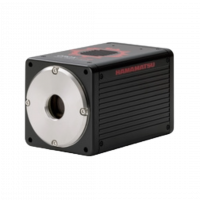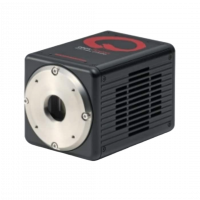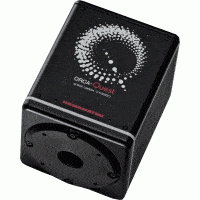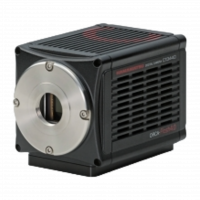
Scientific CMOS Cameras
Low Noise Cameras
Low light imaging requires sensitive cameras with very low noise. Axiom Optics offers a wide range of low noise CMOS and scientific CMOS cameras for demanding scientific and industrial applications including life science, physics, astronomy, machine vision, and more.
Our versatile low noise cameras portfolio includes visible, NIR and UV sensitive cameras, rolling and global shutter cameras, cooled and uncooled cameras, long exposure (up to hours) and high-speed cameras (up to 1,000 fps), but all sCMOS cameras listed here share two common traits: low readout noise and low dark current, making those cameras the best options for low light imaging.
Compare Scientific CMOS Cameras
Every camera in this category shares the defining traits of low readout noise and low dark current, so the choice comes down to what the imaging demands: sensitivity, resolution, speed, spectral range, and shutter type. The table groups the lineup by the job each camera is built for. Full specifications are on each product page.
| Camera | Class | Resolution and pixel | Read noise | Best suited for |
|---|---|---|---|---|
| ORCA-Quest 2 | Photon-counting qCMOS | 9.4 MP, 4.6 µm | <0.3 e- | Photon-number-resolving detection for quantum and the lowest-light imaging |
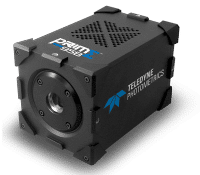
| Prime 95B | High-sensitivity sCMOS | 1.4 to 2.6 MP, 11 µm | 1 to 2 e- | Maximum sensitivity from large pixels and 95 percent QE for dim fluorescence |
| ORCA-Fusion BT | Balanced sCMOS | 5.3 MP, 6.5 µm | 0.3 to 1 e- | The versatile low-light workhorse balancing noise, resolution, and speed |
| Prime BSI | Back-illuminated sCMOS | 4.2 MP, 6.5 µm | 1 to 2 e- | Large field of view with balanced pixel size and high QE, including UV response |
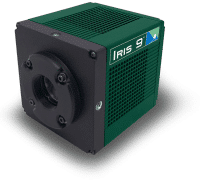
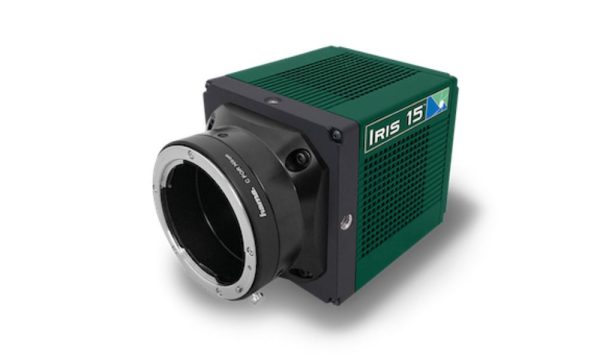
| Iris 9 & Iris 15 | High-resolution sCMOS | 8.8 MP, 4.25 µm | 1 to 2 e- | High pixel count and wide field for detailed whole-sample imaging |
| ORCA-Flash 4.0 | Gen II sCMOS | 4.2 MP, 6.5 µm | 1 to 2 e- | The established general-purpose scientific standard |
| ORCA-Fire | High-speed qCMOS | 9.4 MP, 4.6 µm | <0.3 e- | High resolution and speed together for fast low-light imaging |
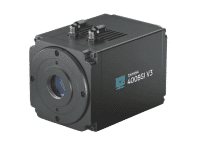
| Dhyana 400BSI | Cost-effective sCMOS | 4.2 MP, 6.5 µm | 1 to 2 e- | Back-illuminated sCMOS performance including UV at a lower price |
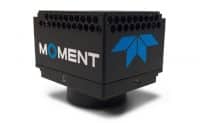
| Moment | Global-shutter CMOS | 7.0 MP, 4.5 µm | 2 to 10 e- | Distortion-free capture of moving samples on a budget |
| Retiga E7 | Long-exposure CMOS | 7.0 MP, 4.5 µm | 2 to 10 e- | Long integrations up to hours for very faint, static signals |
| CB2 | High-speed global-shutter sCMOS | up to 7.0 MP, 4.5 / 9 µm | 1 to 10 e- | Fast global-shutter capture beyond 1000 fps for dynamic events |
| FL-20 | Cost-effective CMOS | 20 MP | See product page | Very high pixel count for detailed imaging at an accessible price |
Need even higher frame rates? See the high-speed scientific cameras. For single-photon sensitivity beyond what qCMOS offers, see the photon counting cameras. For UV-optimized options, see the UV cameras.
Scientific CMOS Camera FAQs
What is the difference between sCMOS, qCMOS, and standard CMOS?
Standard CMOS cameras are affordable and capable but have higher read noise, making them best for well-lit imaging. Scientific CMOS, or sCMOS, is engineered for very low read noise, high dynamic range, and high resolution, which suits demanding low-light scientific imaging. qCMOS is a further step that lowers read noise below the level of a single photon, enabling photon-number-resolving detection for the faintest signals and quantum applications. The right choice follows from how faint the signal is.
What read noise do I need for low-light imaging?
The fainter the signal, the lower the read noise must be. Standard sCMOS at 1 to 2 electrons handles most fluorescence microscopy, back-illuminated sCMOS below 1 electron helps with dimmer signals, and qCMOS below 0.3 electrons is needed to count individual photons in the most photon-starved measurements. If the sample is bright, read noise is far less critical and other factors like speed or resolution should drive the choice.
What is the difference between rolling shutter and global shutter?
A rolling shutter exposes the sensor row by row, which gives the lowest read noise and is ideal for static or slowly changing samples. A global shutter exposes all pixels at once, eliminating the motion distortion that a rolling shutter can introduce with fast-moving subjects, at some cost in noise. Choose global shutter for flow, rapid motion, and quantitative measurement of moving objects, and rolling shutter for the lowest-noise imaging of stationary scenes.
Do I need a back-illuminated sensor?
Back-illuminated sensors reach quantum efficiencies around 95 percent, compared with roughly 80 percent for front-illuminated designs, which meaningfully improves sensitivity when photons are scarce. For dim fluorescence, single-molecule work, and astronomy, back-illumination is worth it. For brighter samples where signal is plentiful, a front-illuminated sensor may be perfectly sufficient and more economical.
Why does pixel size matter?
Larger pixels collect more light each, improving sensitivity and dynamic range, which is why high-sensitivity cameras like the Prime 95B use 11 micron pixels. Smaller pixels give higher spatial resolution for a given sensor size, resolving finer detail. The best choice matches the camera to the optical system so pixels sample at the resolution the optics deliver, avoiding both undersampling, which loses detail, and oversampling, which wastes light per pixel.
When do I need a cooled camera?
Cooling suppresses dark current, which accumulates over time, so it matters most for long exposures of faint signals. Short exposures under adequate light need little cooling, while long-integration work, such as low-light astronomy or the hours-long exposures the Retiga E7 supports, depends on deep cooling to keep dark current from overwhelming the signal. Match the cooling to the longest exposure the application requires.
Which scientific CMOS camera is right for my application?
It depends on the signal and the sample. For the faintest signals and photon counting, choose a qCMOS camera like the ORCA-Quest 2; for dim fluorescence, a high-QE, large-pixel camera like the Prime 95B; for a versatile low-light workhorse, a balanced sCMOS like the ORCA-Fusion; for detailed wide-field imaging, a high-resolution camera like the Iris; and for moving samples, a global-shutter camera like the Moment or CB2. Sharing the target signal level, speed, and field of view with an application engineer narrows the choice quickly.